How Corporate Actions Impact Share Prices and Investor Returns
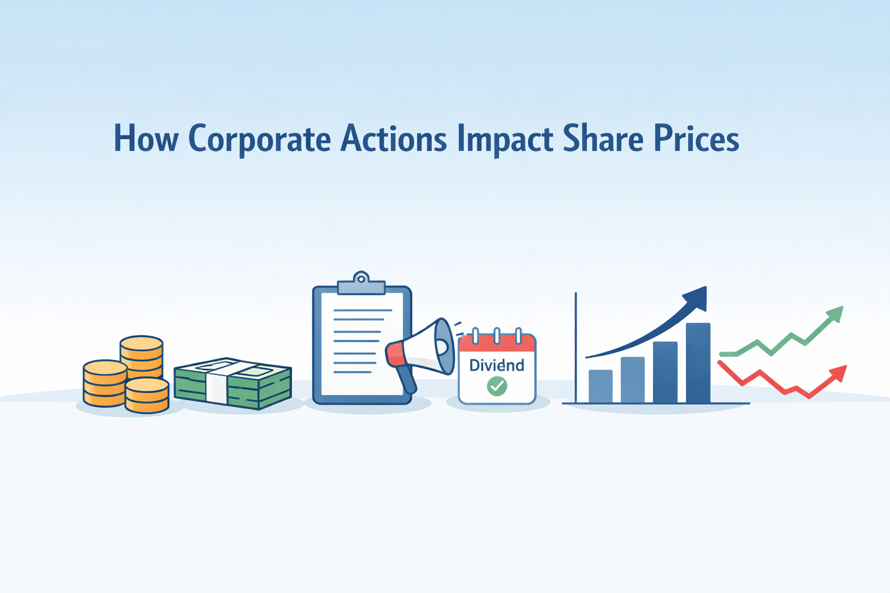
Investors often focus on earnings, news headlines, and price charts. Yet some of the most powerful price movements do not come from quarterly numbers. They come from boardroom decisions. These decisions alter capital structure, reshape ownership, and shift liquidity patterns.
That is where corporate actions impact share prices in ways many investors overlook.
Corporate actions rarely change intrinsic value overnight. However, they immediately change how the market interprets value. Some actions redistribute wealth. Others restructure equity. Some improve liquidity. Others dilute ownership. The mechanical adjustment may look simple on paper, but market reaction rarely follows a straight line.
Understanding these actions helps investors interpret price moves correctly. Without that clarity, adjustments may appear like gains or losses when they are neither.
Let’s examine each major corporate action carefully.
Corporate Actions
Corporate actions refer to decisions taken by a company’s board that directly affect shareholders. In Indian markets, these actions are governed by SEBI regulations and exchange frameworks. They include dividends, bonus issues, stock splits, rights issues, and buybacks.
Some actions transfer profits. Others change the share count. A few restructure capital without altering the total company value. The purpose varies, but the impact always touches shareholders.
Corporate actions fall into two broad categories. Some are mandatory in effect, such as price adjustments on ex-dividend dates. Others depend on shareholder choice, such as rights participation.
The important thing to remember is this: market capitalization does not magically change because share count changes. Value adjusts proportionally. Yet, psychology does not adjust proportionally.
That gap between arithmetic and perception explains why corporate actions impact short-term volatility so strongly.
Investors who confuse structural adjustments with value creation often misjudge momentum. Those who understand the mechanics stay calmer when prices appear to “drop” after a dividend or “rise” after a split.
Let’s move deeper into each type.
Dividends
Dividends represent the distribution of profits to shareholders. In India, companies announce dividends along with record dates and ex-dates. The stock price adjusts on the ex-date to reflect cash leaving the company.
If a stock trades at ₹600 and declares a ₹20 dividend, it may open near ₹580 on the ex-date. This adjustment reflects a transfer of value, not destruction of value.
However, dividend policy influences more than arithmetic.
Companies that maintain stable dividend policies attract a different investor base. Pension funds, income funds, and conservative investors prefer predictable payouts. This stability often reduces extreme price swings.
At the same time, companies that pay very high dividends may limit reinvestment opportunities. If payout ratios rise too high, growth investors may lose interest. That shift can affect long-term valuation multiples.
Dividends also influence compounding. Investors who reinvest dividends accumulate additional shares over time. This reinvestment quietly strengthens total return.
Short-term traders see price adjustments. Long-term investors see income flow.
That layered dynamic shows how corporate actions impact both price mechanics and portfolio structure.
“Start investing with confidence! Explore
0 demat account
and grow your wealth.”
Bonus Issue
A bonus issue occurs when a company converts its reserves into additional equity shares. Shareholders receive extra shares without paying anything. If the company announces a 1:1 bonus, shareholders receive one new share for every share held.
Market price adjusts proportionally. If the pre-bonus price stands at ₹1,000, it may adjust near ₹500 after a 1:1 bonus.
Total investment value remains unchanged. Share count doubles. Price halves.
So, why do markets often react positively?
First, bonus issues signal accumulated reserves. Management communicates confidence in balance sheet strength. Second, lower post-bonus price improves affordability. Increased retail participation may follow. Third, liquidity improves because more shares circulate in the market.
The mathematics stays neutral. Perception does not.
Liquidity expansion sometimes attracts new demand. Demand may create upward momentum independent of intrinsic change.
Understanding this separation prevents overreaction.
Bonus issues demonstrate how corporate actions impact investor psychology as much as financial structure.
Stock Split
Stock splits resemble bonus issues but operate differently in accounting terms. In a split, the company reduces the face value of shares while increasing their number proportionally.
For example, a ₹10 face value share may undergo a 1:2 split. Face value becomes ₹5. Share count doubles. Market capitalization remains unchanged.
Why do companies split shares?
Primarily to improve tradability. A stock trading at ₹4,000 may discourage smaller investors. After a split, a lower nominal price attracts broader participation. Liquidity improves. Bid-ask spreads may tighten.
Market reaction often includes increased volume and short-term volatility. Yet, no new wealth emerges from the split itself.
The company’s assets, earnings, and cash flows remain constant. Only the denominator changes.
Investors must recognize that stock splits adjust optics, not fundamentals.
This structural rebalancing further illustrates how corporate actions impact market behavior beyond intrinsic value.
Rights Issue
A rights issue allows existing shareholders to buy additional shares at a predetermined price, usually below prevailing market levels. Companies raise fresh capital while offering current investors first access.
Ownership structure shifts when new shares enter circulation. If shareholders do not participate, their percentage ownership declines.
Rights issues often signal one of two narratives. The company may raise funds for expansion, debt reduction, or strategic growth. Alternatively, it may need capital to stabilize operations.
Market reaction depends heavily on intent.
If investors believe the capital will generate returns, price may stabilize quickly. If investors suspect financial stress, the price may weaken.
Pricing also influences theoretical adjustments. Since rights shares often come at a discount, market price recalibrates after issue completion.
Rights issues involve more complexity than splits or bonuses. Shareholders must actively decide whether to subscribe or sell rights entitlement.
Here, corporate actions impact ownership distribution directly. They demand participation rather than passive holding.
Buyback of shares
Buybacks represent a reversal of dilution. Instead of issuing new shares, companies repurchase shares from the market. In India, buybacks occur through tender offers or open market routes.
When shares get bought back, total outstanding shares decline. Earnings per share may rise because profits are distributed across fewer shares.
Buybacks influence valuation ratios and capital efficiency metrics. They also send signals.
Here is how buybacks typically affect markets:
- They reduce the supply of shares in circulation
- They may improve earnings per share
- They signal management confidence
- They redistribute surplus cash
- They may support price during volatility
However, buybacks also reduce cash reserves. If executed during weak cash flow periods, they can strain liquidity.
Market interpretation depends on timing and financial strength.
Buybacks provide one of the clearest examples of how corporate actions impact investor returns structurally rather than cosmetically.
How does its Impact Share Prices and Investor Returns
Corporate actions influence price in two primary ways. First, through mechanical adjustments. Second, through behavioral response.
Mechanical adjustments follow arithmetic rules. Dividends reduce the price by payout amount. Bonus and splits adjust proportionally. Rights issues recalibrate ownership. Buybacks reduce supply.
Behavioral reactions vary.
Investors may interpret dividends as stability. They may view buybacks as undervaluation signals. They may see rights issues as expansion or distress. These interpretations influence demand.
Over time, investor returns reflect more than price movement. Dividends contribute income. Buybacks enhance earnings metrics. Rights issues reshape capital structure. Splits and bonuses improve liquidity.
Each action interacts with market psychology differently.
The phrase corporate actions impact captures this layered reality. Value does not emerge from thin air. It redistributes, restructures, or compounds.
Investors who understand this avoid confusion when prices adjust. They recognize when a “drop” reflects dividend payout rather than panic. They identify when the increased share count reflects structural change rather than dilution panic.
Clarity reduces reactionary decisions.
Key Takeaways
Corporate actions reshape equity without always altering intrinsic value. Dividends transfer cash. Bonus issues convert reserves into capital. Stock splits adjust face value and improve liquidity. Rights issues raise fresh funds. Buybacks reduce outstanding shares.
Each action carries mechanical consequences and psychological signals. Understanding both dimensions improves interpretation.
Long-term investor returns depend not only on price appreciation but on how efficiently management allocates capital through these actions.
When you study how corporate actions impact structure, liquidity, and perception, volatility becomes easier to decode. Informed interpretation strengthens disciplined investing.
FAQs:
Q. How do corporate actions affect share price?
Corporate actions adjust the share price either mechanically or psychologically. Dividends reduce the price by the payout amount. Splits and bonus issues adjust proportionally without changing value. Buybacks and rights issues shift supply and ownership, influencing demand. Market perception often amplifies the initial structural adjustment.
Q. Does corporate action impact NAV?
Yes, certain corporate actions affect NAV mechanically. Dividends reduce NAV because cash leaves the company. Bonus and stock splits usually do not change total NAV, only the number of units. Rights issues and buybacks may alter NAV depending on pricing and capital structure changes.
Disclaimer
The stocks mentioned in this article are not recommendations. Please conduct your own research and due diligence before investing. Investment in securities market are subject to market risks, read all the related documents carefully before investing. Please read the Risk Disclosure documents carefully before investing in Equity Shares, Derivatives, Mutual fund, and/or other instruments traded on the Stock Exchanges. As investments are subject to market risks and price fluctuation risk, there is no assurance or guarantee that the investment objectives shall be achieved. Lemonn (Formerly known as NU Investors Technologies Pvt. Ltd) do not guarantee any assured returns on any investments. Past performance of securities/instruments is not indicative of their future performance.
Related Posts


Download Lemonn
Download my app for share market trading, ipo investment, trading account, and all your investment needs.