Government Securities vs PSU Bonds vs Corporate Bonds in India: Which Is Safest?
The Fixed Income Landscape in India
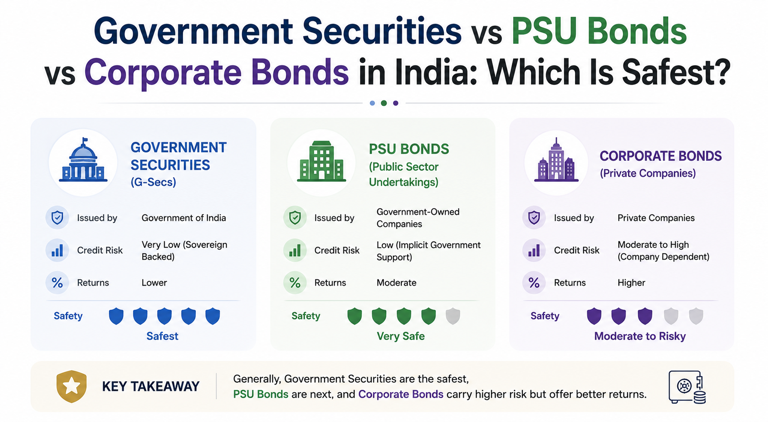
Beyond equity markets, India’s bond market offers investors steady, predictable returns with varying risk profiles. Three main categories cater to different needs: Government Securities (G-Secs) — the safest, PSU (Public Sector Undertaking) bonds — government-backed, and Corporate Bonds — higher yield with credit risk.
| Feature | Government Securities | PSU Bonds | Corporate Bonds |
|---|---|---|---|
| Issuer | Central/State Govt | Govt-owned companies | Private/Public companies |
| Default Risk | Zero (sovereign guarantee) | Very low (implicit govt backing) | Low to high (credit rating dependent) |
| Yield (approx 2026) | 6.8–7.5% | 7.5–8.5% | 7–12% (varies by rating) |
| Minimum Investment | ₹10,000 (RBI Retail Direct) | ₹10,000–₹1 lakh | ₹1,000–₹10 lakh |
| Liquidity | High (G-Sec market) | Moderate | Low to moderate |
| Tax on Interest | Slab rate | Slab rate | Slab rate |
| Listed on Exchange | Yes (NSE/BSE) | Yes | Varies |
Government Securities: The Foundation of Fixed Income
G-Secs are issued by the Central Government (through RBI) and State Governments (SDLs — State Development Loans). They carry zero default risk as the government can print money or levy taxes to meet obligations. The 10-year G-Sec yield serves as the risk-free benchmark for all Indian debt pricing.
“Start investing with confidence! Explore
0 demat account
and grow your wealth.”
How to Buy G-Secs: RBI Retail Direct
RBI launched the Retail Direct scheme allowing individual investors to buy G-Secs directly from the primary market. Register at rbiretaildirect.org.in — it is free. You can invest in auctions and on the secondary market with a minimum of ₹10,000.
PSU Bonds: The Sweet Spot of Safety and Yield
PSU bonds are issued by government-owned entities: NHAI, REC, PFC, NHPC, IRFC, NaBFID, and others. While not carrying a sovereign guarantee, the implicit government backing makes default extremely unlikely. Yields are typically 50–100 basis points above equivalent G-Secs — attractive premium for minimal additional risk.
| PSU Bond Issuer | Nature | Typical Yield (2026) | Min Investment |
|---|---|---|---|
| REC Limited | Power sector lender | 8.0–8.5% | ₹10,000 |
| PFC (Power Finance Corp) | Power sector lender | 8.0–8.4% | ₹10,000 |
| NHAI | Highway development | 7.8–8.2% | ₹10,000 |
| IRFC | Railway finance | 7.7–8.1% | ₹10,000 |
| NaBFID | Infrastructure finance | 7.9–8.3% | ₹10,000 |
Corporate Bonds: Higher Yield, Higher Risk
Corporate bonds offer the highest yields but require careful credit analysis. Investment-grade (AAA/AA rated) corporate bonds from companies like HDFC Bank, Bajaj Finance, and Kotak Mahindra are relatively safe. Below AA, default risk rises meaningfully. Retail investors should stick to AAA/AA-rated corporate bonds.
Disclaimer
The stocks mentioned in this article are not recommendations. Please conduct your own research and due diligence before investing. Investment in securities market are subject to market risks, read all the related documents carefully before investing. Please read the Risk Disclosure documents carefully before investing in Equity Shares, Derivatives, Mutual fund, and/or other instruments traded on the Stock Exchanges. As investments are subject to market risks and price fluctuation risk, there is no assurance or guarantee that the investment objectives shall be achieved. Lemonn (Formerly known as NU Investors Technologies Pvt. Ltd) do not guarantee any assured returns on any investments. Past performance of securities/instruments is not indicative of their future performance.
Related Posts


Download Lemonn
Download my app for share market trading, ipo investment, trading account, and all your investment needs.