Finance ministry warns fuel hikes may lift inflation
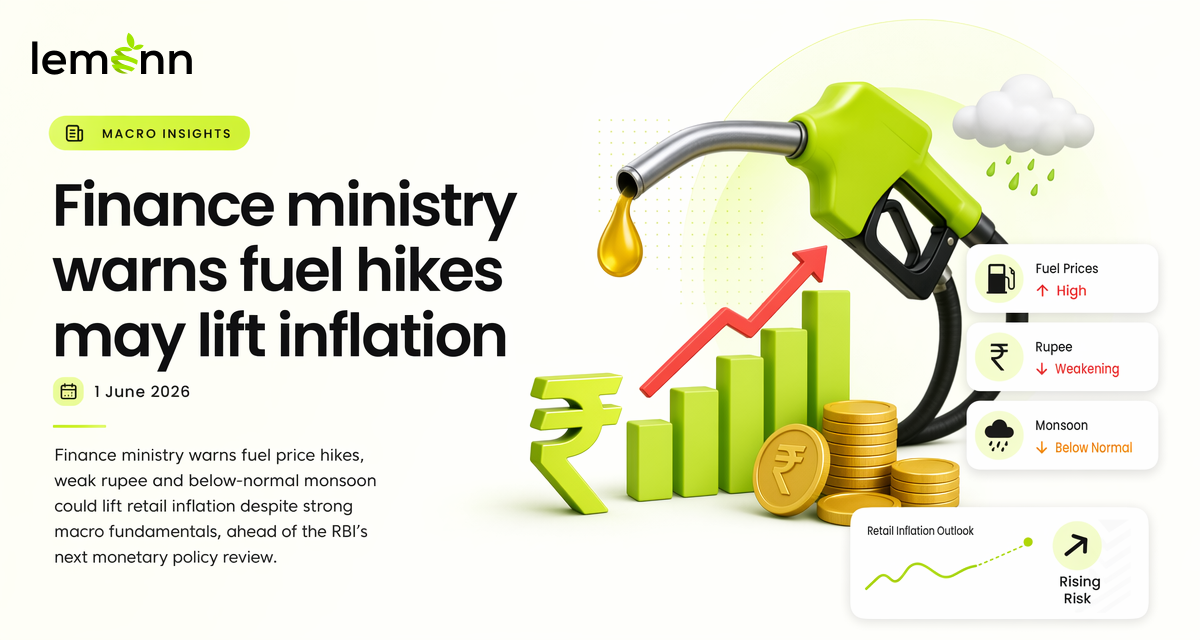
Retail inflation risks are rising as recent fuel price hikes, a weaker rupee and a below-normal monsoon forecast threaten to push up consumer prices in coming months, the Union finance ministry has cautioned in its May economic review. The warning comes even though April retail inflation stayed below the Reserve Bank of India’s 4% target, and ahead of the Monetary Policy Committee decision due on 5 June.
Market overview of inflation trends
- Retail inflation in April at 3.48%, up from 3.4% in March.
- Still within RBI’s 2-6% tolerance band and below the 4% target.
- Wholesale Price Index inflation at 8.3% in April, up from 3.88% in March.
- Ministry flags “growing divergence” between consumer and wholesale inflation.
- Upstream price pressures seen as key risk for future CPI prints.
Fuel price hikes and transmission risks
- Petrol prices raised ₹7.38 over four rounds since late February.
- Diesel prices raised ₹7.52 over the same period.
- Petrol and diesel together hold about 5% weight in the CPI basket.
- Ministry says hikes may trigger both direct and indirect inflation channels.
- Direct impact through higher fuel component in CPI.
- Indirect impact via transport, logistics and energy-intensive goods.
- “The sharp rise in upstream price pressures, along with recent increases in fuel prices, suggests a gradual pass-through to retail inflation through higher transport, energy, and food-related costs in the coming months,” the review said.
“Start investing with confidence! Explore
0 demat account
and grow your wealth.”
External shocks, crude and rupee dynamics
- Global energy prices elevated after conflict in West Asia from 28 February.
- Benchmark Brent crude peak at $118.03 a barrel on 29 April.
- Brent later eased to $91.12, a fall of 22.8%.
- State-run OMCs reportedly still losing about ₹550 crore daily after hikes.
- Ministry says India cannot fully insulate from external energy shocks.
- Rupee depreciation cited as adding to imported inflation pressures.
- “The confluence of elevated global energy prices, a depreciating rupee, rising upstream cost pressures and the prospect of a below-normal monsoon calls for sustained policy vigilance,” the report said.
Monsoon outlook and food inflation risk
- IMD forecast for 2026 monsoon at 92% of long-period average.
- Below-normal rainfall risk flagged for agriculture and rural demand.
- Buffer stocks: rice and wheat at 817.53 lakh tonnes.
- Adequate reservoir storage seen as cushion for cereals.
- Ministry warns rainfall deficit plus geopolitics could lift food inflation.
- Risk of weaker rural demand and slower aggregate growth if food prices rise.
RBI policy context and wholesale price surge
- Review released days before RBI MPC meeting and 5 June policy decision.
- Producer inflation at more than three-and-a-half-year high in April.
- WPI surge driven by energy prices, rupee fall and low base effect.
- Ministry notes risk of WPI feeding into CPI via input costs.
- Retail inflation pressures visible in select food items and services.
- Restaurants and accommodation cited as segments with rising prices.
Macro resilience and policy stance
- Ministry describes India’s macro position as showing “cautious resilience”.
- Strong services exports and adequate FX reserves support external stability.
- Manufacturing and services PMIs remain in expansionary territory.
- Labour market described as stable in the review.
- Strait of Hormuz disruption called “single most consequential variable” for inflation and external outlook.
- “Policy will need to remain agile across monetary, fiscal and structural dimensions to navigate this period of compounded uncertainty while keeping medium-term growth objectives firmly in view,” the ministry said.
Outlook for FY27
- Navigating FY27 seen requiring coordinated monetary and fiscal responses.
- Focus on keeping inflation “durably anchored” while sustaining growth.
- Ministry says early normalisation in West Asia could aid broader recovery.
- Strong services exports and investment commitments seen as upside drivers.
FAQ
Why are fuel price hikes a concern for inflation now?
Fuel has direct CPI weight and also raises transport and input costs, so recent hikes can gradually push retail inflation higher despite current low headline readings.
If retail inflation is below 4%, why is the ministry worried?
Wholesale inflation has jumped to 8.3%, signalling upstream cost pressures that can later pass through to consumers, especially with high energy prices and a weak rupee.
How does the monsoon forecast affect inflation?
A monsoon at 92% of the long-period average raises risk of lower farm output; combined with geopolitical shocks, this could lift food prices and hurt rural demand.
Why are fuel price hikes a concern for inflation now?
Fuel carries direct weight in CPI and also drives transport and input costs. The ministry expects recent petrol and diesel hikes to gradually pass through into higher retail inflation via both direct and indirect channels.
If retail inflation is below 4%, why is the finance ministry worried?
Retail inflation was 3.48% in April, but wholesale inflation jumped to 8.3%. The ministry sees this divergence as a sign that upstream cost pressures, driven by energy prices and rupee depreciation, could later feed into consumer prices.
How could a below-normal monsoon affect inflation and growth?
With monsoon rainfall forecast at 92% of the long-period average, the ministry warns that any significant deficit, combined with current geopolitical conditions, could push up food inflation, weaken rural demand, and weigh on overall growth.
Disclaimer
The stocks mentioned in this article are not recommendations. Please conduct your own research and due diligence before investing. Investment in securities market are subject to market risks, read all the related documents carefully before investing. Please read the Risk Disclosure documents carefully before investing in Equity Shares, Derivatives, Mutual fund, and/or other instruments traded on the Stock Exchanges. As investments are subject to market risks and price fluctuation risk, there is no assurance or guarantee that the investment objectives shall be achieved. Lemonn (Formerly known as NU Investors Technologies Pvt. Ltd) do not guarantee any assured returns on any investments. Past performance of securities/instruments is not indicative of their future performance.
Related Posts



Download Lemonn
Download my app for share market trading, ipo investment, trading account, and all your investment needs.