Forex Market Timings: Global Trading Hours and Sessions Explained
What is the Forex Market?
The foreign exchange market operates as a massive global network in which currencies fluctuate in value every second. Banks, traders, institutions, and fintech platforms interact nonstop. This constant flow creates an environment where liquidity stays strong, spreads react to fresh moves, and prices update instantly.
Overview of the Global Currency Market
The currency market connects economies, businesses, and individuals worldwide. Each region participates at its own pace, volume, and behavior. Institutions run large transactions for trade, investment, and hedging.
“Start investing with confidence! Explore
0 demat account
and grow your wealth.”
Why Forex Trades 24 Hours a Day
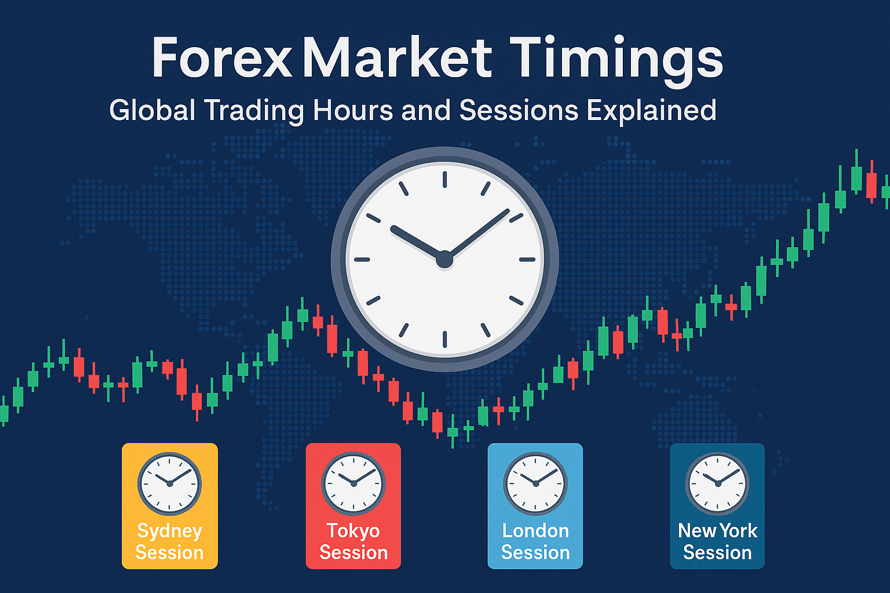
The market follows the rotation of the planet. One market opens when another prepares to close. Sydney enters first, followed by Tokyo, then London, and finally New York.
Major Forex Trading Sessions
Each region forms a unique session with its own tempo. Some hours bring heavy volume, while others stay calm. These sessions attract traders who prefer specific styles. Understanding this pattern helps anyone decode the forex market timings with clarity.
Sydney Session (Pacific Session)
Sydney starts the trading day. Activity begins with moderate volume as markets warm up. AUD pairs show sharper movement because local banks and institutions set the tone. Liquidity stays stable but not aggressive.
Tokyo Session (Asian Session)
Tokyo brings stronger flows. Banks in Japan, Singapore, and Hong Kong push large orders. JPY-based pairs react quickly. News from the region often triggers short bursts of volatility. This session sets the early direction for the entire Asian block.
London Session (European Session)
London controls the highest share of global currency trading. Volume spikes sharply. European economic releases move prices with force. EUR, GBP, and CHF pairs show active swings. This session supports tight spreads, sharp reactions, and deeper liquidity.
New York Session (North American Session)
New York drives the final major wave of the day. USD pairs react instantly to market data, banking flows, and institutional orders. This session often decides the daily trend.
Forex Market Opening and Closing Times (IST, GMT, EST)
Forex market timings depend on time zones. Traders plan their day using fixed benchmarks. IST, GMT, and EST help map each session. These reference points keep trading schedules organized and predictable.
Forex Market Hours in Indian Standard Time (IST)
Sydney opens around 3:30 AM IST. Tokyo joins at 5:30 AM IST. London follows at 1:30 PM IST, and New York begins at 7 PM IST. This arrangement creates a clean flow across the day. Indian traders closely watch the afternoon and evening sessions because liquidity increases sharply during those hours.
Global Forex Market Overlap Timings
Overlaps generate the highest trading activity. London joins Tokyo for a short period. Later in the day, London joins New York. These windows create heavy price movement. Institutions push significant volume during overlaps. Spreads stay tighter and trends develop faster.
Best Time to Trade Forex in India
The most active window for Indian traders runs from 1:30 PM IST to 10:30 PM IST. London stays active in the first half, and New York pushes momentum in the second. EUR/USD, GBP/USD, USD/JPY, and GBP/JPY exhibit sharper price movements.
Overlapping Trading Sessions and Market Volatility
Overlaps are the heartbeat of the currency market. Prices respond aggressively to large orders, news updates, and institutional flow. Traders describe overlaps as the engine of volatility.
London–New York Overlap
This overlap drives the day’s highest volume. European banks place their final orders, and American institutions open new positions. USD pairs move with force. News releases from both regions create sharp reactions.
Tokyo–London Overlap
This overlap lasts for a short duration. Activity increases but remains below the New York overlap. EUR/JPY and GBP/JPY show quick jumps. Asian momentum blends with early European sentiment.
How Overlaps Affect Liquidity and Price Movements
Liquidity increases when sessions merge. Spreads tighten because more participants place orders. Price movement becomes clearer because volume supports smoother swings. Trends strengthen easily during these hours.
How Market Timings Affect Trading Strategies
Market hours shape strategy selection. Some setups thrive in high activity while others work best in calmer conditions. Forex market timing guides traders to the right window for each method.
Scalping During High-Volume Hours
Scalpers seek quick entries and exits. They need tight spreads and strong liquidity. London and the London–New York overlap offer the best conditions for this style.
Swing Trading in Low-Volatility Periods
Swing traders follow broader moves. They prefer calmer hours where noise stays limited. The late New York session and early Sydney hours offer this environment. These windows support wider stops and longer holds because sudden spikes are rare.
Impact of Economic News Releases on Sessions
Economic releases hit the market with strong energy. Inflation data, GDP numbers, employment figures, and policy updates arrive during session hours. New York releases affect USD pairs. London releases impact EUR and GBP.
Weekend and Holiday Forex Market Schedule
The forex market runs 24/7 on weekdays, with a break over the weekend. The forex market’s timing shifts during certain events, so traders plan accordingly.
When Does the Forex Market Close on Friday?
The market closes late Friday night in most regions. New York ends around 2:30 AM IST on Saturday. Liquidity dries up slowly before the final hour.
How Global Holidays Affect Forex Liquidity
Holidays change transaction size. Banks operate with limited staff. Traders see reduced volume, slower reactions, and wider spreads. During major holidays like Christmas or New Year, market behavior stays muted.
Tips for Managing Open Positions Over Weekends
Weekend gaps appear when fresh news hits while markets remain closed. Traders prepare by minimizing exposure before Friday closes. Some reduce position size. Others trail stops during active overlap hours.
Best Time to Trade Major Currency Pairs
Currency pairs behave differently depending on session activity. Each pair reacts to its own region’s volume flow. Forex Market Timings create unique opportunities for each combination.
EUR/USD – Optimal Trading Hours
EUR/USD delivers the strongest movement during the London and New York sessions. European data triggers early moves. American numbers generate later momentum. This pair stays liquid, predictable, and highly active.
GBP/JPY – Peak Volatility Periods
GBP/JPY moves aggressively. This pair reacts instantly to London activity. Tokyo adds extra volume because JPY plays a central role.
AUD/USD – Best Session for Traders
AUD/USD responds strongly during the Sydney and Tokyo sessions. These regions drive early direction. London and New York add secondary movement, but the primary action forms in the Pacific and Asian hours.
Tools to Track Forex Market Timings
Monitoring the clock becomes essential for consistent performance. Traders follow platforms and apps to stay synced with major hours. Tracking helps maintain a structured routine.
Forex Market Clock and Time Converters
Market clocks show live session status. Traders see which regions stay active at any moment. Time converters help align strategies across GMT, IST, and EST. These tools reduce confusion and remove timing errors.
Mobile Apps for Real-Time Forex Hours
Apps show real-time session updates. Push alerts notify users when overlaps begin. Many apps include countdowns for major economic releases. These features help maintain discipline.
Platforms Offering Session Alerts
Advanced platforms send direct notifications. Traders receive instant updates when volume shifts. Some platforms track volatility changes and highlight active pairs. These alerts improve decision-making.
Conclusion: Maximizing Profits by Understanding Forex Timings
Understanding forex market timings helps build a strong foundation for better execution. Every session brings a different level of activity, liquidity, and opportunity. London creates the strongest action, New York drives impactful trends, and Tokyo builds early direction.
FAQs on Forex Market Timings
Q. What time does the forex market open and close in India?
The market opens early Monday morning, around 3:30 AM IST with the Sydney session, and closes around 2:30 AM IST on Saturday when New York closes.
Q. Which forex session is the most volatile?
The London–New York overlap produces the highest volatility because two major financial centers trade simultaneously.
Q. Is forex trading available on weekends?
The market remains closed on weekends across all regions. Trading resumes on Monday with the Sydney session.
Q. What is the best time to trade EUR/USD and GBP/USD?
Both pairs show the strongest activity during the London and New York sessions because liquidity peaks at those times.
Q. How do daylight saving changes affect forex trading hours?
Daylight saving shifts open and close times for London and New York. Traders adjust schedules using live market clocks or converters.
Q. How can I check live forex market opening times?
Market clocks, mobile apps, and trading platforms display real-time session status and countdowns for opening hours.
Disclaimer
The stocks mentioned in this article are not recommendations. Please conduct your own research and due diligence before investing. Investment in securities market are subject to market risks, read all the related documents carefully before investing. Please read the Risk Disclosure documents carefully before investing in Equity Shares, Derivatives, Mutual fund, and/or other instruments traded on the Stock Exchanges. As investments are subject to market risks and price fluctuation risk, there is no assurance or guarantee that the investment objectives shall be achieved. Lemonn (Formerly known as NU Investors Technologies Pvt. Ltd) do not guarantee any assured returns on any investments. Past performance of securities/instruments is not indicative of their future performance.
Related Posts
Download Lemonn
Download my app for share market trading, ipo investment, trading account, and all your investment needs.