
Fixed Deposit vs Recurring Deposit: Which Is Better?
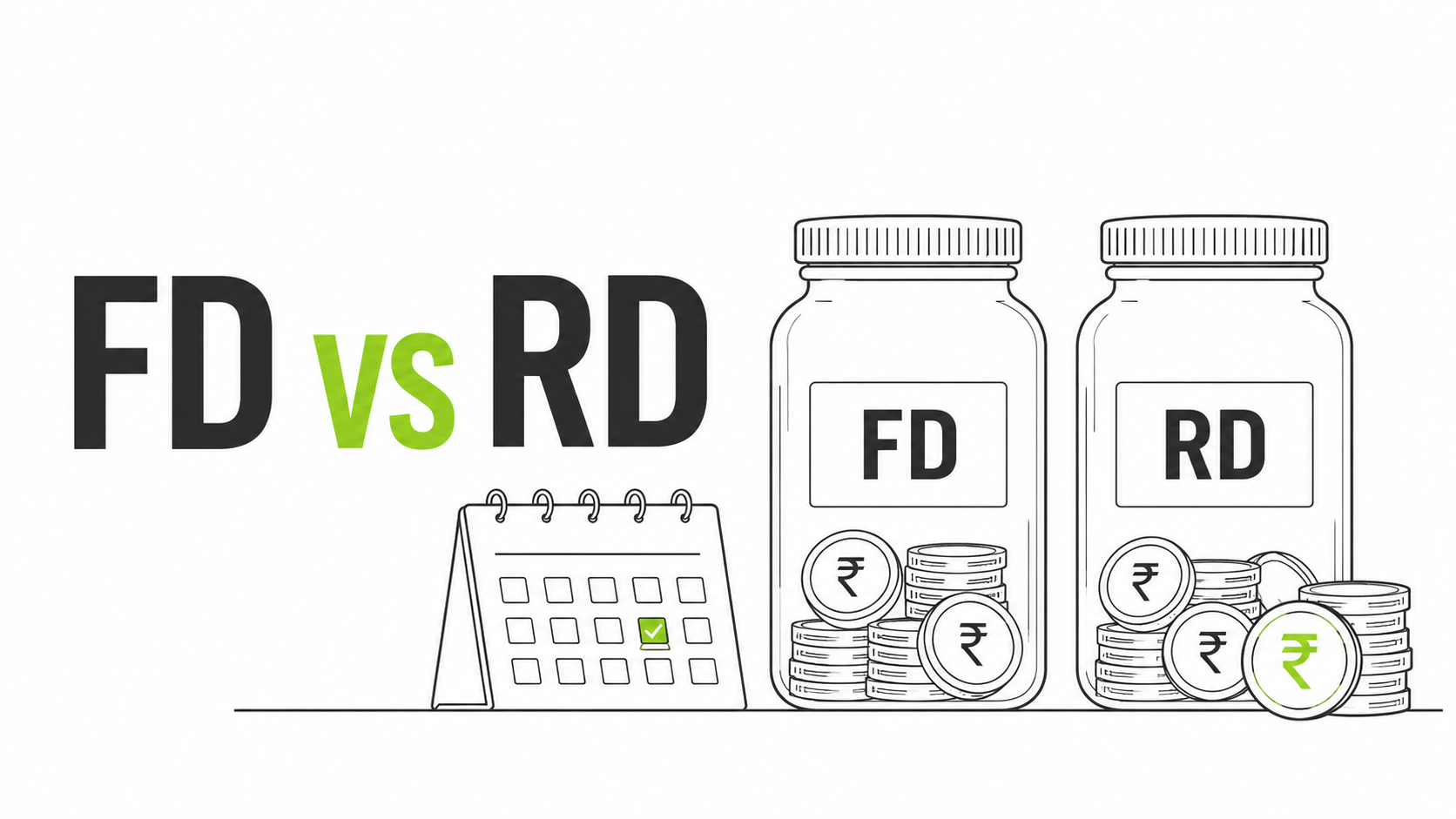
A fixed deposit is usually more suitable when you already have a lump sum available to invest. A recurring deposit is designed for someone who wants to save a fixed amount regularly, usually from monthly income.
The two products are not competing versions of exactly the same strategy. Your cash flow often determines which one makes more sense.
What Is a Fixed Deposit?
A fixed deposit, or FD, allows you to place a lump sum with a bank for a specified tenure at an agreed interest rate.
For example, suppose you have ₹3 lakh that you do not need for the next two years.
You could place the ₹3 lakh in an FD and begin earning interest on the entire amount from the start.
FDs are commonly used for:
- Emergency-fund portions
- Short-term goals
- Capital preservation
- Retirement income
- Money needed at a known future date
What Is a Recurring Deposit?
A recurring deposit, or RD, allows you to deposit a fixed sum periodically, generally every month, for a chosen tenure.
Suppose you earn a salary and can save ₹10,000 every month.
Instead of waiting until you accumulate ₹1.2 lakh, you could begin an RD immediately.
The deposits enter the account gradually.
That distinction matters when comparing returns with an FD.
“Start investing with confidence! Explore
0 demat account
and grow your wealth.”
FD vs RD: Quick Comparison
| Feature | Fixed Deposit | Recurring Deposit |
|---|---|---|
| Contribution style | Lump sum | Regular instalments |
| Best suited for | Existing capital | Monthly savings |
| Interest rate | Set according to deposit terms | Set according to RD terms |
| Entire money earns from day one | Yes | No |
| Saving discipline | Moderate | Strong |
| Premature closure | Usually possible under conditions | Usually possible under conditions |
| Interest taxation | Generally taxable | Generally taxable |
| Market risk | No stock-market exposure | No stock-market exposure |
Which Gives Higher Returns, FD or RD?
A simple interest-rate comparison can be misleading.
Imagine Bank A offers:
- FD rate: 7%
- RD rate: 7%
You might assume the returns will be identical.
But if you have ₹1.2 lakh today and invest it in an FD, the entire ₹1.2 lakh begins earning immediately.
If you instead deposit ₹10,000 per month into an RD, the final ₹10,000 instalment may be invested for only a short period before maturity.
Therefore, the total rupee interest will differ even when the quoted annual rate is the same.
When Is an FD Better?
An FD can make more sense when:
- You already have a lump sum.
- You need money on a known future date.
- You want predictable returns.
- You cannot accept equity-market volatility.
- You want to create a deposit ladder.
Example
Suppose you receive a ₹2 lakh annual bonus.
If your goal is to preserve the money for a planned home renovation in 18 months, an appropriately timed FD may be more practical than investing the amount gradually through an RD.
When Is an RD Better?
An RD can make more sense when:
- You receive monthly salary.
- You struggle to save consistently.
- You are building money for a predictable goal.
- You do not have a lump sum.
- You prefer automated saving.
Example
You need ₹1.2 lakh for an annual insurance premium and travel budget next year.
Saving ₹10,000 per month through an RD can create a structured path toward that target.
How Is FD Interest Taxed?
Interest on ordinary bank fixed deposits is generally taxable according to the income-tax provisions applicable to you.
A common misconception is:
“No TDS means no tax.”
That is incorrect.
TDS is a collection mechanism. Your final tax liability is determined by the tax law and your total income.
If taxable interest is below a TDS threshold or no tax is deducted for another reason, the interest may still need to be reported.
How Is RD Interest Taxed?
RD interest is also generally taxable.
The economic nature is interest income, so an RD does not become tax-free merely because you contribute monthly.
When estimating your return, consider the post-tax amount.
A person in a higher tax bracket can have a lower effective return from a taxable deposit than the headline rate suggests.
Are FDs and RDs Safe?
Bank deposits do not have stock-market volatility, but bank credit risk still exists.
DICGC deposit insurance covers eligible deposits such as savings, fixed, current, and recurring deposits up to ₹5 lakh per depositor per insured bank in the same right and capacity. The limit includes principal and accrued interest.
Important Example
Suppose you have with the same bank:
- Savings account: ₹2 lakh
- FD: ₹3 lakh
- RD: ₹1 lakh
If all deposits are held in the same right and capacity, they are generally aggregated for insurance purposes rather than each receiving a separate ₹5 lakh cover.
What Is Premature Withdrawal?
Banks usually offer some form of early closure for ordinary deposits, but conditions vary.
Possible consequences include:
- A lower applicable interest rate
- A premature-withdrawal penalty
- Loss of expected interest
- Special restrictions on certain products
Read the bank’s deposit policy before investing.
What Is an FD Ladder?
An FD ladder splits your money across several maturity dates.
Instead of placing ₹6 lakh into one three-year FD, you might create multiple deposits with different maturities.
This can improve liquidity because not all your money remains locked until the same date.
It can also reduce the risk of investing the entire amount at a single interest-rate point.
What Is the Biggest Advantage of an RD?
The strongest benefit is behavioural.
An RD automatically creates a monthly saving commitment.
For many salaried people, saving ₹8,000 every month is psychologically easier than trying to preserve ₹96,000 in a savings account for an entire year.
FD vs RD vs SIP
These three are often compared incorrectly.
An FD and RD are bank deposit structures.
A SIP is only a method of investing regularly, commonly into mutual funds.
An equity mutual fund SIP can have:
- Market risk
- Negative short-term returns
- Higher long-term growth potential
An RD has:
- Much lower return uncertainty
- No equity exposure
- More predictable maturity value
Choose based on the goal, not simply the historical return.
Which Is Better for an Emergency Fund?
Liquidity is critical for an emergency fund.
A combination of:
- Savings account
- Sweep FD
- Short-tenure deposits
may be more practical than putting your entire emergency fund into an RD.
Always check premature withdrawal conditions.
Which Is Better for Retirees?
Some retirees use FDs to generate predictable interest income.
However, they should consider:
- Inflation
- Tax on interest
- Deposit concentration
- DICGC limits
- Reinvestment risk when the FD matures
A 7% deposit is not necessarily delivering 7% in real purchasing power after tax and inflation.
Common FD and RD Mistakes
Avoid:
- Choosing only the highest advertised rate
- Ignoring bank quality
- Ignoring DICGC limits
- Forgetting tax on interest
- Locking emergency money for too long
- Assuming RD earns more because you invest monthly
- Breaking deposits repeatedly due to poor cash planning
FAQs
Is RD better than FD?
RD is better for gradual monthly saving. FD is usually more appropriate when the lump sum already exists.
Is RD safer than FD?
If both are eligible deposits at the same insured bank, they fall under the same basic DICGC insurance framework.
Is FD interest tax-free?
Ordinary FD interest is generally taxable.
Is RD interest tax-free?
Ordinary RD interest is generally taxable.
Can I withdraw an FD before maturity?
Many banks allow premature closure under their terms, potentially with a lower interest rate or penalty.
Can an FD lose money?
An ordinary bank FD does not fluctuate with the stock market, but inflation, taxes, bank risk beyond insurance limits, and premature-withdrawal penalties can affect the economic outcome.
Key Takeaways
- Use an FD when you already have a lump sum.
- Use an RD when you want disciplined monthly saving.
- Similar interest rates do not mean identical maturity values.
- Both FD and RD interest are generally taxable.
- Eligible deposits are covered by DICGC only within the prescribed insurance limit.
- Match deposit maturity to the date of your financial goal.
- Compare post-tax returns, not only advertised rates.
Disclaimer
The stocks mentioned in this article are not recommendations. Please conduct your own research and due diligence before investing. Investment in securities market are subject to market risks, read all the related documents carefully before investing. Please read the Risk Disclosure documents carefully before investing in Equity Shares, Derivatives, Mutual fund, and/or other instruments traded on the Stock Exchanges. As investments are subject to market risks and price fluctuation risk, there is no assurance or guarantee that the investment objectives shall be achieved. Lemonn (Formerly known as NU Investors Technologies Pvt. Ltd) do not guarantee any assured returns on any investments. Past performance of securities/instruments is not indicative of their future performance.
Related Posts

Download Lemonn
Download my app for share market trading, ipo investment, trading account, and all your investment needs.



