India’s Goldilocks Moment: Key Insights from the Economic Survey 2025-26
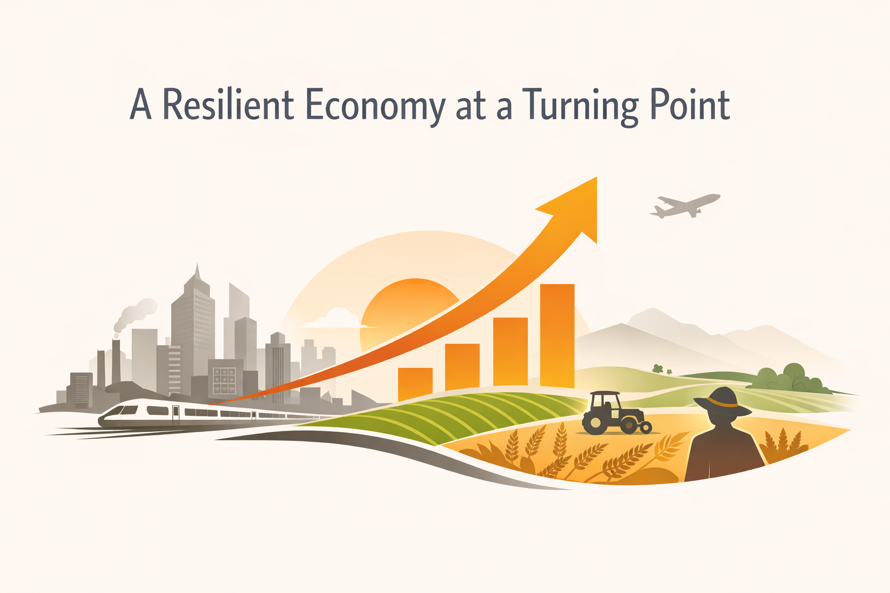
Overview: A Resilient Economy at a Turning Point
India enters 2026 with a rare blend of high growth, low inflation, and strategic reforms. The Economic Survey 2025-26, presented by Finance Minister Nirmala Sitharaman, calls this a “Goldilocks moment” – not too hot, not too cold – as India remains the fastest-growing major economy and the world’s fourth-largest economic power.
Let’s break down the Survey’s most important takeaways in simple terms.
GDP Growth: Beating Expectations
India’s real GDP is estimated to grow 7.4% in FY26, far above earlier projections of 6.3%–6.8%. That’s a clear sign of momentum.
Quarter-wise growth:
- Q1 FY26: 7.8%
- Q2 FY26: 8.2%
- Q4 FY25: 7.4%
“Start investing with confidence! Explore
0 demat account
and grow your wealth.”
What’s Driving Growth?
- Strong industrial output and services sector expansion
- Structural reforms that improved ease of doing business
- Domestic demand, especially in urban areas
The potential growth rate has also been upgraded to 7.0%, showing confidence in long-term expansion.
Inflation: Hitting Record Lows
India saw headline inflation drop to 0.71% in November 2025 – the lowest in a decade. Food inflation even slipped into deflation during parts of the year.
Why this matters:
- Boosts consumer purchasing power
- Gives the RBI room to support growth via rate cuts
The RBI lowered the repo rate to 5.25%, signaling a balanced approach to growth and stability.
But a gentle rise in inflation is expected in FY27, toward the 4% target range.
Fiscal Health: Spending Smart, Consolidating Wisely
India is following a disciplined path to fiscal consolidation, aiming to bring down the deficit while still investing heavily in growth areas.
Key Numbers:
- Fiscal deficit fell from 9.2% in FY21 to 4.4% in FY26
- Capex rose to 4% of GDP – the highest since independence
- GST collections in Dec 2025 hit ₹1.74 lakh crore, up 6.1% YoY
Even with some tax collection shortfalls, the Survey praises the shift toward direct tax buoyancy and formalization.
External Sector: Holding Strong Amid Global Headwinds
Despite global trade tensions – including a 50% U.S. tariff hike on Indian exports – India hit a new export record: $825.3 billion in FY25.
Foreign exchange reserves reached $686.2 billion, enough to cover 11+ months of imports. Meanwhile, FDI grew 19.4% in the first half of FY26, proving investor confidence.
India also inked a major FTA with the EU, giving 99% of Indian exports preferential access and helping offset U.S. trade friction.
Sectoral Snapshots: A Well-Rounded Growth Story
Agriculture:
- Record grain production: 357.7 million metric tons
- Higher MSP across key crops
- Focus on crop diversification to reduce import dependence
Industry:
- Industrial output up 7.8% in Dec 2025
- Big wins in electronics, pharma, and machinery
- PLI scheme attracted ₹1.76 lakh crore in manufacturing investments
Services:
- Contributed 55.3% to GVA
- Financial and digital services led growth
- Gig economy and platform work are reshaping employment
Jobs & Skills: Bright Spots in Employment
Unemployment fell to 4.8%, the lowest in months, with rural female unemployment at just 3.4%.
Other highlights:
- 17 crore jobs created in the past decade
- Labor Force Participation (LFPR) improved to 55.8%
- Government push on skilling, including 50,000 Atal Tinkering Labs and ₹500 crore for AI training hubs
The Survey also flags AI as a disruptor, urging proactive policymaking to balance automation with job creation.
Reforms: The “Butterfly Effect” of Deregulation
One of the Survey’s strongest themes is how small policy shifts can trigger big changes. Examples include:
- MSME deregulation and self-certification
- Upcoming direct tax law for clarity and fewer disputes
- New state-level Investment Friendliness Index
- Reforms in insolvency, labor codes, and compliance reduction
The Road to Viksit Bharat (Developed India)
The Survey outlines four pillars for inclusive growth:
- Garib (Poor)
- Annadata (Farmers)
- Yuva (Youth)
- Nari (Women)
The end goal? By 2047, India aims to be a developed, inclusive, and sustainable economy – with universal education, affordable healthcare, and full employment.
Global Risks & Strategic Sobriety
Despite India’s strong domestic fundamentals, the global picture remains shaky:
- Capital outflows and a weak rupee
- Geopolitical tensions (Russia-Ukraine, US-Iran)
- Rising commodity prices, especially metals and energy
That’s why the Survey urges a mindset of “strategic sobriety” – confident, but cautious.
Key Takeaways
- India is in a rare Goldilocks zone of strong growth and low inflation.
- Real GDP growth hit 7.4%, with FY27 expected at 6.8%–7.2%.
- Inflation is at historic lows, boosting consumption and easing monetary policy.
- Fiscal discipline continues, with smart spending on infrastructure and capex.
- Structural reforms and global trade shifts are shaping the next phase of growth.
FAQs
Q: What is the “Goldilocks moment” in the Economic Survey 2026?
A: It refers to a rare economic scenario where India has strong growth and low inflation – not too hot, not too cold.
Q: Will inflation rise in FY27?
A: Yes, modestly. It’s expected to converge toward the 4% target, allowing steady economic activity.
Q: Why is FDI still strong despite global uncertainty?
A: India’s reform push, digital growth, and infrastructure upgrades are attracting global investors.
Q: What are the top priorities for future reforms?
A: MSME deregulation, tax simplification, skilling, and state-level investment competitiveness.
Disclaimer
The stocks mentioned in this article are not recommendations. Please conduct your own research and due diligence before investing. Investment in securities market are subject to market risks, read all the related documents carefully before investing. Please read the Risk Disclosure documents carefully before investing in Equity Shares, Derivatives, Mutual fund, and/or other instruments traded on the Stock Exchanges. As investments are subject to market risks and price fluctuation risk, there is no assurance or guarantee that the investment objectives shall be achieved. Lemonn (Formerly known as NU Investors Technologies Pvt. Ltd) do not guarantee any assured returns on any investments. Past performance of securities/instruments is not indicative of their future performance.
Related Posts


Download Lemonn
Download my app for share market trading, ipo investment, trading account, and all your investment needs.