What Is Dividend Payout Ratio, and How to Analyze It
What Is the Dividend Payout Ratio?
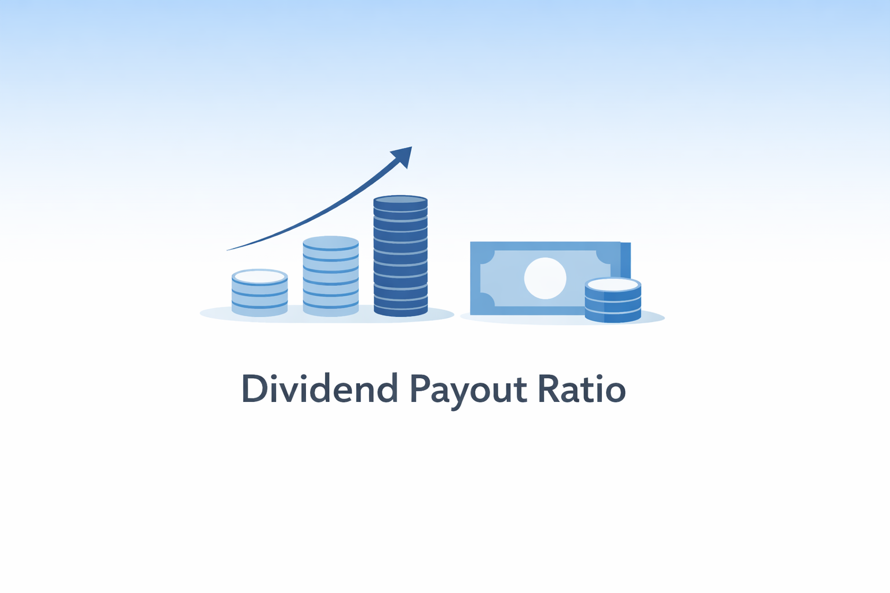
Dividends are visible. They appear in bank accounts. They generate alerts. They feel concrete. But behind every dividend lies a capital allocation decision that shapes the long-term trajectory of the business just as much as it rewards shareholders in the present. That decision is quantified through the dividend payout ratio.
Formula and Calculation of the Dividend Payout Ratio
The formula is deceptively simple.
Total Basis Formula
Per Share Formula
Both formulas yield identical results when data is aligned.
Consider two examples.
Example A:
Net Income = ₹500 crore
Total Dividends = ₹150 crore
Dividend Payout Ratio = 150 ÷ 500 × 100 = 30%
Example B:
EPS = ₹20
DPS = ₹8
Dividend Payout Ratio = 8 ÷ 20 × 100 = 40%
The arithmetic requires seconds. Interpretation requires analysis.
A payout ratio above 100 percent indicates that dividends exceed profits. That excess must be funded from retained earnings or borrowing.
“Start investing with confidence! Explore
0 demat account
and grow your wealth.”
Calculating the Dividend Payout Ratio in Excel
Excel transforms payout ratio analysis into a dynamic framework.
To calculate using per-share values:
- Enter EPS in cell A2
- Enter DPS in cell B2
- In cell C2 input: =B2/A2
- Format as percentage
To calculate using totals:
- Enter Net Income in A2
- Enter Total Dividends in B2
- In C2 input: =B2/A2
The real analytical advantage comes from extending this across years. Five-year sequences reveal stability. Ten-year data exposes discipline. Patterns become visible.
Does the payout ratio increase gradually alongside earnings growth? That suggests controlled shareholder prioritization. Does it spike sharply when earnings fall?
Understanding the Dividend Payout Ratio
The dividend payout ratio sits between two financial objectives: income distribution and internal compounding. Companies must constantly choose how much profit to return and how much to reinvest.
Stable, regulated industries often maintain payout ratios in the 40 to 70 percent range. Their earnings streams are predictable. Their capital requirements are manageable. Investors expect steady income.
Growth-oriented firms often operate with payout ratios below 30 percent. Their earnings are reinvested into product development, market expansion, and strategic acquisitions. Investors expect appreciation rather than income.
Cyclical companies complicate the equation. During strong earnings years, payout ratios may appear moderate. During downturns, the same dividend may push the payout ratio sharply higher because profits contract.
Evaluating the dividend payout ratio effectively requires examining multiple dimensions:
- Earnings stability over time
- Free cash flow coverage
- Debt burden
- Industry capital intensity
- Competitive position
Dividend Sustainability
Sustainability separates strong dividend policies from fragile ones.
A payout ratio above 80 percent can be sustainable in stable industries. It becomes risky in volatile sectors. The key question is whether earnings and cash flow consistently support dividend commitments.
Healthy dividend sustainability typically includes:
- Earnings that grow steadily over multiple cycles
- Free cash flow exceeding dividend obligations
- Conservative leverage
- Gradual dividend growth patterns
Warning indicators include:
- Payout ratios above 100 percent for extended periods
- Dividends financed through debt issuance
- Earnings volatility combined with rigid dividend commitments
- Large one-time dividends masking operational weakness
Sustainability reflects resilience. Resilience compounds.
Dividends Are Industry-Specific
Dividend policies vary significantly across industries.
Technology companies reinvest heavily. Their payout ratios remain low for years. Capital demands are high. Growth drives valuation.
Utilities and telecom firms operate within predictable regulatory frameworks. Their payout ratios often exceed 60 percent. Cash flows remain stable.
Real estate investment trusts distribute a large portion of earnings due to structural mandates. High payout ratios are inherent to their model.
Dividend Payout Ratio vs. Dividend Yield
These two metrics often get conflated. They measure different realities.
Dividend Yield Formula
Dividend Payout Ratio Formula
Dividend Yield measures income relative to the market price. Dividend payout ratio measures income relative to profitability.
A declining stock price can increase dividend yield mechanically. The payout ratio may remain unchanged if earnings stay stable.
A stock trading at a premium valuation may show a modest yield while maintaining a disciplined payout ratio.
To summarize:
| Metric | Measures | Primary Insight |
|---|---|---|
| Dividend Yield | Income vs Market Price | Investor return |
| Dividend Payout Ratio | Income vs Earnings | Sustainability |
Yield attracts attention. Payout ratio validates discipline.
Example of the Dividend Payout Ratio
Consider Company A:
EPS = ₹25
DPS = ₹10
Payout Ratio = 40%
Company A retains 60 percent of earnings. Growth capacity remains intact.
Now consider Company B:
EPS = ₹15
DPS = ₹12
Payout Ratio = 80%
Income appears attractive. Retained capital is limited. Sensitivity to earnings decline increases.
Multi-year perspective adds clarity:
| Year | EPS | DPS | Payout Ratio |
|---|---|---|---|
| 1 | 20 | 6 | 30% |
| 2 | 22 | 8 | 36% |
| 3 | 24 | 10 | 41% |
| 4 | 26 | 12 | 46% |
| 5 | 28 | 14 | 50% |
Here, earnings expand steadily. Dividends rise proportionally. The payout ratio increases gradually. That progression signals confidence supported by performance.
Why Is the Dividend Payout Ratio Important?
The dividend payout ratio provides multiple layers of insight:
- It evaluates dividend sustainability.
- It reveals reinvestment intensity.
- It identifies potential over-distribution risk.
- It assists sector-level comparison.
- It bridges income and growth analysis.
For income-focused investors, it filters unstable dividends. For growth investors, it measures retained capital discipline. For balanced investors, it signals equilibrium.
How Do You Calculate the Dividend Payout Ratio?
Calculation begins with financial statements.
- Identify net income from the income statement.
- Identify dividends paid from the cash flow statement.
- Divide dividends by net income.
Alternatively:
- Calculate earnings per share.
- Calculate dividend per share.
- Divide DPS by EPS.
Extend the calculation across multiple years. Compare against industry averages. Evaluate free cash flow support and debt coverage.
Is a High Dividend Payout Ratio Good?
Well, it depends on multiple factors. First, a high payout ratio explains that the shareholders are looking to invest in stable sectors. But at the same time, the reinvestment flexibility is low in such cases.
Moreover, higher payout ratio stays sustainable as long as the company has free cash flow distribution. But the moment that free cash flow is hindered, higher payout ratios can amplify vulnerability.
On the other end, moderate payout ratios are a perfect example of a balance. They reward shareholders while preserving capital strength.
Overall, there is no single answer to this. High payout ratio does not mean quality, and lower quality does not guarantee prudence. It’s the payout sustainability that decides the quality of the share.
What Is the Difference Between the Dividend Payout Ratio and Dividend Yield?
Dividend yield measures the income return relative to the stock price. Dividend payout ratio measures the portion of earnings distributed.
Yield reflects market dynamics. Payout ratio reflects management decisions.
High yield without sustainable payout invites risk. Moderate yield with disciplined payout often builds long-term confidence.
Both metrics complement each other. Used together, they refine analysis.
The Bottom Line
The dividend payout ratio transforms dividend investing from passive income collection into structured evaluation.
It reveals capital allocation discipline.
It tests sustainability.
It highlights risk exposure.
It balances income with growth.
When analyzed across multiple years, benchmarked within industry context, and evaluated alongside free cash flow and leverage, the Dividend Payout Ratio becomes one of the most powerful dividend screening tools available.
FAQs:
Q. How to interpret the dividend payout ratio?
The first step is to identify the context. A stable dividend ratio is not enough. It has to be backed by consistent earnings and strong cash flow.
Q. What is a good dividend payout ratio?
It depends on the industry you are picking and the earning stability. Some companies have a 30 to 60% dividend payout ratio. But for some growth-focused companies, this ratio is quite low as they spend their profits on expansion and growth.
Q. What does 30% dividend payout mean?
It’s simple. A 30% dividend means the company is giving 30% of its profit to the investors in the form of dividends. The rest 70% is being used for the company’s expansion or has been kept as a reserve for any emergency or future expense.
Q. What does a 50% dividend payout ratio mean?
A 50% dividend ratio means the company is giving away half of its profits to investors in the form of dividends, and the rest is retained for business expansion.
Disclaimer
The stocks mentioned in this article are not recommendations. Please conduct your own research and due diligence before investing. Investment in securities market are subject to market risks, read all the related documents carefully before investing. Please read the Risk Disclosure documents carefully before investing in Equity Shares, Derivatives, Mutual fund, and/or other instruments traded on the Stock Exchanges. As investments are subject to market risks and price fluctuation risk, there is no assurance or guarantee that the investment objectives shall be achieved. Lemonn (Formerly known as NU Investors Technologies Pvt. Ltd) do not guarantee any assured returns on any investments. Past performance of securities/instruments is not indicative of their future performance.
Related Posts
Download Lemonn
Download my app for share market trading, ipo investment, trading account, and all your investment needs.