Understanding the Difference Between Demat And Trading Accounts
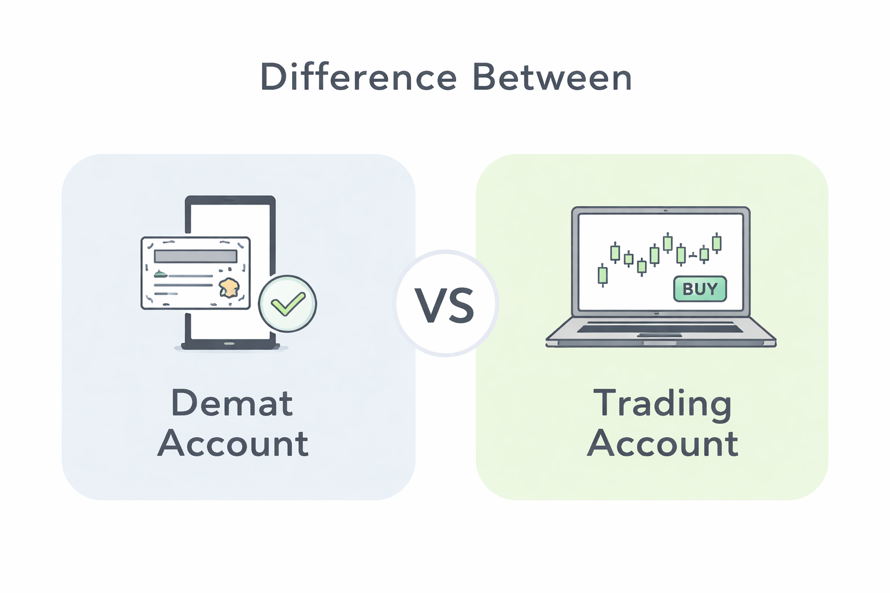
The difference between a demat account and a trading account shapes how every Indian investor steps into the stock market. The two accounts may look similar, yet each one plays a distinct role in how money moves, how shares are stored, and how an investor builds long-term wealth. In a country where digital investing has surged, understanding this difference feels essential. Every beginner entering the market through an app or a brokerage platform eventually realizes that these two accounts work together to create a complete investing experience. Their relevance continues to grow as more individuals invest with confidence in equities, ETFs, IPOs, and bonds.
Demat and trading accounts support India’s fast-growing participation in capital markets. From first-time investors to seasoned traders, everyone depends on how these accounts operate. The evolution of the Indian market—UPI-based IPO applications, instant payments, and real-time settlements—creates a landscape where understanding the difference between a demat and trading account strengthens decision-making and protects investments.
Understanding the Difference Between a Demat And Trading Account
Understanding the difference between a demat and a trading account begins with the simple idea that one stores your securities, and the other helps you buy or sell them. A demat account holds shares in electronic format. It acts like a digital locker. Once you buy shares, they remain in the demat account safely until you sell them or move them to another account.
The trading account works as the transaction engine. Every order—buy or sell—passes through the trading account before reaching the stock exchange. When you place a buy order, the trading account connects to your bank, executes the trade, and then moves the purchased shares into the demat account. When you sell, the transaction starts from your demat account, and the trading account sends the sell order to the exchange. You can open your demat account and trading account with a stockbroker like Lemonn.
Indian investors operate within a streamlined ecosystem regulated by SEBI, stock exchanges, and depositories such as NSDL and CDSL. This setup ensures safety, transparency, and efficiency. Understanding the difference between a demat and a trading account helps investors track their journey clearly. The trading account reflects live market activity, while the demat account preserves long-term assets.
The practical side becomes clearer when beginners realize that they can open both accounts through a single broker. Yet, each one continues to perform a separate task. This division improves market security and makes every transaction traceable.
Key Benefits of Knowing the Difference Between a Demat And Trading Account
Exploring the difference between a demat and a trading account reveals multiple advantages for investors. Together, they help create a smooth, organized, and secure investment experience.
A demat account keeps your shares protected from physical risks. The days of paper share certificates, delays, loss, or damage are long gone. Demat storage brings convenience, faster settlements, and accurate portfolio tracking across different devices.
The trading account enhances the actual process of buying and selling. Investors can place orders instantly, track prices in real time, and make decisions with more confidence. For those who explore derivatives, intraday strategies, ETFs, or futures and options, the trading account becomes even more important.
Both accounts simplify tax calculations and record-keeping. When dividends are received, they match directly with demat holdings. When shares are sold, the trading account records transactions cleanly, helping investors stay compliant and organized during tax filing.
Together, these accounts create a complete market experience. The demat account protects your ownership. The trading account handles the activity that helps you earn, adjust, and build your portfolio.
“Start investing with confidence! Explore
0 demat account
and grow your wealth.”
A Step-by-Step Guide
Step 1: Getting started
Start by choosing a registered broker or financial platform, such as Lemonn, that lets you open both accounts. In fact, Lemonn offers free account opening. Several stockbrokers now offer quick online onboarding. Review their brokerage rates, annual maintenance charges, convenience features, and research tools. Once satisfied, initiate the account-opening process via their digital portal.
Step 2: Required documents
To open both accounts, you will need basic KYC documents. Aadhaar, PAN, a recent photograph, a mobile number, an email, and bank details complete the essential requirements. Some brokers may ask for income proof when you activate derivatives features. The process feels smooth because the system automatically validates details with UIDAI and NSDL/CDSL.
Step 3: How to execute or invest
Once accounts are active, you can begin trading or investing. Through the trading account, place buy orders for stocks, mutual fund units (via direct platforms), ETFs, or other instruments. As soon as the transaction completes, shares enter your demat account. If the price moves in your favor and you want to exit, the trading account routes your sell order instantly. This flow makes the difference between a demat and a trading account easy to observe in real time.
Step 4: Monitoring and exit strategy
Track your investments regularly—view charts, check company updates, and evaluate financial reports. When building long-term strategies, review your demat balance periodically to assess portfolio allocation. The trading account supports short-term adjustments, while the demat account reflects long-term conviction. When exiting, place your sell order through the trading account, after which the settlement updates your bank and demat balance accurately.
Risks and Challenges
Every financial system brings risks, and understanding the difference between a demat and trading account helps reduce confusion during market participation. Here are some of the key risks and practical viewpoints:
Market and valuation risks
• Sudden market swings can reduce portfolio value.
• Trading decisions based on emotion or short-term noise can impact outcomes.
• Lack of research may lead to poorly timed buy or sell actions.
Operational and technical risks
• Platform downtime during peak hours can disrupt trading activity.
• Incorrect order placement, such as choosing the wrong quantity or price, can lead to undesirable trades.
• Failing to maintain adequate balance may cause order rejection.
Security and compliance risks
• Using unsecured networks or sharing login credentials increases vulnerability.
• Ignoring communication from brokers or depositories can lead to missed updates or alerts.
• Mishandling account details across multiple devices can invite cyber threats.
By understanding these risk points, investors gain greater control over their accounts and avoid mistakes that impact long-term goals.
Expert Tips for Indians
Experts offer practical insights that simplify the journey for beginners trying to understand the difference between a demat and a trading account.
- Begin your journey with a stockbroker like Lemonn that offers transparent charges and reliable platform stability.
- Maintain separate investment and trading strategies to control risk.
- Explore long-term investing through your demat account and short-term trading with strict discipline.
- Track company announcements, earnings reports, and sector trends to improve stock selection.
- Use mobile apps for quick monitoring but rely on detailed web dashboards for deeper analysis.
- Review contract notes and transaction summaries regularly to avoid unnoticed errors.
- Activate two-factor authentication to strengthen account security.
- Keep some cash available in the trading account for quick opportunities.
- Revisit your demat portfolio quarterly to ensure balanced diversification.
- Use SIPs and ETFs when you want smoother, more structured market exposure.
These insights build confidence, reduce hesitation, and help beginners grow with a strong foundation.
Conclusion
Understanding the difference between demat and trading account is essential for every Indian investor entering the capital markets. The demat account safeguards your holdings, while the trading account drives every transaction. Together, they form the backbone of modern investing in India. As digital platforms grow, market participation increases, and transparency improves, the need to understand this difference becomes even more meaningful.
When investors combine research, discipline, and risk awareness, they can navigate the market smoothly. With the right balance between long-term vision and short-term clarity, knowing the difference between demat and trading account can help you build wealth for the long term.
FAQs
What is the difference between demat and trading account?
A demat account stores your securities electronically, while a trading account handles buy and sell transactions in the market.
How do you understand the difference between demat and trading accounts in the Indian context?
The trading account places orders on exchanges, and the demat account holds the purchased securities safely until you sell or transfer them.
Who should consider understanding the difference between demat and trading accounts?
Anyone interested in equities, ETFs, IPOs, or long-term wealth creation should understand this difference before investing.
How can I begin learning the difference between demat and trading account?
Choose a broker, complete KYC, open both accounts, then place orders through the trading account while monitoring holdings through the demat account.
Disclaimer
The stocks mentioned in this article are not recommendations. Please conduct your own research and due diligence before investing. Investment in securities market are subject to market risks, read all the related documents carefully before investing. Please read the Risk Disclosure documents carefully before investing in Equity Shares, Derivatives, Mutual fund, and/or other instruments traded on the Stock Exchanges. As investments are subject to market risks and price fluctuation risk, there is no assurance or guarantee that the investment objectives shall be achieved. Lemonn (Formerly known as NU Investors Technologies Pvt. Ltd) do not guarantee any assured returns on any investments. Past performance of securities/instruments is not indicative of their future performance.
Related Posts
Download Lemonn
Download my app for share market trading, ipo investment, trading account, and all your investment needs.