Delivery vs. Intraday Trading: Which One Is Right for You?
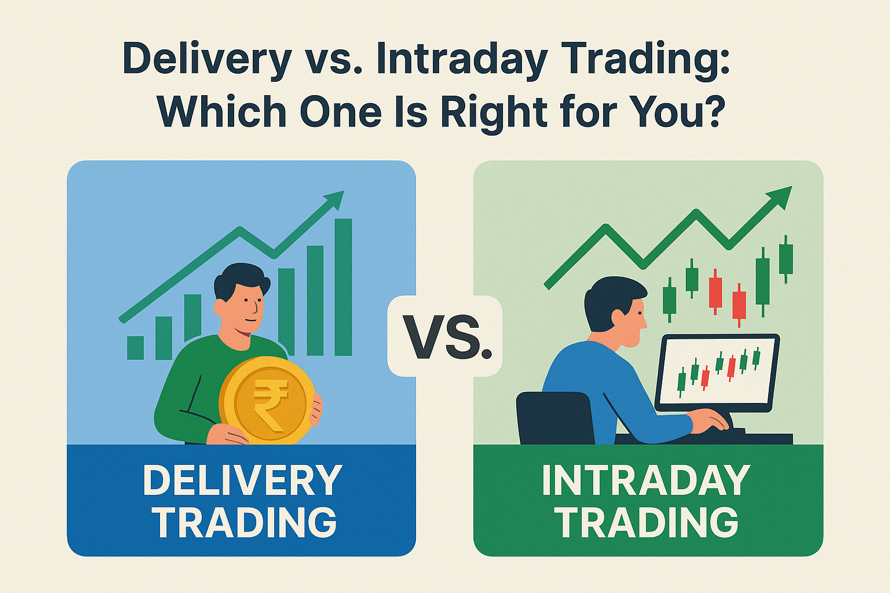
Introduction to Stock Trading Styles
What is Delivery Trading?
Delivery trading means buying shares and holding them in your demat account for more than a day. Once purchased, those shares belong to you until you choose to sell them. You could hold them for a week, a year, or even longer.
This style suits investors who believe in long-term wealth creation through compounding and company growth. You own the stock, you earn dividends, and you ride long-term price appreciation.
“Start investing with confidence! Explore
0 demat account
and grow your wealth.”
What is Intraday Trading?
Intraday trading is buying and selling the same stock within a single trading session. You open and close all positions before the market shuts for the day. Traders here focus on short-term price movements, not ownership.
The goal is speed. Profit depends on volatility, timing, and precision. Intraday traders rely on charts, indicators, and momentum instead of company fundamentals.
Why Choosing the Right Style Matters
Your trading style determines your risk, time commitment, and return potential. Someone with a 9-to-5 job may not monitor charts all day, while a full-time trader thrives on quick decisions.
Choosing between delivery and intraday trading isn’t about better or worse, it’s about fit. Understanding both styles helps you align your strategy with your temperament and financial goals.
Understanding Delivery Trading
How Delivery Trading Works
When you buy stocks for delivery, you pay the full price upfront and take ownership in your demat account. You can hold them indefinitely. When the price meets your target, you sell and realize gains.
Brokerages don’t offer high leverage here because the shares are fully owned. You get delivery settlement on T+1 (trade day + one day), which means your stock appears in the demat account the next day.
Benefits of Delivery Trading
Delivery trading suits investors who believe in growth and long-term stories. You benefit from:
- Ownership: The stock is yours until sold.
- Dividends: You receive company payouts.
- No Daily Pressure: You don’t need to monitor every tick.
- Capital Gains: You can hold through short-term volatility.
When markets fluctuate, delivery traders often stay calm because they think in terms of years, not hours.
Risks and Limitations of Delivery Trading
The key risk lies in holding capital for long periods. Prices may stay sideways for months before showing growth. Also, profits depend on overall market trend and company performance. Yet for patient investors, time often smooths out these fluctuations. Delivery trading rewards discipline, patience, and long-term conviction more than quick reactions.
Understanding Intraday Trading
How Intraday Trading Works
Intraday trading works on real-time market action. Traders buy when momentum builds, sell when prices spike, or short-sell when the market dips. All trades close the same day. Brokers allow margin, so you can trade multiple times your capital. Positions must be squared off before the session ends. Profits and losses are realized instantly.
Benefits of Intraday Trading
- Quick Profit Potential: You can earn from short-term price swings.
- High Liquidity: Positions open and close daily.
- Margin Facility: Smaller capital can control larger trades.
- No Overnight Risk: Global or after-hours news doesn’t impact you.
Intraday trading gives excitement and adrenaline, perfect for those who enjoy fast decisions and direct control.
Risks and Limitations of Intraday Trading
Intraday trading comes with high volatility. Markets move quickly, and sharp reversals can happen within minutes. Leverage amplifies both profits and losses.
It demands continuous monitoring, discipline, and technical skill. For active traders who understand momentum and control emotion, intraday trading can be highly rewarding.
Key Differences Between Delivery and Intraday Trading
Time Horizon of Investment
Delivery traders think long-term, months or years. Intraday traders work in minutes or hours. One focuses on wealth creation; the other on daily income. Your time horizon defines which suits you better.
Capital Requirements and Margin Usage
Delivery trades require full payment for shares. Intraday traders can use broker-provided margins, often 5x to 20x their funds. That increases exposure but also the risk.
Delivery investors keep their risk limited to their invested capital, while intraday traders use leverage as a double-edged tool.
Profit Potential and Risk Exposure
Delivery trading profits compound gradually over time. Intraday profits can be immediate but volatile. In delivery, price appreciation and dividends build wealth; in intraday, small percentage gains multiply through volume and frequency.
Your profit style depends on patience versus agility, both valid, just different.
Taxation on Delivery vs Intraday Trading
For delivery trading, both short-term capital gains tax (STCG) and long-term capital gains tax (LTCG) apply. If you sell equity shares within 12 months of purchase, STCG at the rate of 20% applies.
Long-term capital gains (LTCG) tax applies if you sell listed equity shares after holding them for more than 12 months. For sales on or after July 23, 2024, LTCG is payable at 12.5% on gains exceeding Rs. 1.25 lakh in a financial year.
Intraday profits fall under speculative business income and are taxed at your applicable slab rate. Hence, traders must maintain detailed records of daily transactions for tax purposes.
Who Should Choose Delivery Trading?
Long-Term Wealth Creators
If you believe in the power of compounding and company growth stories, delivery trading is your style. You let time do the work and allow businesses to create value.
Many of India’s wealthiest investors, such as Rakesh Jhunjhunwala and Radhakishan Damani, built fortunes through patient delivery investing.
Investors with Lower Risk Appetite
Delivery trading carries minimal stress compared to day trading. Once you buy, you’re not forced to act immediately. The absence of intraday volatility lets you sleep peacefully while your investments work in the background.
People Seeking Dividend Income
Dividend-paying companies reward long-term holders. Delivery investors collect regular cash flow through dividends while benefiting from long-term appreciation, a double advantage for steady portfolio growth.
Who Should Choose Intraday Trading?
Traders Seeking Quick Profits
If you love action, quick execution, and instant results, intraday trading fits your personality. Every trading day brings new opportunities across stocks and sectors. Momentum traders, scalpers, and arbitrage players thrive in this space by capitalizing on volatility.
Investors Comfortable with High Risk
Intraday trading rewards those comfortable with uncertainty and rapid decision-making. You control trades minute by minute, and success depends on risk management, timing, and emotional balance.
People Actively Tracking Markets Daily
If market analysis, charts, and data excite you, intraday trading could feel natural. Active participation and constant learning matter more than holding patience.
It’s a game of focus, speed, and discipline, qualities that shape skilled traders over time.
Expert Tips for Traders and Investors
Risk Management in Intraday Trading
Always set stop-loss levels. Decide the maximum loss per trade and stick to it. Position sizing is key, never risk more than 1–2% of your capital on one trade.
Keep emotions out. Intraday trading is a skill, not a gamble. Track your trades, learn from patterns, and build consistency before chasing size.
Building a Strong Portfolio with Delivery Trades
For delivery investors, quality matters more than quantity. Focus on companies with strong balance sheets, leadership, and long-term potential. Diversify across sectors such as banking, IT, FMCG, and energy to protect against market cycles.
Reinvest dividends and hold through corrections. Over the years, compounding becomes your greatest ally.
Using a Hybrid Approach – Mixing Delivery & Intraday
Many experienced traders use a mix. They allocate a portion of funds for long-term delivery investments and another for intraday opportunities.
This approach balances stability with excitement, long-term growth cushions short-term experimentation. The hybrid method helps maintain liquidity while building lasting wealth.
Conclusion – Choosing Between Delivery and Intraday
The choice between delivery and intraday trading depends on your personality, time, and goals. Delivery investing is slow, steady, and growth-oriented. Intraday trading is fast, technical, and tactical.
If you enjoy analyzing businesses and letting compounding work, go with delivery. If you thrive on market action, patterns, and quick profits, intraday suits better.
The smart approach? Learn both. Use delivery for wealth creation and intraday for skill sharpening. With discipline and clarity, both can coexist in your financial journey under one portfolio.
FAQs
Q1: Which is more profitable – delivery trading or intraday trading?
Both can be profitable depending on skill and strategy. Delivery builds wealth over years, while intraday generates short-term income through daily trades.
Q2: Can a beginner start with intraday trading?
Beginners can start small in intraday trading, focusing first on learning chart patterns, volume analysis, and stop-loss discipline before scaling up.
Q3: Can I do both delivery and intraday trading from the same account?
Yes. Most brokers allow both types of trading within one account. You can choose the order type (delivery or intraday) while placing trades.
Q4: Which option is safer for long-term investors?
Delivery trading is better for long-term investors seeking stability, compounding, and dividend income without daily market involvement.
Disclaimer
The stocks mentioned in this article are not recommendations. Please conduct your own research and due diligence before investing. Investment in securities market are subject to market risks, read all the related documents carefully before investing. Please read the Risk Disclosure documents carefully before investing in Equity Shares, Derivatives, Mutual fund, and/or other instruments traded on the Stock Exchanges. As investments are subject to market risks and price fluctuation risk, there is no assurance or guarantee that the investment objectives shall be achieved. Lemonn (Formerly known as NU Investors Technologies Pvt. Ltd) do not guarantee any assured returns on any investments. Past performance of securities/instruments is not indicative of their future performance.
Related Posts
Download Lemonn
Download my app for share market trading, ipo investment, trading account, and all your investment needs.