Confirmation Bias in Stock Picking: How to See What’s Actually There
What is Confirmation Bias in Investing?
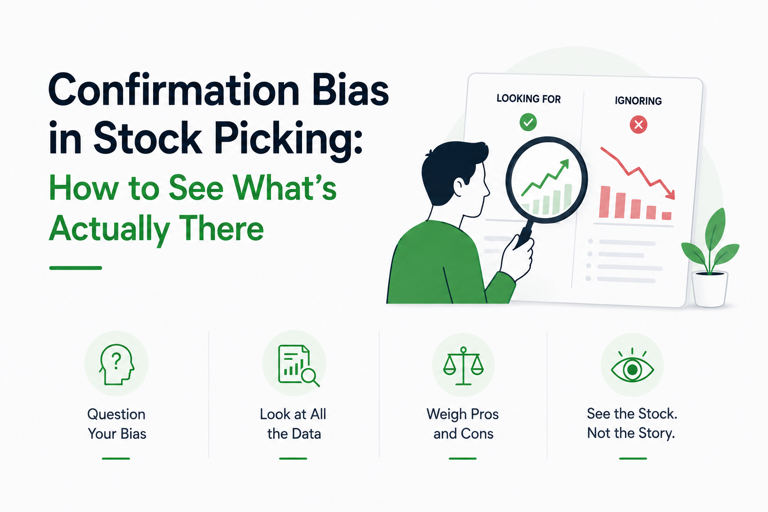
Confirmation bias is the tendency to search for, interpret, and remember information in a way that confirms pre-existing beliefs. Once an investor decides they like a stock, they unconsciously focus on bullish evidence and dismiss or downplay bearish evidence. This leads to overpaying for stocks and holding losing positions too long.
How Confirmation Bias Manifests in Indian Market Investing
| Behavior | What It Looks Like | The Reality |
|---|---|---|
| Selective reading | Only reading bullish analyst reports on a stock | Ignoring the bearish view from a different credible analyst |
| Following like-minded investors | Only following Twitter/X accounts that also hold the stock | Echo chamber — misses contrary signals |
| Dismissing negative news | ‘That bad quarterly result is just one quarter’ | May be the start of a structural decline |
| Anchoring to analyst targets | Trusting the ₹2,000 target when stock is at ₹1,800 | Target was set 18 months ago, conditions changed |
“Start investing with confidence! Explore
0 demat account
and grow your wealth.”
The Devil’s Advocate Technique
Before buying any stock, write a structured bear case — the strongest argument for why the stock will fail. Force yourself to take the short seller’s view. If you can’t write a credible bear case, you haven’t understood the risks. If the bear case is stronger than you initially thought, reconsider position size.
Pre-Mortem Analysis
The pre-mortem asks: ‘Imagine it is 2 years from now and this investment has lost 40% of its value. What went wrong?’ By assuming failure and working backwards, investors surface risks they would have otherwise ignored. This is the opposite of confirmation bias — you are pre-supposing the negative outcome.
Building an Unbiased Research Process
- Read at least one bearish analyst report before buying
- Check short interest data on NSE F&O — high short interest may signal informed negative view
- Look for management red flags: high promoter pledge, frequent auditor changes, related-party loans
- Check what the stock has done after previous quarterly results — is it consistently disappointing?
- Ask: ‘Why is this stock available at this price if the opportunity is so obvious?’
Disclaimer
The stocks mentioned in this article are not recommendations. Please conduct your own research and due diligence before investing. Investment in securities market are subject to market risks, read all the related documents carefully before investing. Please read the Risk Disclosure documents carefully before investing in Equity Shares, Derivatives, Mutual fund, and/or other instruments traded on the Stock Exchanges. As investments are subject to market risks and price fluctuation risk, there is no assurance or guarantee that the investment objectives shall be achieved. Lemonn (Formerly known as NU Investors Technologies Pvt. Ltd) do not guarantee any assured returns on any investments. Past performance of securities/instruments is not indicative of their future performance.
Related Posts



Download Lemonn
Download my app for share market trading, ipo investment, trading account, and all your investment needs.