
Commodity Trading in India: Markets, Contracts & More
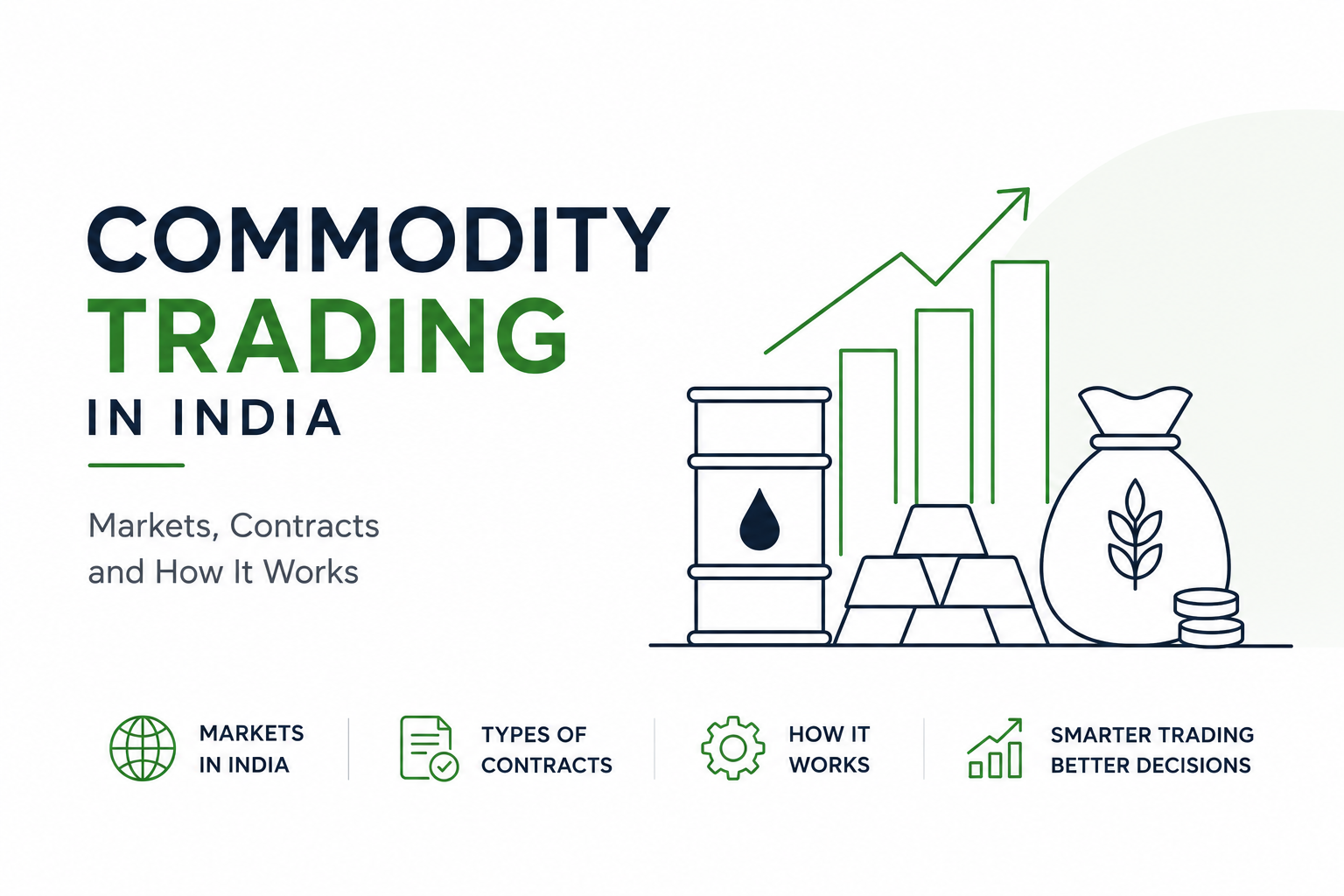
Commodity trading in India allows traders, investors, producers, and businesses to buy or sell exchange-traded contracts linked to commodities such as gold, silver, crude oil, natural gas, metals, and agricultural products.
Most commodity trading happens through futures and options contracts rather than by buying the physical commodity itself. These contracts trade on SEBI-regulated exchanges, with MCX and NCDEX among the key commodity-focused exchanges in India.
What Is Commodity Trading?
Commodity trading is the buying and selling of contracts whose value is linked to an underlying physical commodity.
For example, instead of purchasing barrels of crude oil and arranging storage, a trader can take a position in a crude oil futures contract. The contract’s price changes based on movements in the underlying commodity market.
Commodity derivatives broadly fall into two categories in India:
- Agricultural commodities: Cereals, pulses, spices, oilseeds, and similar products
- Non-agricultural commodities: Gold, silver, crude oil, natural gas, aluminum, and other metals and energy products
SEBI identifies agricultural and non-agricultural commodity derivatives as the two broad categories traded in the Indian market.
How Does Commodity Trading Work in India?
Commodity trading in India takes place through recognized exchanges and SEBI-registered intermediaries.
The basic process looks like this:
- Open a trading account with a broker that offers commodity derivatives.
- Choose an exchange and commodity contract.
- Check the contract’s lot size, expiry, margin requirement, and settlement terms.
- Buy or sell the futures or options contract.
- Monitor your margin and profit or loss.
- Exit the position before expiry or allow it to proceed to settlement, depending on the contract.
SEBI maintains a database of registered brokers participating in the commodity derivatives segment, which investors can use to verify intermediaries.
“Start investing with confidence! Explore
0 demat account
and grow your wealth.”
A Simple Commodity Futures Example
Suppose a gold futures contract is trading at ₹1,00,000 per specified trading unit.
You expect gold prices to rise, so you buy one futures contract. If the futures price later moves to ₹1,02,000, your position gains value.
If the price falls to ₹98,000 instead, the position loses value.
The actual profit or loss depends on the exchange-defined quotation method, lot size, price movement, transaction costs, and where you exit the trade.
This leverage is one reason commodity futures can produce significant gains or losses from relatively small price movements.
Which Commodity Exchanges Operate in India?
India has several recognized exchanges permitted to offer commodity derivatives.
SEBI’s recognized exchange list includes Multi Commodity Exchange of India (MCX), NCDEX, NSE, and BSE for commodity derivatives.
MCX
Multi Commodity Exchange of India, commonly called MCX, is a specialized commodity derivatives exchange.
Traders commonly associate MCX with contracts linked to:
- Gold
- Silver
- Crude oil
- Natural gas
- Copper
- Aluminium
- Zinc
- Other metals and commodities
The exact contracts available can change, so traders should always check the current exchange contract list before placing a trade.
NCDEX
NCDEX is another SEBI-recognised exchange dedicated to commodity derivatives. It has historically had a stronger focus on agricultural commodity markets.
Agricultural derivatives can involve commodities such as cereals, pulses, spices, and oilseeds, subject to the contracts currently permitted and listed for trading.
NSE and BSE
Commodity derivatives are not limited to commodity-only exchanges.
Following regulatory integration, exchanges were permitted to operate across multiple market segments starting in October 2018. NSE and BSE subsequently introduced commodity derivative segments alongside their other market offerings.
NSE, for example, started commodity derivatives trading with bullion futures in October 2018.
What Types of Commodities Can You Trade?
Commodity derivatives cover several distinct markets, each driven by different economic factors.
| Commodity category | Common examples | Important price drivers |
|---|---|---|
| Bullion | Gold, silver | Interest rates, US dollar, inflation expectations, global risk |
| Energy | Crude oil, natural gas | Global supply and demand, inventories, geopolitics, weather |
| Base metals | Copper, aluminum, zinc | Industrial demand, China, manufacturing, inventories |
| Agriculture | Spices, oilseeds, cereals | Monsoon, crop output, government policy, demand |
| Other contracts | Exchange-specific products | Underlying market conditions and contract design |
Contract availability varies by exchange and can change over time.
What Are Commodity Futures Contracts?
A commodity futures contract is an agreement to buy or sell a specified quantity and quality of a commodity according to standardized exchange terms at a future date.
Every contract has predefined specifications.
These usually include:
- Underlying commodity
- Trading unit or lot size
- Price quotation
- Tick size
- Expiry date
- Delivery or settlement mechanism
- Quality specifications, where relevant
- Delivery centers, where applicable
You do not get to choose your own lot size or expiry date. The exchange standardizes these terms.
Why Do People Use Commodity Futures?
There are two major reasons.
Hedging
Businesses can use futures to reduce exposure to commodity price movements.
For example, a manufacturer that regularly consumes a metal may face higher costs if metal prices rise sharply. Commodity derivatives can potentially help manage part of that price risk.
NSE specifically highlights risk management and hedging against volatile raw-material prices as important functions of commodity derivatives.
Trading and Speculation
Traders can also take positions based on their view of future commodity prices.
A trader expecting prices to rise may take a long position, while someone expecting prices to decline may take a short position.
Unlike a commercial hedger, the trader usually does not have exposure to the physical commodity.
What Are Commodity Options?
Commodity options give the buyer a right linked to the underlying commodity derivative without the same obligation structure as a futures position.
The two basic types are:
- Call option: Generally used when the trader expects prices to rise
- Put option: Generally used when the trader expects prices to fall
The buyer pays an option premium for this right.
NSE describes futures and options as common exchange-traded commodity derivative products.
Options have additional concepts such as strike price, premium, intrinsic value, time value, and expiry. They can also behave very differently from futures, particularly as expiry approaches.
What Is Margin in Commodity Trading?
You generally do not pay the full notional value of a futures contract upfront. Instead, you maintain a prescribed margin with your broker or clearing system.
Suppose a contract has a notional value of ₹5 lakh. If the applicable margin were ₹50,000, a trader could obtain exposure to the ₹5 lakh contract by providing a fraction of its full value.
This is leverage.
It can increase capital efficiency, but it also magnifies risk. A relatively small adverse move in the commodity price can result in a substantial loss relative to the money initially set aside for the position.
Margin requirements are not fixed forever. Exchanges and clearing corporations can revise them based on volatility, risk conditions, and regulatory requirements.
How Is Profit and Loss Calculated?
For a simplified futures trade:
Profit or loss = Price movement × applicable contract quantity
Suppose you buy a contract at ₹500 and sell it at ₹510. If the contract represents 1,000 units, the gross gain would be:
₹10 × 1,000 = ₹10,000
This is before brokerage, taxes, exchange charges, and other applicable costs.
If the price had fallen by ₹10 instead, the position would have incurred a gross loss of ₹ 10,000.
Always use the actual exchange contract specifications when calculating potential profit and loss.
How Does Commodity Contract Settlement Work?
Settlement depends on the particular commodity and contract.
Depending on the contract specifications, settlement can involve mechanisms such as financial settlement or physical delivery.
Physical delivery introduces additional considerations because the commodity must meet specified standards and settlement procedures. Quality, quantity, delivery location, timelines, and other exchange requirements can become relevant.
This is why traders should never assume they can simply leave every commodity position open until expiry.
Before trading, check:
- Expiry date
- Tender or delivery period, where applicable
- Delivery intention requirements
- Settlement method
- Additional margins near expiry
- Broker policies for positions approaching delivery
These rules are particularly important for traders who have no intention of receiving or delivering the underlying commodity.
Who Regulates Commodity Trading in India?
The Securities and Exchange Board of India (SEBI) regulates India’s exchange-traded commodity derivatives market.
SEBI’s current list of recognized exchanges includes MCX and NCDEX as commodity derivatives exchanges, while NSE and BSE are also permitted to operate commodity derivatives segments.
SEBI also regulates intermediaries and issues rules and circulars covering areas such as risk management, clearing, settlement, participation, and exchange operations.
Commodity derivatives regulation continues to evolve. SEBI continued to issue and review commodity derivatives measures in 2026, including matters related to stress testing and market participation.
What Charges Apply to Commodity Trading?
The cost of a commodity trade can include several components.
These may include:
- Brokerage
- Exchange transaction charges
- Commodities Transaction Tax (CTT), where applicable
- SEBI charges
- GST
- Stamp duty
- Other applicable statutory or clearing charges
CTT applies to specified commodity futures and options transactions executed on exchanges.
Stamp duty also applies to relevant transactions. For example, NSE’s published investor information lists stamp duty on commodity futures at 0.002% on the buyer side.
GST at 18% also applies to stock broker services, according to NSE’s investor information.
Rates and applicability can change. Check the latest broker contract note, exchange schedule, and applicable tax rules rather than relying on an outdated charges table.
What Moves Commodity Prices?
Commodity prices respond to a wider range of factors than many new traders expect.
Global Demand and Supply
Crude oil, gold, silver, copper, and other globally traded commodities are influenced by international supply and demand.
A supply disruption thousands of kilometers away can affect Indian commodity futures prices.
Currency Movements
Many commodities are priced internationally in US dollars.
As a result, the USD/INR exchange rate can influence domestic prices even when the international commodity price itself has not moved dramatically.
Geopolitical Events
Wars, sanctions, trade restrictions, shipping disruptions, and production decisions can move energy and metal markets quickly.
Weather
Weather is particularly important for agricultural commodities and natural gas.
Rainfall, drought, floods, temperature changes, and crop conditions can affect expected supply.
Government Policy
Import duties, export restrictions, stock limits, agricultural policies, and other regulatory measures can influence Indian commodity markets.
Global Economic Conditions
Interest rates, inflation expectations, manufacturing activity, and economic growth can affect demand for commodities.
Gold, for example, may respond differently to economic uncertainty than an industrial metal such as copper.
Commodity Trading vs Equity Trading
Commodity and equity trading both occur on regulated exchanges, but their underlying exposures are very different.
| Feature | Commodity trading | Equity trading |
| Underlying | Physical commodity | Company shares |
| Common derivatives | Futures and options | Futures and options |
| Major drivers | Supply, demand, currency, weather, geopolitics | Earnings, valuation, business performance, economy |
| Expiry | Derivative contracts expire | Cash-market shares do not expire |
| Physical settlement | Relevant for certain contracts | Different settlement framework |
| Leverage | Common in derivatives | Common in equity derivatives |
| Key regulator | SEBI | SEBI |
Neither market is automatically easier or safer. The risks depend heavily on the instrument and position being traded.
What Are the Risks of Commodity Trading?
Commodity trading can be highly risky, particularly when derivatives and leverage are involved.
1. Leverage Risk
A leveraged position creates exposure far greater than the initial margin provided.
Losses can therefore accumulate quickly.
2. Price Volatility
Crude oil, natural gas, metals, and agricultural commodities can experience sharp movements after unexpected news.
3. Margin Risk
When volatility increases, margin requirements may rise.
A trader may need additional funds to maintain a position or may have to close it.
4. Liquidity Risk
Not every commodity and expiry has the same trading activity.
Lower liquidity can mean wider bid-ask spreads and difficulty exiting at the expected price.
5. Expiry and Delivery Risk
Holding certain contracts close to expiry without understanding settlement rules can create complications, especially where physical delivery is involved.
6. Global Event Risk
Commodity markets often respond rapidly to geopolitical developments, economic data, currency movements, and international supply disruptions.
How Can Beginners Start Commodity Trading?
A beginner should understand the contract before worrying about predicting the next price move.
A practical approach is:
- Learn futures and options basics. Understand leverage, margin, expiry, and settlement.
- Choose a SEBI-registered broker. Confirm that the broker provides access to the required commodity exchange.
- Pick one commodity initially. Learning how one market behaves is usually more manageable than following ten at once.
- Read the contract specifications. Check lot size, expiry, tick size, settlement, and margin.
- Calculate your rupee risk before entering. Do not judge risk only by the percentage price movement.
- Account for trading costs. Brokerage, CTT, GST, stamp duty, and exchange charges can affect net returns.
- Use risk controls. Decide how much capital you can risk before placing the trade.
The key point is simple: know the contract first, then consider the trade.
Is Commodity Trading Suitable for Beginners?
Commodity trading is accessible to retail traders, but leveraged commodity derivatives are not beginner-friendly, even though opening a trading account is easy.
Before trading with real money, a beginner should be comfortable answering questions such as:
- What is the contract’s lot size?
- How much does a ₹1 price movement change my profit or loss?
- What margin is required?
- When does the contract expire?
- How is it settled?
- What happens if I hold it near expiry?
- What are my total trading costs?
If you cannot answer these questions for a contract, you probably do not understand the position well enough to trade it yet.
FAQs About Commodity Trading in India
Is commodity trading legal in India?
A. Yes. Exchange-traded commodity derivatives are legal in India when traded through recognized exchanges and registered intermediaries under the applicable regulatory framework. SEBI regulates the commodity derivatives market.
Which is the main commodity exchange in India?
A. MCX is one of India’s major commodity derivatives exchanges, particularly associated with bullion, energy, and metal contracts. NCDEX is another recognized commodity derivatives exchange. NSE and BSE are also permitted to offer commodity derivatives.
Can I trade commodities without buying physical goods?
A. Yes. Traders commonly use futures and options to gain exposure to commodity prices without initially purchasing the physical commodity. However, you must understand the settlement and delivery rules of the specific contract.
Can I trade gold on a commodity exchange?
A. Yes. Gold-related futures and other eligible derivative contracts are available in India’s commodity derivatives market, subject to the products currently listed by individual exchanges.
What is a lot size in commodity trading?
A. Lot size is the standard quantity represented by one commodity contract. It affects the contract’s total value and the rupee impact of a price movement.
Do commodity futures expire?
A. Yes. Commodity futures have specified expiry dates. Traders must know the expiry and settlement rules before entering a position.
Is commodity trading risky?
A. Yes. Commodity derivatives can involve substantial risk due to leverage, volatility, margin requirements, liquidity conditions, and contract settlement requirements.
Do I need a demat account for commodity trading?
A. The account requirements can depend on the product, settlement mechanism, broker, and exchange rules. Check the current requirements with a SEBI-registered broker before activating the commodity derivatives segment.
What is the difference between commodity futures and options?
A. Futures create contractual obligations according to the terms of the contract. An option gives its buyer a right associated with the underlying contract in exchange for paying a premium. Their risk, margin, and payoff structures are different.
What is CTT in commodity trading?
A. CTT stands for Commodity Transaction Tax. It applies to specified exchange-traded commodity derivative transactions according to prevailing tax rules.
Key Takeaways
- Commodity trading in India primarily involves exchange-traded futures and options linked to physical commodities.
- MCX, NCDEX, NSE, and BSE are recognized exchanges permitted to operate commodity derivatives segments.
- Commodities include bullion, energy products, metals, and agricultural products.
- Every commodity contract has its own lot size, expiry, margin, and settlement rules.
- Futures use leverage, which can magnify both profits and losses.
- Commodity prices can be affected by global markets, currencies, weather, geopolitics, and government policy.
- Trading costs can include brokerage, CTT, exchange charges, GST, SEBI charges, and stamp duty.
- Beginners should understand contract specifications and calculate rupee risk before placing a commodity trade.
Disclaimer
The stocks mentioned in this article are not recommendations. Please conduct your own research and due diligence before investing. Investment in securities market are subject to market risks, read all the related documents carefully before investing. Please read the Risk Disclosure documents carefully before investing in Equity Shares, Derivatives, Mutual fund, and/or other instruments traded on the Stock Exchanges. As investments are subject to market risks and price fluctuation risk, there is no assurance or guarantee that the investment objectives shall be achieved. Lemonn (Formerly known as NU Investors Technologies Pvt. Ltd) do not guarantee any assured returns on any investments. Past performance of securities/instruments is not indicative of their future performance.
Related Posts
Download Lemonn
Download my app for share market trading, ipo investment, trading account, and all your investment needs.



