Book Value and Market Value of Shares: Meaning, Formula, and Key Differences
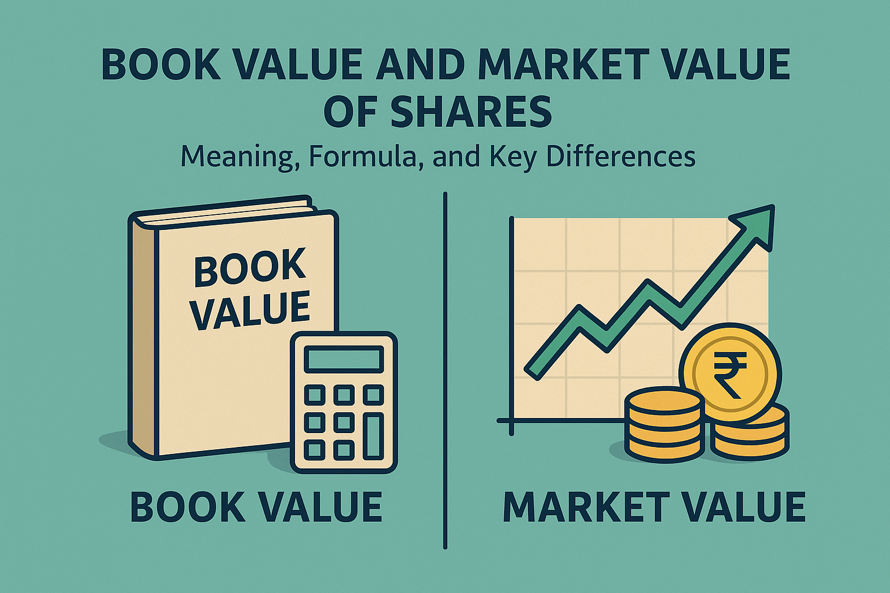
Introduction – Understanding Share Valuation Basics
Every stock carries two personalities: the one printed inside a company’s balance sheet and the one that traders shout about on the exchange floor. One stays steady, calm, and factual. The other jumps, twists, and reacts to every headline. These two metrics — book value and market value — form the starting point for anyone learning how share valuation actually works.
Before an investor buys a stock, the immediate instinct is to ask, “Is the price worth it?” That curiosity opens the door to understanding what the business owns, what the market believes, and how the gap between the two can uncover opportunity, hype, fear, or mispricing.
Why Investors Need to Know the Value of a Share
Valuation sits at the heart of every investment decision. Stocks swing every day, but understanding the difference between intrinsic worth and market enthusiasm helps investors stay grounded. Understanding value prevents emotional purchases and clarifies whether a price reflects strength, weakness, or unrealistic optimism.
“Start investing with confidence! Explore
0 demat account
and grow your wealth.”
Role of Book Value and Market Value in Investment Decisions
Book value lays the foundation. Market value represents expectation. Together, they show where the company stands and where investors believe it is going. This combination gives a layered understanding of a stock’s actual worth and perceived future potential.
What Is the Book Value of a Share?
Book value feels like a quiet truth. It ignores hype, avoids predictions, and sticks to what the company actually holds after settling liabilities. It is the accountant’s version of worth — steady, reliable, and rooted in tangible facts.
Definition and Concept of Book Value
Book value is the net asset value of a company as reported in its financial statements. It represents the shareholder’s claim if everything were sold and all obligations settled. It omits noise, future hope, and speculation — it lives inside factual records.
Formula for Calculating Book Value Per Share (BVPS)
BVPS = (Shareholders’ Equity – Preference Equity) ÷ Total Outstanding Shares
This simple formula sits at the heart of value investing.
Example Calculation of Book Value
Imagine a company with:
• Total Assets: ₹500 crore
• Total Liabilities: ₹300 crore
• Shareholders’ Equity: ₹200 crore
• Outstanding Shares: 10 crore
BVPS = ₹20
This means the business offers ₹20 of tangible value for every share held.
What Book Value Indicates About a Company’s Financial Health
A rising book value is viewed as a positive indicator. Generally, it indicates asset growth, low liabilities, and disciplined reinvestment. Weak book value signals balance sheet stress or shrinking asset quality. Analysts often use changes in book value to track whether the company’s foundation is strengthening or slipping over time.
What Is the Market Value of a Share?
Put simply, market value reflects the real-time price of an asset, the price at which an asset can be bought or sold in the open market. In other words, market value is the number flashing across trading screens — a moving target shaped by belief, fear, news, and expectations. Unlike book value, which is static, stock price changes every second as the market reacts to new information.
Definition and Meaning
Market value is the price investors are willing to pay for one share at any given moment. Multiply that price by total outstanding shares, and you get the company’s market capitalization.
How Market Value Is Determined in the Stock Market
It forms naturally based on:
• Quarterly results
• Analyst reports
• Industry conditions
• Global trends
• Market mood
In short, market value is the marketplace verdict — emotional, forward-looking, and fast-moving.
Factors That Influence Market Value (Demand, Supply, Performance, Sentiment)
Demand boosts price. Supply pushes it down. Strong earnings push it up. Negative news drags it down. Market sentiment often swings more than fundamentals, creating temporary distortions in value.
Example of Market Value Calculation
The market value of a stock can be calculated using mathematical tools, formulas, and ratios, such as P/E ratio, EV/EBITDA ratio, and Price/Book value.
Key Differences Between Book Value and Market Value
The distance between book value and market value reveals investor psychology. One number remains calm and slow-moving. The other leaps ahead in terms of future expectations.
Comparative Table – Book Value vs. Market Value
• Book Value = Actual net asset value
• Market Value = Price investors assign
• Book value shifts slowly
• Market value shifts instantly
• Book value shows reality
• Market value reflects perception
When Market Value Is Higher or Lower Than Book Value
• Market value > book value → optimism about growth
• Market value < book value → potential undervaluation or concern
What the Difference Reveals About Investor Sentiment
The gap captures belief. A huge premium shows confidence. A discount indicates fear or an undervalued opportunity.
Importance of Book Value and Market Value in Stock Analysis
Both values serve different purposes. Investors often combine them to judge long-term potential, short-term market behavior, and asset-driven stability.
How Investors Use Book Value to Identify Undervalued Stocks
Value investors love companies whose prices fall below book value because it signals that assets may be worth more than the stock market currently acknowledges. However, this is not always a foolproof approach.
Market Value as a Measure of Perceived Worth
Market value reflects the world’s judgment — what investors believe the company can achieve in the future.
Role of P/B (Price-to-Book) Ratio in Valuation
P/B Ratio = Market Value ÷ Book Value
A low P/B suggests undervaluation. A high P/B shows premium expectations.
Factors Affecting the Book Value of Shares
Book value changes slowly because it depends on fundamental financial factors.
Company’s Assets and Liabilities
Stronger assets and controlled debt push book value higher.
Depreciation and Asset Revaluation
Depreciation reduces book value. Revaluation of fixed assets can increase it depending on accounting standards.
Retained Earnings and Reserves
Companies reinvesting profits naturally expand book value.
Factors Affecting the Market Value of Shares
Market value responds instantly to real-time triggers.
Company Performance and Earnings
Profit growth often leads to rallying stock prices.
Market Sentiment and Economic Conditions
Inflation, interest rates, and global market volatility all impact stock valuations.
Industry Trends and Government Policies
Sector-specific reforms or disruptions can drive price fluctuations.
Relationship Between Book Value and Market Value
Understanding the interaction between these values helps classify stocks into growth, value, or distressed categories.
When Market Value > Book Value – Growth Stocks
These companies attract optimism, showing investors believe future earnings will exceed current fundamentals.
When Market Value < Book Value – Undervalued or Distressed Stocks
Low valuations might signal opportunity or deeper structural issues.
Interpreting the Price-to-Book Ratio
A single ratio that compresses sentiment, asset quality, and valuation in one number.
Limitations of Book Value and Market Value
No valuation method is foolproof.
Book Value May Not Reflect Current Market Conditions
Modern businesses rely heavily on intangible assets that book value can’t fully capture.
Market Value Can Be Volatile
Rapid fluctuations can distort investor perception.
Need for Combined Analysis with Other Financial Metrics
PE ratio, ROE, free cash flow, and debt ratios — all add layers of clarity.
Practical Example – Comparing Two Companies
Different industries follow different valuation rules.
Case Study: IT Company vs Manufacturing Firm
An IT firm may have low tangible assets but a high market valuation. A manufacturing firm may have a high book value but a moderate market value due to a slower growth perception.
How Book and Market Values Differ Across Sectors
The nature of the industry (sector) determines which value carries more weight — growth-heavy sectors favor market value, while asset-heavy sectors rely more on book value.
Conclusion – Why Both Values Matter for Smart Investing
Book value keeps the analysis grounded. Market value keeps it forward-looking. Together, they help investors identify undervaluation, overvaluation, sentiment cycles, and long-term opportunities. Smart decisions come from understanding both, not choosing one over the other.
FAQs
What is the book value of a share in simple terms?
It is the net asset value per share.
How is the book value of a share calculated?
By dividing shareholders’ equity by the total number of outstanding common shares.
What is the market value of a share?
The real-time trading price of the stock.
Why is market value higher than book value?
Because it reflects future expectations and sentiment.
Which is more important – book value or market value?
Both matter for a complete valuation picture.
How does the price-to-book ratio help investors?
It shows whether a stock is undervalued or overpriced.
What does it mean if a stock is trading below book value?
It may indicate opportunity or company-specific concerns.
Disclaimer
The stocks mentioned in this article are not recommendations. Please conduct your own research and due diligence before investing. Investment in securities market are subject to market risks, read all the related documents carefully before investing. Please read the Risk Disclosure documents carefully before investing in Equity Shares, Derivatives, Mutual fund, and/or other instruments traded on the Stock Exchanges. As investments are subject to market risks and price fluctuation risk, there is no assurance or guarantee that the investment objectives shall be achieved. Lemonn (Formerly known as NU Investors Technologies Pvt. Ltd) do not guarantee any assured returns on any investments. Past performance of securities/instruments is not indicative of their future performance.
Related Posts



Download Lemonn
Download my app for share market trading, ipo investment, trading account, and all your investment needs.