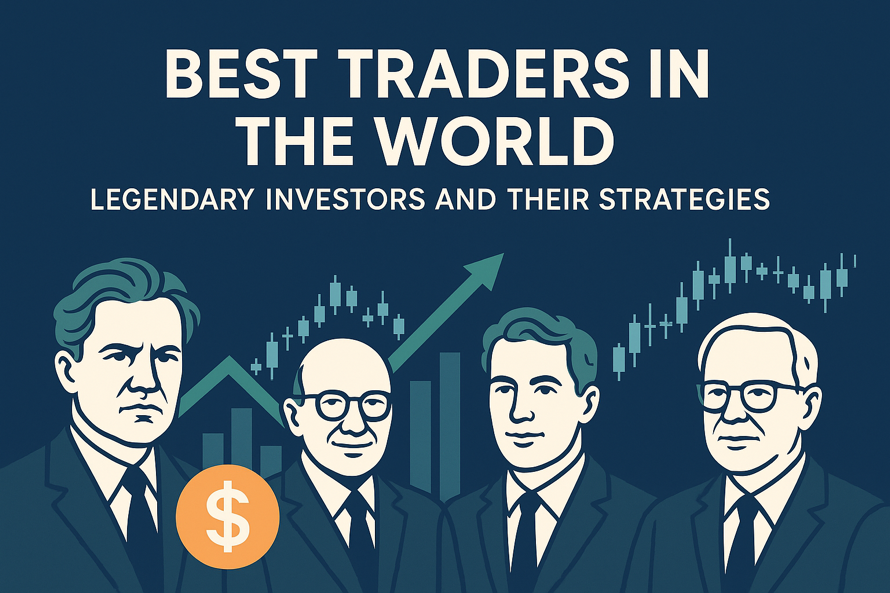
Best Traders in the World – Legendary Investors and Their Strategies
Introduction to World’s Top Traders
Who Is a Trader?
A trader is someone who buys and sells financial instruments, stocks, currencies, commodities, or derivatives, to profit from price changes. Unlike investors who build wealth over years, traders act on timing, precision, and psychology. They read markets like living organisms, spotting opportunities in chaos.
A great trader isn’t defined by luck or one big win. They’re characterized by discipline, the ability to cut losses fast, control greed, and strike when odds tilt in their favor.
“Start investing with confidence! Explore
0 demat account
and grow your wealth.”
Difference Between Trader and Investor
The difference lies in mindset and time horizon. Investors think in terms of years; traders think in moments. An investor might hold Apple stock for a decade. A trader might buy it at 9:15 a.m. and sell it by 3:30 p.m.
Investors focus on value and compounding. Traders focus on momentum, volatility, and liquidity. Yet, the best traders in the world often understand both: the patience of an investor and the instinct of a risk-taker.
Why Studying Successful Traders Matters
Learning from market legends is like compressing decades of experience into hours. Their wins teach timing. Their losses teach humility.
By studying their principles, strategies, and failures, ordinary traders can skip years of trial and error.
Best Stock Market Traders in the World
Jesse Livermore – The Legendary Speculator
Jesse Livermore began trading in bucket shops at age 14 and became famous for shorting the market during the 1929 crash. He turned patterns, tape reading, and crowd psychology into an art form.
Livermore believed markets are driven by human emotion, greed, fear, and hope. His timeless lesson? “The big money is not in the buying or selling, but in the waiting.”
Despite multiple fortunes won and lost, his trading wisdom shaped generations of speculators. Livermore taught that patience and timing matter more than constant action.
George Soros – The Man Who Broke the Bank of England
In 1992, George Soros made history by shorting the British pound and earning over $1 billion in a single day. His Quantum Fund became legendary for macro-level bets on global currencies and economies.
Soros’s approach, known as reflexivity, revolved around feedback loops, how market perception influences reality. He watched human behavior as closely as charts.
His ability to spot imbalances in policy and perception made him one of the best traders in the world, a strategist who turned global trends into monumental profits.
Paul Tudor Jones – The Macro Trading Expert
Paul Tudor Jones predicted the 1987 stock market crash and made nearly 200% returns that year. His secret? Meticulous chart study and deep respect for risk management.
Jones believes success comes from defending your capital first and attacking later. His mantra, “Losers average losers”, reminds traders to cut losses quickly instead of doubling down on mistakes.
He still trades with the same humility decades later, showing that consistency outlasts hype.
Ray Dalio – Founder of Bridgewater Associates
Ray Dalio built the world’s largest hedge fund, Bridgewater Associates, on principles of radical transparency and systematic decision-making.
Unlike many traders who rely on gut instinct, Dalio uses data-driven models to predict how economies react to interest rates, inflation, and policy cycles. His famous “All Weather Portfolio” is designed to perform across every market condition.
Dalio blends trading with philosophy, writing about ego, failure, and the power of reflection, making him a teacher as much as a trader.
Stanley Druckenmiller – Master of Risk Management
Stanley Druckenmiller managed billions for Soros and helped engineer the same 1992 pound short that shocked the world. He’s known for conviction trading, going big when confidence is highest.
He once said, “The best traders make money by being right infrequently but betting heavily when they are.” Druckenmiller mastered timing, not perfection.
Best Commodity and Forex Traders
Richard Dennis – The Turtle Trading System
Richard Dennis turned $1,600 into over $200 million through disciplined trend following. To prove trading could be taught, he trained a group of ordinary people, the famous Turtle Traders, who also went on to make millions.
His system was simple: follow trends, manage risk, and never predict. Rules over emotion. Process over intuition.
Dennis’s philosophy reshaped modern trading education, showing that anyone with patience and structure can win consistently.
Andrew Krieger – Famous for Currency Trades
Andrew Krieger gained fame in 1987 for shorting the New Zealand dollar after the Black Monday crash. His positions were reportedly larger than New Zealand’s entire money supply.
He exploited overvalued currencies and central-bank weaknesses, making huge profits for Bankers Trust. Krieger’s aggression and precision earned him a near-mythical status in forex circles, proof that conviction backed by calculation can rewrite history.
John Henry – Trend Following in Commodities
Before owning the Boston Red Sox, John Henry built a fortune as a trend-following commodities trader. His rules-based system relied purely on data, no emotions, no predictions.
Modern-Day Successful Traders
Steven Cohen – Hedge Fund Trading Icon
Steven A. Cohen, founder of Point72 Asset Management, built his reputation on lightning-fast decision-making and deep research. Known for scalping profits from intraday volatility, Cohen combines quantitative insights with human intuition.
He trains his team to think like poker players—probability, pattern, and position sizing rule everything. Despite controversies earlier in his career, Cohen’s resilience and reinvention have kept him among the world’s top traders.
Jim Simons – The Quantitative Trading Genius
Jim Simons, founder of Renaissance Technologies, is a mathematician who turned code into cash. His Medallion Fund is often described as the most successful in history, with annualized returns exceeding 35%.
Simons revolutionized trading with algorithms that detect patterns invisible to humans. His success lies in finding order in randomness, a level of precision unmatched by traditional traders.
Where most see chaos, Simons sees data points. He embodies the future of trading: science fused with strategy.
Rakesh Jhunjhunwala – India’s Big Bull (Investor-Trader Hybrid)
The late Rakesh Jhunjhunwala blurred the line between trader and investor. Known as India’s Big Bull, he turned a few thousand rupees into billions by mixing trading instincts with long-term conviction.
He believed in studying business fundamentals intensely, but acted swiftly when momentum was on his side. His legacy lives on as proof that India can produce global-calibre market minds.
Jhunjhunwala often said, “Markets are about psychology, controlling your fear is the real edge.”
Common Traits of the World’s Best Traders
Strong Risk Management Discipline
Every legendary trader protects capital like oxygen. Livermore used stop losses religiously. Soros reduced his exposure the moment conviction waned.
Risk management is what keeps winners in the game. They never chase every trade; they wait for asymmetric setups where potential reward far outweighs potential loss.
Patience and Timing in Market Entry/Exit
Patience separates pros from gamblers. The best traders in the world often wait days, even weeks, for the right setup, then strike decisively.
Livermore called it “sitting tight.” Druckenmiller called it “betting big when you’re sure.” Either way, timing is an art of controlled aggression.
Continuous Learning and Adaptability
Markets evolve, and so must traders. Dalio studies history to forecast cycles. Simons refines algorithms daily. Cohen adjusts to changing liquidity conditions.
Lessons Retail Traders Can Learn from the Greats
Importance of Trading Psychology
Technical tools are useless if emotions rule. Great traders master themselves first. They accept losses as part of the game and keep confidence steady regardless of streaks.
Following a Proven Strategy
Each legend followed a defined playbook: Livermore’s price action, Dennis’s trend rules, Simons’s models, and Dalio’s macro logic. Consistency builds results.
Avoiding Overleveraging and Emotional Decisions
Overleveraging is often termed the fastest way to destruction. Even Soros, with his billion-dollar trades, used leverage strategically, never recklessly.
Conclusion – Can You Trade Like the Best in the World?
The truth? May not be exactly like them, but you can learn to think like them. The best traders in the world didn’t start with perfect systems. They began with curiosity, persistence, and an obsession with improvement. They studied patterns when others partied. They journaled trades when others panicked.
FAQs:
Q1: Who is considered the greatest trader of all time?
It is difficult to name one. Jesse Livermore is widely regarded as the greatest trader ever, known for his market timing and massive profits from the 1929 crash.
Q2: What strategies made George Soros successful?
Soros used global macro trading and reflexivity—studying how market sentiment shapes reality—to spot and profit from economic shifts.
Q3: Are the best traders always billionaires?
No. Great traders become successful through discipline and risk control, not wealth alone. Billionaire status is often a result, not a goal.
Q4: Can retail traders apply strategies used by top global traders?
Yes. Retail traders can follow trend rules, manage risk, and stay disciplined—core habits of the world’s best traders.
Q5: Who are some of the best traders in India?
The late Rakesh Jhunjhunwala, Ramesh Damani, and Porinju Veliyath are often counted among India’s top market icons known for their sharp timing and conviction.
Disclaimer
The stocks mentioned in this article are not recommendations. Please conduct your own research and due diligence before investing. Investment in securities market are subject to market risks, read all the related documents carefully before investing. Please read the Risk Disclosure documents carefully before investing in Equity Shares, Derivatives, Mutual fund, and/or other instruments traded on the Stock Exchanges. As investments are subject to market risks and price fluctuation risk, there is no assurance or guarantee that the investment objectives shall be achieved. Lemonn (Formerly known as NU Investors Technologies Pvt. Ltd) do not guarantee any assured returns on any investments. Past performance of securities/instruments is not indicative of their future performance.
Related Posts


Download Lemonn
Download my app for share market trading, ipo investment, trading account, and all your investment needs.