
How to Analyse a Company’s Annual Report in India
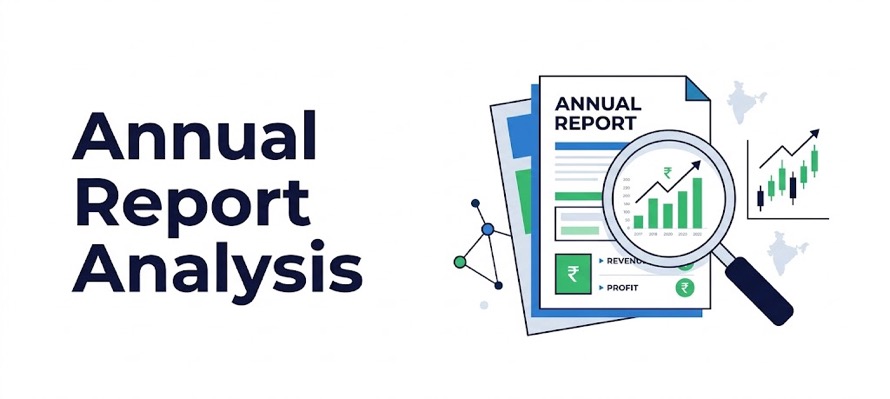
An annual report is the most comprehensive source of information about a listed Indian company, far more informative than quarterly results or news articles. Most retail investors never read annual reports. Those who do have a significant information advantage.
What Is in an Annual Report?
| Section | What’s in It | Time to Spend |
|---|---|---|
| Chairman’s Letter | CEO/MD vision, honest assessment of the year, strategic priorities | 10 minutes: very important for management quality assessment |
| Management Discussion and Analysis (MD&A) | Detailed business review, market conditions, opportunities and risks | 20 minutes: most information-rich section |
| Financial Statements | P&L, Balance Sheet, Cash Flow, Changes in Equity | 20 minutes: focus on trends over 3 to 5 years |
| Auditor’s Report | Independent assessment, qualifications, key audit matters | 5 minutes: any qualification is a serious warning sign |
| Notes to Accounts | Accounting policies, related party transactions, contingent liabilities | 15 minutes: where hidden risks are disclosed |
| Corporate Governance Report | Board composition, committees, director independence | 5 minutes: check promoter pledging and related party dealings |
8 Questions to Answer From Every Annual Report
- Did revenue grow? By how much vs the prior year and vs management guidance?
- Is operating profit (EBITDA) margin expanding or compressing over 3 to 5 years?
- Is debt going up or down? What is debt being used for: capex or working capital?
- What does management say about challenges? Are they honest or evasive and promotional?
- Are there any auditor qualifications, emphasis of matter, or management override of controls?
- What is the capex plan? Is the company investing for growth or extracting cash?
- Are related party transactions increasing? Are they at arms-length pricing?
- Is cash flow from operations positive and growing alongside reported profits?
“Start investing with confidence! Explore
0 demat account
and grow your wealth.”
Red Flags in Annual Reports
- Auditor resignation during the year; extremely serious signal of governance failure
- Auditor qualifications on revenue recognition or asset valuation
- Growing related party transactions without clear business rationale
- Promoter pledging of shares increasing year after year
- Management discussion that sounds promotional rather than honest about challenges
- Contingent liabilities increasing significantly; potential future cash drains
How to Find Annual Reports
Visit the BSE website (bseindia.com) or NSE (nseindia.com), search the company name, and go to the Annual Reports section. All listed companies must upload annual reports within 21 days of the AGM. The company’s investor relations page is another reliable source.
FAQs
How long does it take to read an annual report?
A focused reading of the key sections takes 45 to 60 minutes. You don’t need to read every word, focus on MD&A, auditor’s report, notes to accounts, and related party disclosures.
Which annual report section is most important?
The Management Discussion and Analysis (MD&A) section. It reveals how management thinks about the business, what risks they acknowledge, and their forward-looking view.
Are annual reports available for free?
Yes. BSE and NSE provide all annual reports for free. No paid subscription required.
Should I read annual reports for every stock I invest in?
Yes, at minimum once per year for existing holdings and before any initial investment. For trading positions, quarterly results are sufficient.
What is a ‘qualified’ auditor’s report?
A qualification means the auditor found something they could not verify or disagreed with management on accounting treatment. Any qualification is a yellow to red flag; investigate further.
Disclaimer
The stocks mentioned in this article are not recommendations. Please conduct your own research and due diligence before investing. Investment in securities market are subject to market risks, read all the related documents carefully before investing. Please read the Risk Disclosure documents carefully before investing in Equity Shares, Derivatives, Mutual fund, and/or other instruments traded on the Stock Exchanges. As investments are subject to market risks and price fluctuation risk, there is no assurance or guarantee that the investment objectives shall be achieved. Lemonn (Formerly known as NU Investors Technologies Pvt. Ltd) do not guarantee any assured returns on any investments. Past performance of securities/instruments is not indicative of their future performance.
Related Posts
Download Lemonn
Download my app for share market trading, ipo investment, trading account, and all your investment needs.



