
Apple’s New CEO John Ternus: Everything You Need to Know
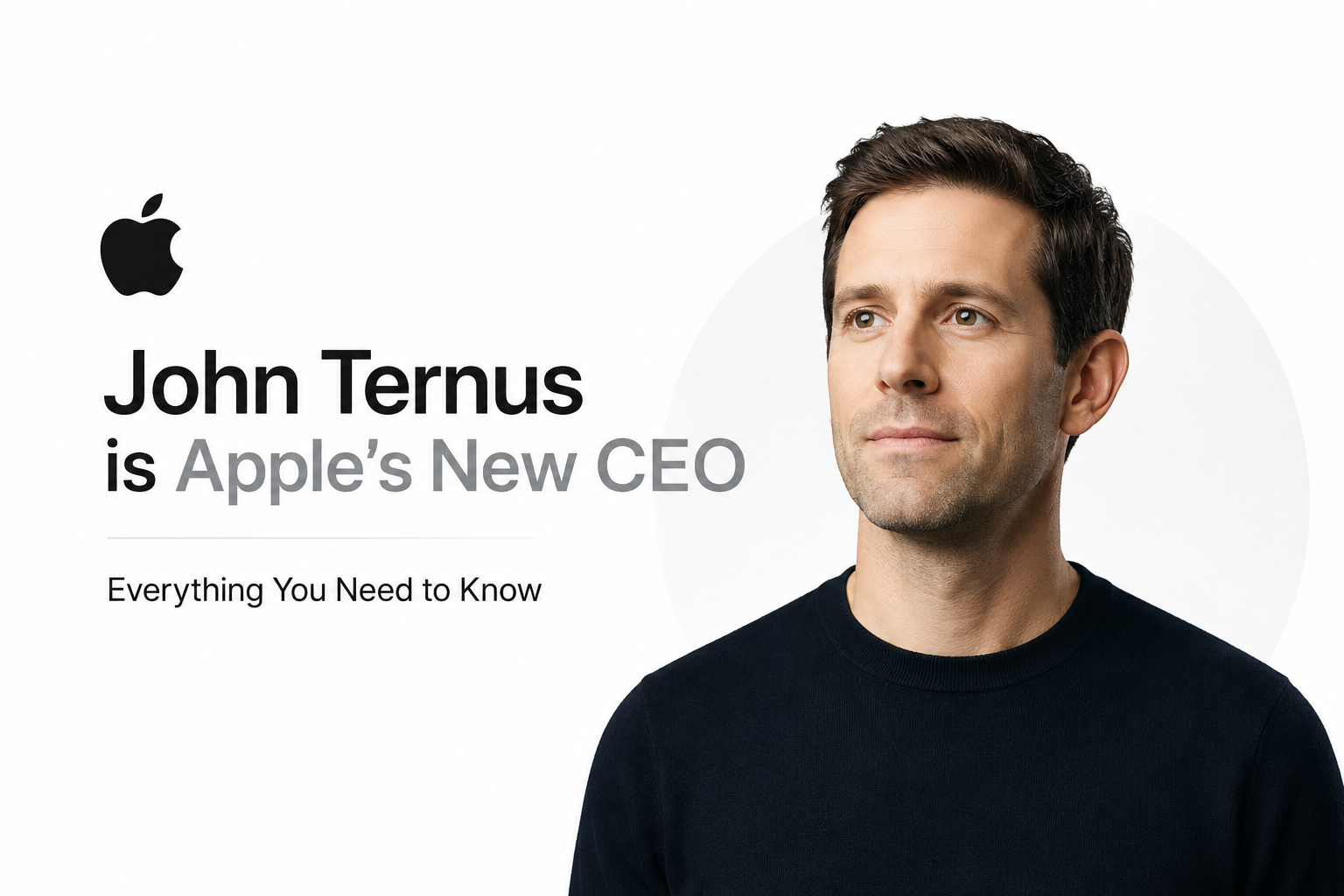
Apple has a new CEO. John Ternus officially became Apple’s chief executive officer on September 1, 2026, succeeding Tim Cook after Cook’s 15-year run at the top of the company. Cook has not left Apple. He has moved into the role of executive chairman.
Ternus is a longtime Apple executive with a mechanical engineering background. He joined the company in 2001 and most recently served as senior vice president of Hardware Engineering.
His appointment puts a product engineer at the top of one of the world’s largest technology companies. Here is who Ternus is, why Apple chose him, and what his leadership could mean for Apple’s future.
Who is Apple’s new CEO, John Ternus?
John Ternus became Apple’s CEO on September 1, 2026. He also joined Apple’s board of directors as part of the leadership transition.
Apple announced the succession on April 20, 2026, following what the company described as a long-term succession planning process.
| Detail | John Ternus |
|---|---|
| Current role | CEO of Apple |
| Became CEO | September 1, 2026 |
| Previous role | SVP, Hardware Engineering |
| Joined Apple | 2001 |
| Education | University of Pennsylvania |
| Degree | Bachelor’s in Mechanical Engineering |
| Previous employer | Virtual Research Systems |
| Predecessor | Tim Cook |
Before Apple, Ternus worked as a mechanical engineer at Virtual Research Systems. He earned his bachelor’s degree in Mechanical Engineering from the University of Pennsylvania.
He joined Apple in 2001 and went on to become one of its most senior product executives.
As head of Hardware Engineering, Ternus oversaw engineering across major products including the iPhone, Mac, iPad, Apple Watch, AirPods, and Apple Vision Pro.
One of the most significant projects during his rise was the Mac’s transition from Intel processors to Apple silicon. Moving to Apple’s own chips gave the company greater control over the performance, efficiency, hardware, and software of the Mac.
That combination of engineering experience and knowledge of Apple’s product development process helps explain why Ternus emerged as Tim Cook’s successor.
Why did Apple choose John Ternus as CEO?
Apple’s board unanimously selected Ternus after a planned succession process.
The company highlighted his leadership, technical expertise, understanding of Apple, and focus on creating products.
Three factors stand out.
“Start investing with confidence! Explore
share market
and grow your wealth.”
Deep knowledge of Apple
Ternus has spent about 25 years inside the company. He already understands Apple’s approach to integrating hardware, software, silicon, services, and design.
Choosing an internal candidate also gives Apple continuity at a time when its core businesses remain enormous and highly profitable.
Experience building major products
Ternus has worked across Apple’s hardware portfolio rather than focusing on a single device.
That experience matters because Apple’s future depends on an increasingly connected ecosystem of phones, computers, wearables, services, custom chips, health features, and emerging computing platforms.
An engineering background suited to Apple’s next challenges
Some of Apple’s biggest challenges are technical.
The company must integrate AI across its devices, keep advancing Apple silicon, develop new hardware formats, and find opportunities beyond its mature product categories.
Having an engineer as CEO could give product and technical decisions an especially influential role in Apple’s next chapter.
What happened to Tim Cook?
Tim Cook stepped down as CEO but remains closely involved with Apple.
He became executive chairman of Apple’s board on September 1, 2026. Apple said he will continue assisting with certain areas of the business, including engagement with policymakers.
That makes the transition more gradual than a complete change of leadership.
Cook joined Apple in 1998 and became CEO in August 2011. During his tenure, Apple’s market capitalization grew from roughly $350 billion to $4 trillion, according to Apple. Annual revenue increased from $108 billion in fiscal 2011 to more than $416 billion in fiscal 2025.
The Cook era also saw Apple expand well beyond its traditional Mac and iPhone businesses. Apple Watch, AirPods, Apple Vision Pro, Apple silicon Macs, Apple Pay, Apple Music, and Apple TV all arrived or developed significantly under his leadership.
Services grew into a business generating more than $100 billion in annual revenue, according to Apple.
Cook’s continued presence as executive chairman means Ternus inherits the CEO role with his predecessor still available during the transition.
How is John Ternus different from Tim Cook?
The biggest difference is their professional background.
Cook built his reputation in operations. Before becoming CEO, he served as Apple’s chief operating officer and was closely involved in its global supply chain, sales, service, and support operations.
Ternus comes from product engineering.
| Tim Cook | John Ternus |
|---|---|
| Operations background | Engineering background |
| Former Apple COO | Former hardware engineering chief |
| Became CEO in 2011 | Became CEO in 2026 |
| Supply-chain and operational expertise | Hardware and product expertise |
| Now executive chairman | Now CEO |
That difference could influence Apple’s priorities, but it would be premature to expect an immediate strategic overhaul.
Ternus developed his career within the same organization, while Cook remains executive chairman. Apple’s leadership change therefore combines a new CEO with significant continuity.
What could change under John Ternus?
The impact of a new CEO is unlikely to appear overnight.
Apple plans major products years in advance, so many devices released early in Ternus’s tenure will have been conceived or developed while Cook was CEO.
The more meaningful question is where Ternus puts Apple’s resources over the next several product cycles.
Artificial intelligence
AI is one of Apple’s biggest competitive challenges.
Advanced AI features require coordination among chips, devices, operating systems, software, and cloud infrastructure. Apple’s ability to control many of those layers could become an advantage if it can integrate them effectively.
Ternus’s engineering experience could be particularly relevant as AI becomes more deeply connected to Apple’s hardware.
Apple silicon
Apple-designed chips have changed the company’s approach to computing.
By controlling its processors, Apple can optimize hardware and software together rather than depending entirely on another company’s chip roadmap.
The transition has already reshaped the Mac. Under Ternus, the bigger question is how Apple’s custom silicon strategy develops across its wider product ecosystem.
New product categories
Apple also needs to identify where its next major growth platform will come from.
Wearables, health technology, spatial computing, new display formats, and other emerging devices could become increasingly important.
Ternus’s appointment does not tell us which category Apple will pursue next. It does mean that an executive with decades of hardware development experience will make the final calls.
Product innovation
Every new Apple category faces unusually high expectations.
Ternus inherits the difficult task of maintaining highly successful existing products while also finding ideas capable of creating meaningful new businesses.
That balance between protecting today’s Apple and building tomorrow’s Apple could ultimately define his tenure.
What does Apple’s CEO change mean for customers?
For most iPhone, Mac, or Apple Watch owners, there may be little immediate difference.
The first signs of Ternus’s influence are more likely to emerge through long-term product decisions than sudden changes to existing devices.
Areas worth watching include:
- Apple’s approach to AI
- Future iPhone designs and form factors
- New generations of Apple silicon
- Mac and iPad positioning
- Spatial computing
- Wearable and health technology
- Entirely new device categories
- Apple’s balance between hardware and services
Those decisions will provide a clearer picture of what a Ternus-led Apple looks like.
The bigger picture
John Ternus inherits a very different Apple from the company Tim Cook took over in 2011.
Apple is now a mature global business generating hundreds of billions of dollars in annual revenue. Its challenge is no longer simply making the iPhone, Mac, or Watch more successful.
It must also find its next major source of growth.
Ternus brings one defining characteristic to that challenge: Apple’s next era will be led by an engineer who spent decades building its products.
Whether that leads to a more product-driven Apple will become clearer over the next several years.
Frequently Asked Questions
Who is the new CEO of Apple?
John Ternus became Apple’s CEO on September 1, 2026, succeeding Tim Cook. He previously served as Apple’s senior vice president of Hardware Engineering.
When did John Ternus join Apple?
Ternus joined Apple in 2001. He had spent about 25 years at the company by the time he became CEO.
What did John Ternus do before becoming Apple CEO?
He led Apple’s Hardware Engineering organization, which works across the company’s major device categories. He also played an important role in hardware development during Apple’s transition of the Mac to Apple silicon.
Is John Ternus an engineer?
Yes. Ternus earned a bachelor’s degree in Mechanical Engineering from the University of Pennsylvania and worked as a mechanical engineer before joining Apple.
Why did Tim Cook step down?
Apple described the CEO change as part of a long-term succession planning process. Cook remains with the company as executive chairman.
How could Apple change under John Ternus?
It is too early to know. His engineering background could influence Apple’s approach to AI, custom silicon, hardware innovation, wearables, spatial computing, and future product categories.
Key takeaways
- John Ternus became Apple CEO on September 1, 2026, succeeding Tim Cook.
- He joined Apple in 2001 and rose to lead Hardware Engineering.
- His background is primarily in engineering and product development, while Cook’s was rooted in operations.
- Tim Cook remains at Apple as executive chairman.
- AI, Apple silicon, new devices, and product innovation are key areas to watch under Ternus.
- The transition offers continuity because Ternus is a longtime Apple executive, but his engineering background could gradually shape Apple’s priorities.
Disclaimer
The stocks mentioned in this article are not recommendations. Please conduct your own research and due diligence before investing. Investment in securities market are subject to market risks, read all the related documents carefully before investing. Please read the Risk Disclosure documents carefully before investing in Equity Shares, Derivatives, Mutual fund, and/or other instruments traded on the Stock Exchanges. As investments are subject to market risks and price fluctuation risk, there is no assurance or guarantee that the investment objectives shall be achieved. Lemonn (Formerly known as NU Investors Technologies Pvt. Ltd) do not guarantee any assured returns on any investments. Past performance of securities/instruments is not indicative of their future performance.
Related Posts



Download Lemonn
Download my trading app for SIP, demat account services—get a free demat account with our demat apps.



