
Top Indian Unicorn Startups 2026
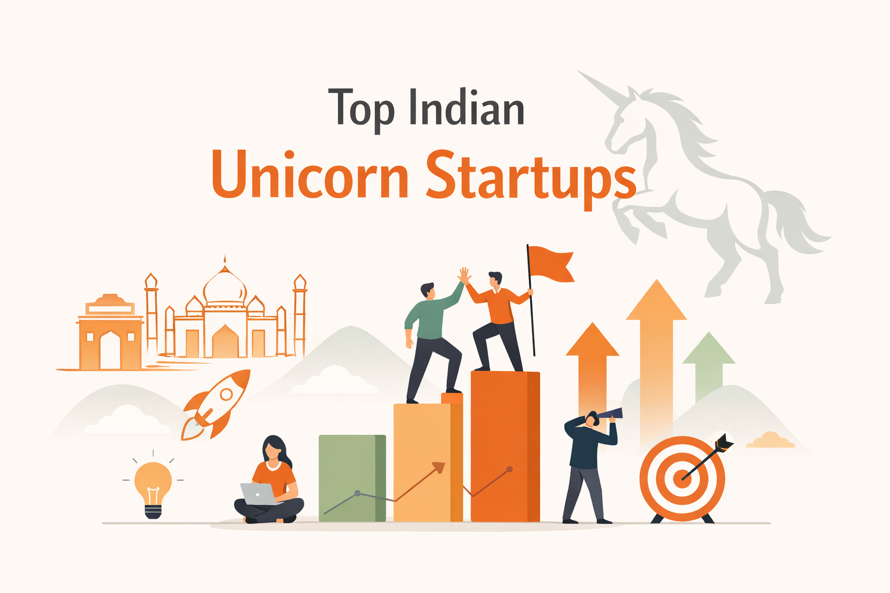
Discussing the top Indian unicorn startups 2026 is like getting a ringside seat to India’s growth story. These unicorns are not just billion-dollar companies; they are flagbearers who dot the country’s financial landscape. They signal where consumption is shifting, where investors are looking, where policy conversations head next, and where the next decade of innovation may be taking shape. By 2026, India’s unicorn count crossed the 125-plus mark, and each one is a story that blends technology, hustle, regulation, capital, and audacity into something unmistakably Indian.
Understanding Top Indian Unicorn Startups 2026
Understanding top Indian unicorn startups 2026 is about exploring the engines that drive modern India. These are companies that broke through the $1 billion valuation barrier because they solved real problems—some massive, some surprisingly simple—at unmatched scale. They belong to industries that did not exist a decade ago or existed in outdated forms that could no longer keep up with India’s ambition.
These unicorns cut across fintech, EV mobility, quick commerce, D2C brands, edtech, logistics, SaaS, agritech, and B2B supply chains. What makes them important is not only what they built, but how they built it: with digital public infrastructure at their fingertips, impatient consumers who valued speed over tradition, and investors who finally understood India’s demand curve. We have listed some of them below, in no particular order:
Top Indian Unicorn Startups 2026 (as of Dec 2025)
| Startup | Sector | *Approx. Valuation (USD) | Year founded | Key highlight |
|---|---|---|---|---|
| Zepto | Quick commerce | $7B | 2021 | Among the fastest Indian startups to reach a multi-billion-dollar valuation |
| Swiggy | Food & hyperlocal | $10.7B | 2014 | Expanded from food delivery into quick commerce |
| Razorpay | Fintech | $7.5B | 2014 | Key player in online payments for Indian businesses |
| Ola Electric | EV mobility | $5.4B | 2017 | Leading two-wheeler EV maker with a nationwide network |
| Lenskart | D2C retail | $5B | 2008 | Omnichannel eyewear leader with international presence |
| PhysicsWallah | Edtech | $3.7B | 2020 | Low-cost, exam-focused edtech with a strong YouTube base |
| Meesho | Social commerce | $3.9B | 2015 | Asset-light ecommerce platform empowering small sellers |
| boAt | Electronics | $1.4B | 2016 | Major audio and wearables brand in India and abroad |
| Ather Energy | EV manufacturing | $1.3B | 2013 | Premium electric scooter brand with charging network |
| OfBusiness | B2B commerce | $5B | 2015 | Procurement and financing platform for SMEs |
| FirstCry | E-commerce | $1.7B | 2010 | Large baby-care and kids’ products ecosystem |
| Infra.Market | Construction tech | $2.8B | 2016 | Tech-enabled construction materials supply chain |
| Groww | Fintech | $3B | 2016 | Major retail investing platform in India |
Data Source: Venture Intelligence
*Company valuation at the time of the latest round of funding
“Start investing with confidence! Explore
0 demat account
and grow your wealth.”
Key Benefits of Top Indian Unicorn Startups 2026
The impact of top Indian unicorn startups 2026 is rarely limited to their business segment. Their influence spills into society, financial markets, and policy thinking.
Economic expansion with velocity
Every unicorn becomes a job creator, a demand generator, and a training ground for future founders. Hundreds of startups trace their roots to alumni from Razorpay, Swiggy, Meesho, or Ola Electric.
Global capital confidence
When international investors pump billions into India despite global slowdowns, unicorns act as proof of stability. They signal that the Indian consumer story still has decades of headroom.
Accelerated adoption of digital systems
Unicorns lean heavily on UPI, ONDC, GST-linked compliance, and Aadhaar-based verification. That deepens India’s formal digital ecosystem.
Transparent valuation frameworks
As unicorns prepare for IPOs, retail investors benefit from clearer disclosures, improved governance, and better market sophistication.
Long-term compounding for the economy
More unicorns mean broader tax bases, a strong export potential, and deeper domestic demand layers.
A Step-by-Step Guide
Step 1: Getting started
Anyone studying top Indian unicorn startups 2026 begins with curiosity, but curiosity without structure fails fast. The first step is immersion. Learn how venture capital works in India. Understand why certain sectors explode at specific moments—UPI years, cheap mobile data, quick-commerce boom, EV headwinds, D2C waves, and SaaS maturity. When you know the cycle, the unicorn stories stop looking like accidents and start feeling like patterns.
Step 2: Required documents
For investors preparing for eventual IPO participation or private-market exposure:
– A fully KYC-compliant trading account
– PAN and Aadhaar for verification
– Access to DRHPs and audited financial reports
– Understanding of valuation terms: gross margin, burn rate, CAC, contribution profit, unit economics
For entrepreneurs learning from unicorns, documents look different:
– Problem-mapping sheets
– Customer journey drafts
– Cash-flow models
– Competitive analysis decks
These build clarity before ambition takes over.
Step 3: How to execute or invest
Retail investors:
Study the business model. Strip away the hype. Compare with listed peers. Watch for profitability signals, even if distant.
Startup founders:
Unicorns are not templates—they’re case studies. Borrow discipline, not identity. What worked for Razorpay may not work for agritech, and what built Zepto cannot be replicated in fintech.
Employees considering joining unicorns:
Study ESOP liquidity windows, vesting schedules, and growth opportunities. Unicorn jobs reward risk-takers but demand patience.
Angel investors or VCs:
Look at founder resilience. How did they perform in down cycles? Look at retention, not downloads. Look at revenue quality, not gross GMV spikes.
Step 4: Monitoring and exit strategy
Markets evolve. Unicorns evolve faster. Monitoring includes:
– Cash flow improvements
– Expansion into Tier 2 and Tier 3 markets
– New revenue streams
– International expansion
– Ability to pivot during regulatory shifts
An exit could happen through:
– IPO
– Secondary share sale
– ESOP buyback
– Strategic acquisition
Unicorn investing is not impulse-based; it is a slow evaluation of accelerating companies.
Risks and Challenges
India’s unicorn engine runs fast, but not without friction.
Market unpredictability
New entrants arrive with fresh capital. Consumer preferences shift. Sometimes the winner today becomes the struggler tomorrow.
Regulatory turbulence
Fintech norms change overnight. EV guidelines evolve. EdTech faces oversight. Compliance is survival.
Valuation bubbles
Not every unicorn remains a unicorn. Some recalibrate when global capital tightens.
Operational inefficiencies
Scale is glamorous until logistics, quality control, and unit economics demand recalibration.
Competitive overload
India is a large market. It is also a crowded one. Every startup competes with a dozen others and global giants.
Expert Tips for Indians
Here’s a set of insights crafted to help Indian investors, founders, and keen observers make sense of the forces shaping top Indian unicorn startups 2026. These pointers blend experience, pattern recognition, and real-world signals that experts constantly track.
• Follow long-term themes, not momentary hype. Unicorns are born from deep structural shifts – digital payments, EV adoption, hyperlocal logistics, SaaS exports—not from trends that burn bright and fade fast. When you learn to read these long arcs, every new unicorn starts making sense.
• Study the founder’s execution style more than the pitch deck. India’s unicorns share one trait: relentless execution. Razorpay is obsessed with merchant experience. Zepto obsessed over timing and logistics. Execution is the true moat, not the idea.
• Use IPO filings to understand how real numbers differ from social media narratives. DRHPs reveal burn rates, margins, customer concentration, and unit economics. This is where the story meets the truth.
• Keep an eye on cash burn—growth means nothing if margins never improve. A company can scale like wildfire and still fail if the economics collapse. Sustainable growth always leaves breadcrumbs: rising contribution margins, improving retention, and controlled CAC.
• Track which unicorns build defensible moats. Logistics networks, proprietary tech stacks, and high switching costs often separate lasting unicorns from those that fade after funding slows.
• Watch regulatory signals closely. India’s policy cycle shapes the destiny of entire sectors. A single guideline can accelerate fintech, slow down edtech, or transform EV mobility overnight.
• Diversify learning. SaaS unicorns teach operational discipline. E-commerce unicorns teach scale mechanics. EV unicorns teach ecosystem-building. Each category adds a different lens.
Conclusion
The story of top Indian unicorn startups 2026 is a story of India’s entrepreneurial awakening. These companies are bold, sometimes chaotic, often criticised, but always consequential. They reshape industries, rewrite expectations, and push India’s digital economy into global relevance. Their rise inspires thousands of new founders and gives investors a front-row seat to a country reinventing itself.
FAQs on Top Indian Unicorn Startups 2026
What do you understand by top Indian unicorn startups 2026?
It refers to India’s leading startups valued above USD 1 billion in 2026.
How do top Indian unicorn startups 2026 work in India?
They operate through tech-enabled models, venture funding, nationwide adoption, and strong compliance frameworks.
How do the top Indian unicorn startups 2026 boost growth?
Economic growth, job creation, digital innovation, global investor confidence, and sector-wide transformation.
Are there any risks related to the top Indian unicorn startups 2026?
Yes—valuation corrections, regulatory friction, intense competition, and capital slowdowns.
Who should study top Indian unicorn startups 2026?
Investors, entrepreneurs, job-seekers, policymakers, and students studying India’s startup ecosystem.
How can I get started with top Indian unicorn startups 2026?
Research sectors, track funding reports, read DRHP filings, and analyze financial performance trends.
Disclaimer
The stocks mentioned in this article are not recommendations. Please conduct your own research and due diligence before investing. Investment in securities market are subject to market risks, read all the related documents carefully before investing. Please read the Risk Disclosure documents carefully before investing in Equity Shares, Derivatives, Mutual fund, and/or other instruments traded on the Stock Exchanges. As investments are subject to market risks and price fluctuation risk, there is no assurance or guarantee that the investment objectives shall be achieved. Lemonn (Formerly known as NU Investors Technologies Pvt. Ltd) do not guarantee any assured returns on any investments. Past performance of securities/instruments is not indicative of their future performance.
Related Posts

Download Lemonn
Download my app for share market trading, ipo investment, trading account, and all your investment needs.



