
STCG and LTCG: Understanding Capital Gains Tax in India
Introduction to Capital Gains
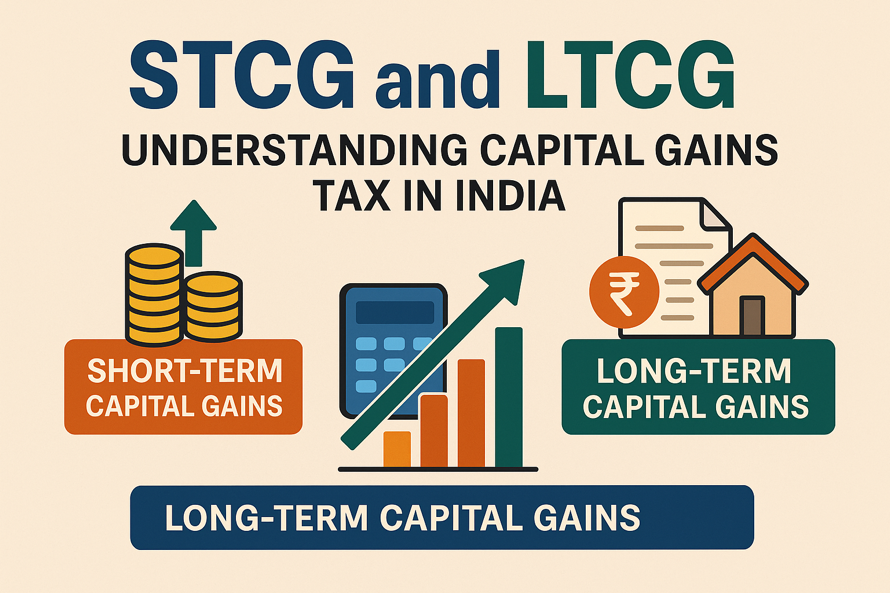
When you sell something valuable, a share, mutual fund units, property, or any capital asset, and you book a profit, that profit counts as a capital gain. In India, taxation of those gains falls into two main categories: Short-Term Capital Gains (STCG) and Long-Term Capital Gains (LTCG). Understanding STCG and LTCG matters to every investor, trader, and property owner because smart timing and asset selection can increase real, after-tax returns.
What are Capital Gains?
Capital gains arise when you transfer a capital asset for a value higher than your cost. Cost includes acquisition and improvement costs, as well as eligible transfer expenses. The gap between sale value and cost becomes your gain, which then falls under STCG or LTCG, depending on the asset class’s holding period.
“Start investing with confidence! Explore
0 demat account
and grow your wealth.”
Difference Between Short-Term and Long-Term Capital Gains
The holding period decides the capital gains category. Hold an asset within the short window and the gain becomes STCG; hold beyond the long-term threshold and the gain moves to LTCG. For listed equity and equity-oriented mutual funds (with STT paid), the threshold sits at 12 months.
Why Capital Gains Tax Matters for Investors
Taxes shape your take-home. A ₹5 lakh gain can feel very different after taxes, based on tenure and asset type. Clear awareness of STCG and LTCG helps you plan holding periods, switch tactics when required, and protect compounding.
What is STCG (Short-Term Capital Gains)?
Definition of STCG
STCG applies when you sell a capital asset within the short-term threshold. For listed equity shares and equity-oriented mutual funds with STT paid, that threshold is 12 months. For assets like real estate and many unlisted securities, the threshold is 24 months.
STCG Tax Rates for Equity Shares and Equity Mutual Funds
For listed equity shares and equity-oriented mutual funds where STT applies, STCG falls under Section 111A. As per the post-Budget 2024 changes effective from 23-07-2024, the rate stands at 20% plus applicable surcharge and cess.
STCG Tax Rates for Debt Funds, Real Estate, and Other Assets
For assets outside the Section 111A equity bucket, STCG is added to total income and is taxed at your slab rate.
When STCG is Applicable
Any sale inside the short-term holding window triggers STCG. For equity with STT: within 12 months. For property and many other assets: within 24 months.
What is LTCG (Long-Term Capital Gains)?
Definition of LTCG
LTCG applies when you sell an asset after the long-term threshold. For listed equity shares and equity-oriented mutual funds with STT, that means after 12 months. For property and many other assets, that means after 24 months.
LTCG Tax Rates for Equity Shares and Equity Mutual Funds
From 23-07-2024 onward, LTCG on listed equity and equity-oriented mutual funds (with STT) attracts 12.5% tax on gains above ₹1.25 lakh in a financial year, plus surcharge and cess. The threshold rose from ₹1 lakh to ₹1.25 lakh, and the rate moved from 10% to 12.5%.
LTCG Tax Rates for Debt Funds, Real Estate, and Other Assets
For many non-equity assets, policy changes simplified the structure. Property sold after 24 months now faces a 12.5% LTCG rate (plus surcharge and cess) without indexation for transactions on or after 23-07-2024. For property acquired before July 23, 2024, resident individuals and HUFs may choose between the new 12.5% rate without indexation and the older 20% rate with indexation, depending on which results in a lower tax liability.
Exemptions and Indexation Benefits
Historic rules allowed indexation for several long-term assets. Post-23-07-2024 changes shift this landscape for many categories, with indexation largely withdrawn for new transfers. Exemption routes still play a key role: Sections 54, 54F, and 54EC allow gains on eligible long-term assets (LTCG) to be avoided when reinvested in specified assets within prescribed timelines and instruments.
Key Differences Between STCG and LTCG
Holding Period Requirements
Listed equity and equity-oriented mutual funds reach long-term at 12 months; property and many other assets reach long-term at 24 months. Tenure decides the label and the rate.
Tax Rates and Exemptions
Section 111A equity STCG stands at 20%; equity LTCG stands at 12.5% above ₹1.25 lakh. Outside equity buckets, STCG applies slab rates, while LTCG often applies a flat rate (commonly 12.5% after the recent reforms), subject to asset-specific rules.
Impact on Different Asset Classes
Equity enjoys STT-linked concessions. Real estate enjoys reinvestment-based exemptions. Debt and other assets follow revised long-term regimes that emphasize flat rates over indexation in some cases.
Effect on Investment Strategy
Awareness of tenure and rate helps with better decisions: stretching a sale beyond the threshold can lift post-tax outcomes; planned reinvestment can unlock exemptions; and sequencing of disposals across financial years can optimize the annual equity LTCG threshold.
How to Calculate STCG and LTCG Tax
Example Calculation for Equity Shares
Assume you bought listed shares for ₹4 lakh on 15-07-2023 and sold them on 10-10-2023 for ₹6 lakh with STT paid. The holding period sits inside 12 months, so STCG applies. Tax equals ₹2 lakh × 20% = ₹40,000, plus surcharge and cess.
Change the date: sell on 20-08-2024 for ₹6 lakh. Now the holding period has crossed 12 months, so this becomes LTCG. If your total equity LTCG for the year equals ₹2 lakh, the first ₹1.25 lakh enjoys tax exemption, and the balance ₹75,000 attracts 12.5% tax = ₹9,375, plus surcharge and cess.
Example Calculation for Real Estate
Assume you bought a house for ₹50 lakh on 01-06-2022 and sold it on 10-09-2026 for ₹80 lakh. The holding period exceeds 24 months, so LTCG applies. Gain equals ₹30 lakh. For transfers on or after 23-07-2024, the rate equals 12.5%. Tax equals ₹3.75 lakh plus surcharge and cess. Exemptions may apply if you reinvest under Sections 54/54F/54EC within the timelines.
Role of Indexation in LTCG
Historically, indexation adjusted cost using the Cost Inflation Index. Recent tax reforms withdrew indexation for many long-term assets transferred on or after 23-07-2024 and shifted them toward flat-rate regimes.
Tax-Saving Strategies for Investors
Using Exemptions Under Section 54, 54F, and 54EC
Section 54 provides an exemption from long-term capital gains on the sale of a residential property if the proceeds are invested in a new residential house within the specified timeline. Section 54F applies when you reinvest net consideration from long-term assets (other than a residential house) into a residential house in India. Section 54EC offers specified bonds (such as NHAI/REC) for investing capital gains from property transfers within six months of the transfer, subject to caps and lock-in.
Tax-Loss Harvesting to Offset Gains
Short-term capital loss (STCL) can be set off against both STCG and LTCG.
Long-term Capital Loss (LTCL) can only be set off against long-term capital gains (LTCG), not STCG.
Choosing the Right Investment Horizon for Tax Efficiency
A clear investment horizon brings clarity on tax. Equity holdings that cross 12 months qualify for concessional LTCG treatment and the annual equity LTCG threshold. Property held beyond 24 months qualifies for long-term status and access to property-linked exemptions.
Recent Updates in STCG and LTCG Rules (2025)
Latest Budget Announcements Affecting Capital Gains
Budget 2024 reshaped equity capital gains: equity STCG moved to 20%; equity LTCG moved to 12.5%, and the equity LTCG threshold rose to ₹1.25 lakh per financial year. For several non-equity assets, long-term regimes moved toward flat rates with indexation largely withdrawn for new transfers from 23-07-2024.
Impact on Retail and Institutional Investors
Retail investors now plan disposals around the 12-month equity line and the ₹1.25 lakh equity LTCG threshold. Property sellers weigh Section 54/54F/54EC paths more proactively. Institutions adjust models for revised rates and book positions with a closer eye on post-tax alpha.
Conclusion – Optimizing Investments with STCG and LTCG Awareness
STCG and LTCG determine real returns from your investments. With a firm grip on holding-period thresholds, rate slabs, exemption windows, and the post-July-2024 framework, investors can choose the right exit month, harvest losses at the right time, and route gains through eligible reinvestments.
FAQs
Q. What is the difference between STCG and LTCG in simple terms?
STCG applies to gains from assets sold within the short-term window; LTCG applies to gains from assets sold after the long-term window. Each path uses different rates and, for a few assets, specific reliefs.
Q. What is the tax rate on STCG for equity mutual funds?
For equity-oriented mutual funds with STT sold within 12 months, STCG applies at the rate of 20% under Section 111A, plus surcharge and cess.
Q. How much LTCG is tax-free in India?
For listed equity and equity-oriented mutual funds with STT, ₹1.25 lakh of long-term gains per financial year is exempt; capital gains above that amount are subject to 12.5% plus surcharge and cess.
Q. Can STCG be set off against LTCG?
Short-term capital losses can offset both short-term and long-term gains. Long-term capital losses typically offset long-term capital gains.
Disclaimer
The stocks mentioned in this article are not recommendations. Please conduct your own research and due diligence before investing. Investment in securities market are subject to market risks, read all the related documents carefully before investing. Please read the Risk Disclosure documents carefully before investing in Equity Shares, Derivatives, Mutual fund, and/or other instruments traded on the Stock Exchanges. As investments are subject to market risks and price fluctuation risk, there is no assurance or guarantee that the investment objectives shall be achieved. Lemonn (Formerly known as NU Investors Technologies Pvt. Ltd) do not guarantee any assured returns on any investments. Past performance of securities/instruments is not indicative of their future performance.
Related Posts



Download Lemonn
Download my app for share market trading, ipo investment, trading account, and all your investment needs.



