How to Know Your Demat Account Number: A Guide
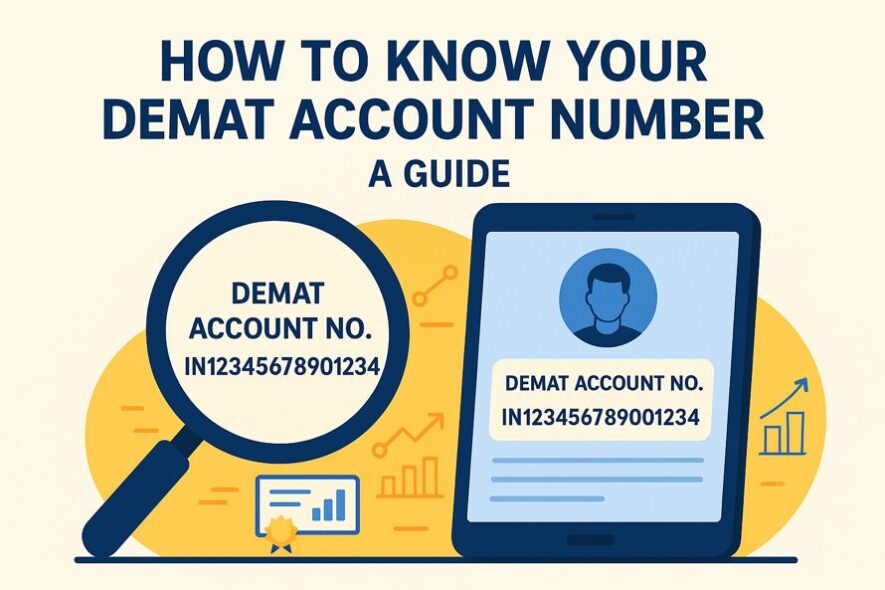
What is a Demat Account Number?
A Demat account number serves as your unique identifier for holding stocks. It allows you to hold securities like stocks, mutual funds, and more in electronic form. It’s similar to your bank account number. While a bank account number helps you hold your cash, you can hold shares, bonds, ETFs, and other investments in a demat account. Every time you buy or sell shares, this number comes into play. It links your profile to the depository system.
This number is created when you open a Demat account with a broker registered under NSDL or CDSL. Think of it as your access point to India’s stock market in digital form. Without this number, you can’t settle trades, transfer shares, or track your portfolio.
Demat vs Trading Account: Key Differences
A Demat account holds your shares in electronic form. A trading account lets you buy and sell them. Both accounts work together, but they serve different purposes.
When you place an order to buy stocks, your trading account executes the trade. Once the transaction is complete, the shares are credited to your Demat account. Selling follows the reverse. Your trading account connects you to the market. Your Demat account keeps your holdings safe.
“Start investing with confidence! Explore
0 demat account
and grow your wealth.”
Format of a Demat Account Number
Your Demat account number has a fixed format based on your depository.
If your account is with NSDL, your number starts with “IN” followed by 14 digits.
Example: IN30242012345678
If it’s with CDSL, your number is a straight 16-digit numeric code.
Example: 1234567890123456
This number stays the same even if you use multiple platforms under one broker.
DP ID vs Client ID Explained
Your full Demat number is a combination of:
- DP ID: Assigned to your broker or Depository Participant
- Client ID: Assigned to you as the investor
In NSDL accounts, the DP ID is the first 8 characters, and the Client ID is the last 8.
In CDSL accounts, the 16-digit number acts as a full identifier, where DP and Client IDs are stored internally.
Methods to Find Your Demat Account Number
Through Welcome Email/SMS from Depository Participant
When you open your Demat account, you receive a welcome email or an SMS from your broker. This email or SMS contains all information about your demat account. This includes your DP name, DP ID, Client ID, and your full Demat account number.
Just type phrases like “Demat account details,” “NSDL,” “CDSL,” or your broker’s name in the search bar, and you will find your demat account number here. Most platforms also send a soft copy of your client master report (CMR), which clearly shows your Demat number.
Via Broker’s Trading Platform or App
Log in to your broker’s app or web dashboard. Head to your Profile, Account Settings, or Demat Details section. Most platforms show the Demat number next to your PAN, linked bank, and other KYC details.
For example:
- Lemonn → Login > Profile icon > Account details
- Zerodha → Console > Account > Demat
- Groww → You > Personal Details > DP Information
- Angel One → Menu > My Profile > DP Details
Every broker puts it under a different label, but it’s always there.
Checking Your Account Statement
Monthly or quarterly account statements sent by NSDL or CDSL mention your Demat number at the top. These PDFs include holdings, ISINs, and transaction records. If you’ve subscribed to e-statements, check your registered email.
For physical statements, look near the top right—your Demat number appears with your name and PAN.
Calling Customer Support of Your Broker
If you can’t locate your account details online, call your broker’s customer care. Provide your registered mobile number, PAN, and date of birth for verification. They’ll share your Demat number or resend your welcome kit.
Always call the official helpline listed on your broker’s website or mobile app.
Logging in to NSDL or CDSL Portal
You can also log in directly to the depository websites:
- NSDL e-CAS: https://nsdlcas.nsdl.com
- CDSL Easi: https://web.cdslindia.com/myeasi/
Use your PAN, date of birth, and OTP for login. Once inside, you can download your CAS (Consolidated Account Statement), which shows your Demat number and holdings across platforms.
How to Identify Whether You Are with NSDL or CDSL
Prefix Codes: INXXXXXXXX (NSDL) vs 16-digit (CDSL)
Just by looking at your Demat number, you can tell your depository:
- Starts with IN → You’re with NSDL
- Pure 16-digit number → You’re with CDSL
This small identifier helps when filling forms, checking eligibility for IPOs, or updating KYC. Always use the correct format based on your depository.
Using Depository Participant Name as a Hint
Your broker’s backend systems also give it away. For example:
- NSDL is preferred by full-service brokers like ICICI Direct, Kotak, and HDFC Securities.
You can also check your Client Master Report (CMR). It clearly states whether your account is under NSDL or CDSL.
Common Issues and Troubleshooting
Forgotten Login Credentials
If you forget your login ID or password for your broker’s app or the NSDL/CDSL portal, use the “forgot” option. Most systems send OTP to your registered mobile and email to reset access in minutes.
Once you’re in, you’ll see your Demat number under account info or profile.
Mistaking Trading Account Number for Demat Number
Some investors confuse their trading account ID with their Demat number. Your trading ID is used to log in and place orders. Your Demat number is linked to the backend, where shares are credited.
Always cross-check the format. If it starts with “IN,” it’s your Demat number. If it looks like an email or short alphanumeric ID, that’s your trading account.
Broker Merger or Platform Migration Confusions
If your broker merges with another or shifts platforms, your Demat number stays the same in most cases. However, you might get new login credentials or a new app interface.
In such cases, check your email or login to the updated platform. Look under profile settings or DP information to reconfirm your Demat details.
Tips to Keep Your Demat Account Information Secure
Avoid Sharing Credentials
Never share your Demat number, PAN, or login details with anyone. Even if someone claims to be from your broker or exchange, keep your credentials private.
Use Strong Passwords for Apps
Set a strong password for your trading and Demat platform—avoid birthdates or simple patterns. Update it every few months. Also, log out after use, especially if you access your account from shared devices.
Enable Two-Factor Authentication
Always turn on 2FA in your broker’s app. This adds an extra layer of security. You’ll need OTPs or app-based approvals every time you log in or initiate a fund transfer. Most brokers allow 2FA setup via email, SMS, or authenticator apps.
Conclusion
Your Demat account number is the gateway to your investment life. You can use it to hold, transfer, and track your securities. You can use it to apply for IPOs, claim dividends, and even check your stock portfolio. Everything here traces back to your demat account number.
So, it’s very important that you keep track of your demat account number. And even if you have forgotten or don’t know it, this guide has provided enough information to get it.
Once you get it, make sure you save it and keep it safe. Every long-term wealth journey in the markets begins with knowing your Demat number.
FAQs:
How can I find my Demat account number in Zerodha/Groww/Upstox?
Go to your broker app or website → Profile or Account section → Look for “DP details” or “Demat details.” You’ll see your full 16-digit number if it’s CDSL, or an IN+14-digit format if NSDL. You can also locate it on your Client Master Report (CMR) received during onboarding.
Can I have multiple Demat account numbers?
Yes. You can open separate Demat accounts with different brokers. Each one will have its own unique Demat number, but all can be linked to the same PAN.
Is my PAN number linked to my Demat account?
Yes. Every Demat account is directly linked to your PAN. It’s used for verification, KYC, and compliance across trading platforms and depositories.
What’s the difference between a DP ID and a Demat account number?
The DP ID identifies your broker (Depository Participant), while the full Demat number includes both DP ID and your personal client ID. Together, they form your unique investor identity.
How long does it take to get a Demat account number after opening an account?
Usually, within 24 to 48 hours after full KYC verification. Once activated, you’ll receive the Demat number via email or inside your broker dashboard.
Can I trade without knowing my Demat account number?
Yes. Most platforms handle backend processes. But for IPOs, pledging shares, or filling KYC forms, you’ll need to access your Demat number.
Is the Demat account number the same as the client ID?
Not exactly. In NSDL, the client ID is part of your full Demat number. In CDSL, the 16-digit Demat number represents both client and DP identity in one.
Disclaimer
The stocks mentioned in this article are not recommendations. Please conduct your own research and due diligence before investing. Investment in securities market are subject to market risks, read all the related documents carefully before investing. Please read the Risk Disclosure documents carefully before investing in Equity Shares, Derivatives, Mutual fund, and/or other instruments traded on the Stock Exchanges. As investments are subject to market risks and price fluctuation risk, there is no assurance or guarantee that the investment objectives shall be achieved. Lemonn (Formerly known as NU Investors Technologies Pvt. Ltd) do not guarantee any assured returns on any investments. Past performance of securities/instruments is not indicative of their future performance.
Related Posts


Download Lemonn
Download my app for share market trading, ipo investment, trading account, and all your investment needs.