What is a Consolidated Account Statement (CAS) and Why Investors Need It
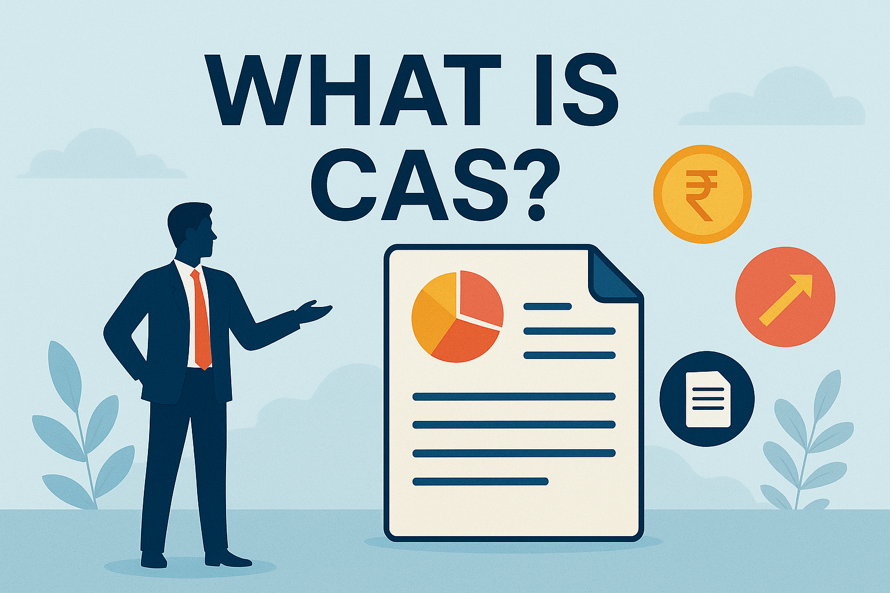
People of all income levels choose mutual funds as their main investment option. However, you also need to keep track of your investments to ensure that they meet your goals and standards. This is where the CAS (Consolidated Account Statement) comes in. Investors have the option of using a consolidated account statement to monitor their investments seamlessly. This blog post will explain what is CAS and why investors need it.
Understanding the Consolidated Account Statement (CAS)
When investing in various financial tools, such as mutual funds, a Consolidated Account Statement (CAS) displays all of an investor’s transactions. Furthermore, it provides a single report of all your investments, making it easier to keep and manage your portfolio.
Definition and Purpose of CAS
Under a single PAN, a Consolidated Account Statement (CAS) shows all of your mutual fund investments, independent of mutual fund companies. Monthly releases allow investors to monitor and examine their purchases, returns, and holdings without consulting many records. For tax reasons, financial planning, and regulatory compliance, this unified documentation is vital.
“Start investing with confidence! Explore
0 demat account
and grow your wealth.”
Why CAS Was Introduced: Regulatory Background
To enable simpler investor reporting of stocks and investments, SEBI introduced the CAS. Earlier, investors kept several records with many fund companies and depositories, which made asset management difficult. The CAS solves this by aggregating all the data into a single document, therefore simplifying access and increasing openness.
What Information Does a CAS Include?
Investors need this document, so knowing what is CAS is crucial as it provides all the information they need regarding purchasing, selling, and other operations in a mutual fund. Moreover, this provides investors with the necessary knowledge to monitor mutual fund performance.
Financial Transactions and Portfolio Summary
Including dividend distributions, swaps, redemptions, and acquisitions, the CAS offers a comprehensive picture of all financial activity. It also displays the portfolio’s current value of investments, the quantity of each plan owned, and their combined performance.
Asset Classes Covered in CAS
The CAS includes a range of asset classes, such as:
- Corporate bonds and debentures
- Equity shares
- Government securities
- Money market instruments
- Mutual fund units
- Preference shares
- Securitized instruments
- Sovereign gold bonds
This extensive coverage ensures that investors have a complete understanding of their investments.
What’s Excluded from CAS
The CAS provides extensive information, but it does not include several investments, such as:
- Bank fixed deposits
- Insurance policies
- National Savings Certificates (NSCs)
- Physical holdings of securities
- Public Provident Fund (PPF) accounts
For these assets, investors should look at separate statements.
CAS Issuance and Delivery: What Investors Should Know
An explanation of what is CAS, its frequency, formats, and security is provided to investors via the issuing and distribution of CAS. Therefore, investors must stay informed about options for email communication, password-protected digital access, and monthly or semi-annual delivery.
Monthly, Half-Yearly, and Annual CAS Timelines
The system produces and dispatches the CAS based on the activities in an investor’s account:
- Monthly CAS: Issued if there are any transactions in the mutual fund folios or Demat account throughout the month.
- Half-Yearly CAS: Every six months, usually in April and October, a CAS with holding data is delivered if there are no transactions in any of the accounts.
- Annual CAS: An annual statement detailing the year’s activities and assets is also given.
Electronic vs Physical CAS Formats
Investors have the option of receiving the CAS in a physical or electronic format:
- Electronic CAS (e-CAS): Delivered via email, giving quick access and minimizing paper usage.
- Physical CAS: Sent through the postal service for investors who demand hard copies.
You can amend the format selection by contacting the relevant mutual fund or depository institution.
Password Protection and Data Security
Electronic CAS documents protect data security with password protection. The investor uses their PAN and date of birth to create the password. Moreover, this method protects confidential financial details from unwanted access.
Key Features of NSDL CAS
NSDL CAS demonstrates what is CAS by providing features such as asset-wise categorization, graphical portfolio views, interactive PDFs, and integrated demographic data. Therefore, these elements help investors effectively manage and understand their assets.
Asset-Wise Classification and Graphical Portfolio View
The NSDL CAS offers a whole range of assets by grouping investments based on asset classifications and plans. It also provides graphical displays of the portfolio, allowing investors to see how their assets are distributed and performing.
Demographic Data Integration
The document offers the demographic details of the investor, including name, address, and phone number. This link guarantees that, on all investing platforms, personal information is current and consistent.
Interactive PDF Features and Benefits
Acting as an interactive PDF, NSDL’s CAS enables investors to rapidly access various sections. Furthermore, improving the user experience and encouraging a deeper understanding of the investment portfolio are key elements, such as hyperlinks to scheme information and in-built analytical tools.
How to Manage Your CAS Preferences
Knowing what is CAS helps investors to make their choices better. This entails switching the default depository and altering their contact details or email address. Furthermore, the option to opt out of distribution is included, ensuring their investment records are accurate and up-to-date.
Changing the Default Depository
Investors may request a change in their default depository (NSDL or CDSL) by means of their Depository Participant (DP). This upgrade will thus influence which depository stores and distributes the CAS.
Address and Email Preferences
Owners should get in touch with their designated point of contact (DP) or specific mutual fund companies to modify their address or email preferences. Thus, the timely delivery of the CAS depends on furnishing accurate contact information.
Opting Out of CAS Delivery
Investors who wish to opt out of receiving the CAS can formally request this by contacting their mutual fund company or designated person (DP). To gain a consolidated perspective on investments, it is essential to update the CAS continually.
Advantages of Using CAS for Portfolio Management
Understanding what is CAS facilitates your appreciation of its benefits. These advantages include faster tracking of your assets, greater transparency, and a consistent view of your portfolio. This helps owners to handle their money and make wise judgments properly.
Simplified Investment Tracking
Investors can easily monitor their portfolios and ensure their latest data on all of their assets by using CAS. Moreover, fast access to knowledge helps to optimize general investment strategies and speeds up decision-making.
Enhanced Transparency Across Platforms
CAS enhances openness as it logs every transaction completely. This also helps investors to check their activities and guarantees adherence to rules set by SEBI, therefore building trust in financial reporting.
Unified View for Better Financial Decisions
Investors can make more informed investment decisions by using the consolidated mutual fund statement, which provides detailed information about a fund house’s or organization’s performance, financial status, and overall position.
Conclusion
You can easily monitor your investment portfolio using the Consolidated Account Statement (CAS). Therefore, understanding what is CAS allows you to monitor performance, make well-informed investment choices, and expedite your tax filing process by knowing how to access, analyze, and use the data it provides. Moreover, periodically examine your CAS to stay informed about your assets and identify any possible inconsistencies. As always, consider speaking with a financial counsellor for personalized help with your assets.
FAQs
Q. What is a Consolidated Account Statement (CAS)?
A Consolidated Account Statement (CAS) provides a comprehensive overview of all your mutual fund investments from various fund companies. Moreover, for effective investment tracking, it contains transaction information, current holdings, and portfolio value.
Q. How often is CAS generated and sent?
If the investor’s accounts have any transactions, the CAS is produced each month. Therefore, a statement is delivered every six months, usually between April and October, if there are no transactions.
Q. Which investments are included in CAS?
Mutual funds, preference shares, corporate bonds, and debentures make up the CAS. Further, securitized instruments, money market instruments, government securities, and sovereign gold bonds held in Demat form also contribute to it.
Q. Can I receive my CAS via email?
Yes, by changing their settings with their mutual fund companies or Depository Participant, investors may choose to get the CAS online by email.
Q. Is it mandatory to receive a CAS?
Even though you don’t have to obtain the CAS, you should because it provides a more comprehensive view of your investments and facilitates easier portfolio management.
Q. How do I change my CAS delivery preferences?
Investors can customize how they want their CAS to be delivered by contacting their Depository Participant or mutual fund houses and making the necessary requests.
Q. What if I have multiple demat accounts?
When all Demat accounts link to the same PAN, the CAS consolidates the information from these accounts into a single statement.
Q. Is CAS available for postal savings schemes too?
No, the CAS doesn’t provide details about investments in postal savings schemes.
Disclaimer
The stocks mentioned in this article are not recommendations. Please conduct your own research and due diligence before investing. Investment in securities market are subject to market risks, read all the related documents carefully before investing. Please read the Risk Disclosure documents carefully before investing in Equity Shares, Derivatives, Mutual fund, and/or other instruments traded on the Stock Exchanges. As investments are subject to market risks and price fluctuation risk, there is no assurance or guarantee that the investment objectives shall be achieved. Lemonn (Formerly known as NU Investors Technologies Pvt. Ltd) do not guarantee any assured returns on any investments. Past performance of securities/instruments is not indicative of their future performance.
Related Posts


Download Lemonn
Download my app for share market trading, ipo investment, trading account, and all your investment needs.