The Adani Empire: How One Family Is Reshaping India’s Economic Future
Introduction: From Trader to Titan
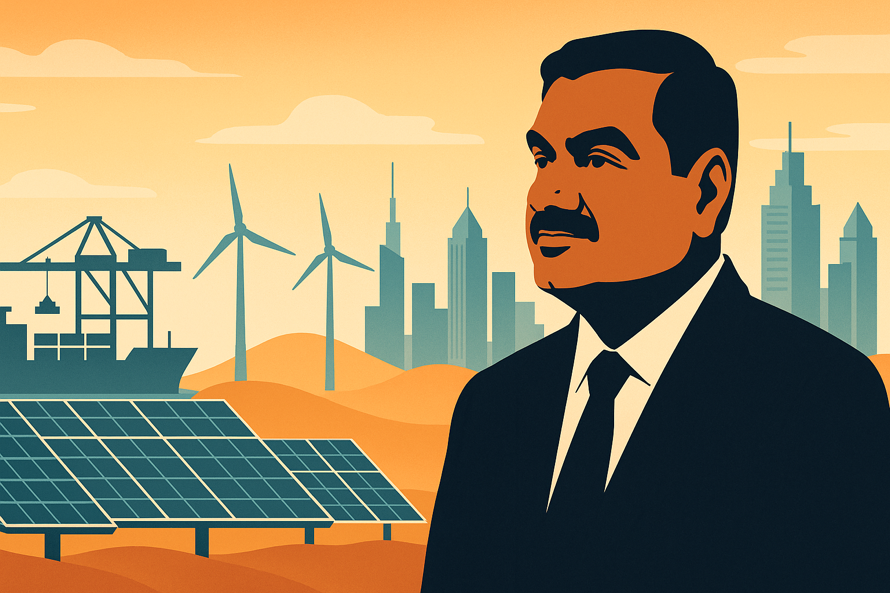
In less than four decades, the Adani Group has grown from a modest commodity trading firm into one of India’s most powerful conglomerates. At the heart of this transformation is Gautam Adani—visionary entrepreneur, infrastructure builder, and one of Asia’s wealthiest individuals. But behind the business success lies a deeper story: of generational planning, strategic alliances, and a tightly woven family network that fuels a $213 billion empire.
Building Blocks: How Adani Capitalized on India’s Infrastructure Boom
The Adani story begins in 1988 with a simple export business. But a pivotal moment came in 1995, when the group launched Mundra Port—now India’s largest private port. This wasn’t just a business decision; it was a strategic move that aligned perfectly with India’s infrastructure needs at the time.
By 2025, Adani’s reach spans across:
- Energy & Utilities: Largest private players in both renewable (Adani Green) and thermal power (Adani Power).
- Ports & Logistics: Dominance through APSEZ with 10 ports across India.
- Cement: Massive $10.5B acquisition of Ambuja & ACC in 2022.
- Airports: Largest private airport operator in India.
- Digital & Data: Building hyperscale data centers and a consumer super app.
What ties it all together? Vertical integration. Adani owns the supply chain—from mining coal to running the ports that ship it, and from generating electricity to powering its own operations.
“Start investing with confidence! Explore
share market
and grow your wealth.”
The Family Engine: A Dynasty in the Making
The Adani Group isn’t just a corporation; it’s a family-run engine of economic power.
Key Figures:
- Gautam Adani – Chairman, strategist, and builder of the empire.
- Karan Adani – Oversees ports, logistics, and cement; married into the legal powerhouse family of Cyril Shroff.
- Jeet Adani – Leads digital and airports; developing a super app and engaged to a diamond trading heiress.
- Pranav & Sagar Adani – Nephews managing real estate, gas, and green energy initiatives.
This next-gen leadership isn’t accidental. With Ivy League and global business degrees, each family member is positioned in a high-growth sector, signaling a sophisticated succession plan. Each will hold equal stakes in the family trust, ensuring shared power and long-term stability.
Navigating Controversy: The Hindenburg Fallout
In January 2023, Hindenburg Research accused the Adani Group of stock manipulation and financial irregularities. The market response was swift and brutal—over $150 billion in market cap was wiped out. Gautam Adani’s net worth plummeted from $120B to $48B within weeks.
But resilience followed:
- The Supreme Court of India dismissed calls for a government-led probe.
- Strategic ally Mukesh Ambani’s Reliance reportedly bought Adani shares to stabilize the group.
- Adani’s stocks rebounded, and by May 2025, his net worth had climbed back to over $60B.
Rather than retreat, the group doubled down on growth, reinforcing its image as a “nation builder” aligned with India’s economic goals.
The Other Side of the Coin: Influence, Power, and Criticism
Adani’s dominance isn’t without concern. Critics warn of:
- Market concentration in ports, logistics, and green energy.
- Political proximity, especially with Prime Minister Narendra Modi, raising questions of favoritism.
- Sustainability paradox: Despite leading in renewables, the group still invests heavily in coal.
These dynamics raise critical debates about fair competition, regulatory oversight, and corporate power in India’s democracy.
Corporate Citizenship: Doing Good While Doing Business
The Adani Foundation, chaired by Priti Adani, plays a central role in building public trust. Its work spans:
- Education for over 27,000 students
- Healthcare via mobile clinics and hospitals
- Livelihood support for 50,000+ farmers
- Disaster relief, sports programs, and rural infrastructure
This isn’t just CSR—it’s social infrastructure that supports the group’s social license to operate, especially in regions where large-scale industrial projects face public scrutiny.
What’s Next: Future-Proofing the Adani Empire
Gautam Adani plans to retire by 70, passing the reins to the next generation. With each heir managing a major vertical, the family is ensuring continuity without centralized dependency. This kind of foresight is rare in family-run businesses, many of which struggle with succession chaos.
Future bets include:
- Creating the world’s largest renewable energy park
- Scaling India’s airport network
- Launching a consumer super app for digital dominance
- Driving urban transformation with mega-projects like Dharavi redevelopment
Key Takeaways
- Adani Group is India’s most vertically integrated conglomerate, with presence across energy, logistics, digital, and infrastructure.
- Strategic succession planning and family grooming are central to its continuity.
- Despite major controversy, the group bounced back—thanks to deep financial roots, political savvy, and operational strength.
- The group’s CSR initiatives build long-term goodwill, essential for operating in sensitive areas.
- The Adani dynasty will continue to shape not just markets, but the future of India’s economic development.
FAQs
How did the Adani Group start?
It began in 1988 as a commodity trading firm and later diversified into ports, energy, and logistics.
What was the Hindenburg controversy?
In 2023, Hindenburg Research accused Adani of stock manipulation and fraud, leading to a massive stock crash. The group recovered most of its market value within a year.
Who are the future leaders of the Adani Group?
Karan, Jeet, Pranav, and Sagar Adani—all trained abroad and leading different verticals—are set to take over leadership by the 2030s.
Is the Adani Group involved in green energy?
Yes, through Adani Green Energy, it’s building large-scale solar and wind projects while still investing in traditional energy like coal.
Disclaimer
The stocks mentioned in this article are not recommendations. Please conduct your own research and due diligence before investing. Investment in securities market are subject to market risks, read all the related documents carefully before investing. Please read the Risk Disclosure documents carefully before investing in Equity Shares, Derivatives, Mutual fund, and/or other instruments traded on the Stock Exchanges. As investments are subject to market risks and price fluctuation risk, there is no assurance or guarantee that the investment objectives shall be achieved. Lemonn (Formerly known as NU Investors Technologies Pvt. Ltd) do not guarantee any assured returns on any investments. Past performance of securities/instruments is not indicative of their future performance.
Related Posts


Download Lemonn
Download my trading app for SIP, demat account services—get a free demat account with our demat apps.