How to Read a DRHP Before Applying for an IPO
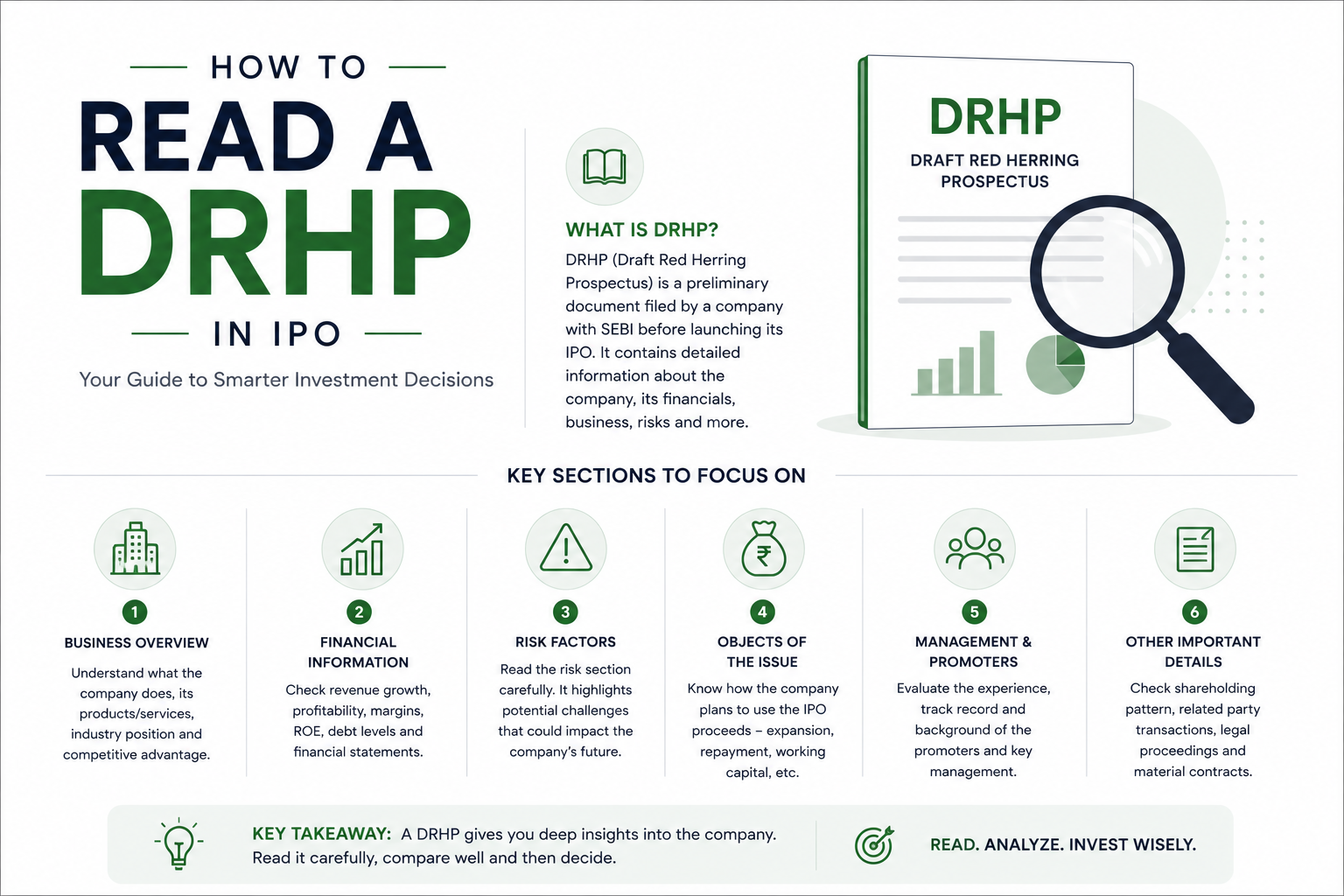
A Draft Red Herring Prospectus (DRHP) is one of the most useful documents to read before applying for an IPO in India. It explains the company’s business, financials, risks, promoters, use of IPO proceeds, legal proceedings, and other information that can help you evaluate the offer.
You do not need to read every page from start to finish. For most retail investors, the smarter approach is to focus on a few high-value sections, cross-check the numbers, and look for risks that could materially affect the business after listing.
What Is a DRHP?
A Draft Red Herring Prospectus, or DRHP, is an offer document filed with the Securities and Exchange Board of India (SEBI) before a company launches a public issue.
Think of it as the company’s detailed pre-IPO disclosure document.
A DRHP can contain hundreds of pages covering areas such as:
- Business operations
- Industry overview
- Risk factors
- Financial statements
- Promoters and management
- IPO objectives
- Outstanding litigation
- Related-party transactions
- Capital structure
- Material contracts
It provides prospective investors with considerably more information than an IPO advertisement, a social media discussion, or a grey market premium.
However, a DRHP is still a draft document. Details can change before the IPO opens.
DRHP vs RHP: What Is the Difference?
DRHP and RHP are related, but they are not the same document.
An RHP, or Red Herring Prospectus, is filed closer to the public issue and contains updated information about the offer.
| DRHP | RHP |
|---|---|
| Draft offer document | Updated offer document |
| Filed earlier in the IPO process | Filed closer to the IPO |
| Used during SEBI’s review process | Used when the public issue is approaching |
| Some offer details may not yet be final | Contains more current issue information |
| Useful for early research | More relevant for the final apply-or-skip decision |
If you are deciding whether to apply for an IPO, read the latest RHP as well. Do not rely solely on an older DRHP if more recent disclosures are available.
Where Can You Find an IPO’s DRHP?
You can generally find IPO offer documents through:
- SEBI’s website
- The company’s website
- Stock exchange websites
- Websites of the issue’s merchant bankers or book-running lead managers
Use the official filing rather than relying on a third-party summary.
An IPO summary can show that revenue grew by 30%. The DRHP or RHP can help you understand why it grew, whether profits followed, how much debt the company carries, and what risks management itself is required to disclose.
How to Read a DRHP Before Applying for an IPO
If a DRHP is 400 or 500 pages long, reading from page 1 to the last page is rarely the most efficient approach for a retail investor.
Start with these sections:
- Risk factors
- Business overview
- Objects of the offer
- Financial information
- Management and promoters
- Capital structure
- Related-party transactions
- Outstanding litigation
- Industry information
- Offer details
Then use keyword searches within the PDF for terms such as debt, litigation, promoter, related party, customer, supplier, contingent liability, negative cash flow, regulatory, default, and proceedings.
1. Start With the Risk Factors
The Risk Factors section is one of the first places you should go.
Companies are required to disclose material risks associated with their business and the offering. These can range from ordinary industry risks to issues that could seriously affect future earnings.
Look for risks involving:
- Dependence on a small number of customers
- Dependence on key suppliers
- Regulatory approvals
- Outstanding litigation
- High debt
- Negative cash flows
- Geographic concentration
- Dependence on promoters or key executives
- Foreign exchange exposure
- Raw material price volatility
- Intellectual property disputes
- Past regulatory action
Do not panic simply because the section is long. IPO documents are supposed to contain detailed risk disclosures.
Instead, ask:
Which risks could materially damage revenue, profit, cash flow, or the company’s ability to operate?
Look for Customer Concentration
Suppose a company earns:
- 38% of revenue from its largest customer
- 61% from its top five customers
That concentration deserves attention.
Losing one large customer could materially affect revenue even if the company’s overall industry is growing.
Compare concentration across multiple financial years. A falling percentage can indicate diversification, while a rising percentage of dependence warrants a closer look.
2. Understand What the Company Actually Does
Next, read the Our Business or equivalent business overview section.
By the end of it, you should be able to explain in simple language:
- What does the company sell?
- Who pays it?
- How does it make money?
- What are its major costs?
- Where does it operate?
- Who are its customers?
- What gives it an advantage over competitors?
- What could disrupt its business?
If you cannot explain how the company makes money after reading the section, be cautious about investing solely on IPO hype.
Look Beyond the Company’s Strengths
DRHPs typically include sections that describe competitive strengths.
These can be useful, but remember that they are the issuer’s description of its own advantages.
If the document says the company has a “strong market position,” look for evidence.
For example:
- Market share
- Customer retention
- Distribution reach
- Manufacturing capacity
- Brand recognition
- Revenue growth
- Margins
- Return ratios
Prefer measurable evidence over adjectives.
3. Check Why the Company Is Raising Money
The Objects of the Offer section tells you what the IPO is intended to accomplish.
This is one of the most important parts of a DRHP.
An IPO can contain:
- Fresh issue
- Offer for Sale (OFS)
- Or a combination of both
These structures have very different implications.
What Is a Fresh Issue?
In a fresh issue, the company issues new shares and receives the proceeds after applicable issue expenses.
The money may be used for:
- Repaying debt
- Building manufacturing facilities
- Capital expenditure
- Working capital
- Acquisitions
- Investment in subsidiaries
- General corporate purposes
Suppose a company raises ₹1,000 crore through a fresh issue and plans to use ₹600 crore to repay borrowings.
That could reduce interest costs and strengthen its balance sheet.
But you still need to ask why the company accumulated that debt and whether the underlying business generates enough cash.
What Is an Offer for Sale?
In an Offer for Sale, existing shareholders sell their shares.
The proceeds from those shares go to the selling shareholders, not to the company.
For example:
₹1,000 crore IPO
- ₹300 crore fresh issue
- ₹700 crore OFS
Only the fresh issue portion represents new capital raised by the company, before relevant expenses.
The ₹700 crore OFS allows existing shareholders to sell part of their holdings.
Is a Large OFS a Red Flag?
Not automatically.
Promoters, private equity funds, venture capital investors, and other shareholders may use an IPO to partially exit after holding an investment for years.
Instead of treating every OFS as negative, ask:
- Who is selling?
- How much are they selling?
- What will their ownership be after the IPO?
- Is the promoter significantly reducing exposure?
- Is the company itself receiving enough capital for its stated needs?
Context matters more than the existence of an OFS.
4. Read the Financial Statements
Next, move to the financial information.
At minimum, compare the company’s performance across the available historical periods.
Focus on:
- Revenue
- EBITDA or operating profit, where relevant
- Profit after tax (PAT)
- Operating cash flow
- Total borrowings
- Net worth
- Earnings per share
- Trade receivables
- Inventory
- Contingent liabilities
Do not judge an IPO using revenue growth alone.
Check Revenue Growth
Suppose revenue looks like this:
| Financial year | Revenue |
|---|---|
| FY1 | ₹800 crore |
| FY2 | ₹1,050 crore |
| FY3 | ₹1,400 crore |
That is strong top-line growth.
Now compare profit:
| Financial year | PAT |
|---|---|
| FY1 | ₹80 crore |
| FY2 | ₹82 crore |
| FY3 | ₹85 crore |
Revenue has grown substantially faster than profit.
That should lead to another question:
Why are margins not improving with scale?
Possible explanations include rising raw material costs, employee expenses, marketing expenditure, finance costs, or competitive pricing pressure.
Check Profit Margins
A simple net profit margin calculation is:
Net profit margin = PAT ÷ Revenue × 100
If PAT is ₹100 crore on revenue of ₹1,000 crore:
₹100 crore ÷ ₹1,000 crore × 100 = 10%
Track this over multiple years.
Rising revenue with falling margins can indicate that growth is becoming more expensive.
5. Compare Profit With Cash Flow
One of the most useful checks in a DRHP is comparing reported profit with cash flow from operating activities.
A company can report accounting profits without generating equivalent cash.
For example:
| Year | PAT | Operating cash flow |
|---|---|---|
| FY1 | ₹100 crore | ₹92 crore |
| FY2 | ₹130 crore | ₹55 crore |
| FY3 | ₹160 crore | -₹20 crore |
Profits look excellent.
Cash generation looks much weaker.
This does not automatically mean something is wrong, but it demands investigation.
Why Can Profit and Cash Flow Differ?
Common reasons include:
- Customers taking longer to pay
- Inventory accumulation
- Changes in working capital
- Supplier payment timing
- Rapid business expansion
- Accounting adjustments
Search the financial statements and management discussion for the explanation.
Repeatedly negative operating cash flow alongside rising accounting profits deserves particularly close attention.
6. Check the Company’s Debt
Look at total borrowings and finance costs.
Then ask:
- Is debt increasing or decreasing?
- How much debt is short-term?
- What interest rate does the company pay?
- Is IPO money being used to repay borrowings?
- Has the company previously defaulted or delayed payments?
- Does operating cash flow comfortably support debt obligations?
Debt itself is not automatically bad.
A manufacturing business may reasonably use more debt than an asset-light software company. Compare leverage with businesses that have similar economics.
Useful Debt Ratios
One commonly used metric is:
Debt-to-equity = Total debt ÷ Shareholders’ equity
Suppose:
- Debt = ₹500 crore
- Equity = ₹1,000 crore
Debt-to-equity is:
0.5x
Do not evaluate this ratio in isolation. Industry norms and the company’s ability to service its debt matter.
7. Examine Promoters and Management
An IPO means you are buying into a business run by real people.
Read the sections covering:
- Promoters
- Directors
- Key managerial personnel
- Senior management
- Promoter group
Look at their:
- Experience
- Educational and professional background
- Other directorships
- Compensation
- Shareholdings
- Past businesses
- Regulatory or legal disclosures
Check Promoter Ownership Before and After the IPO
A significant reduction in promoter ownership is not automatically negative, but you should understand why it is happening.
Compare:
Pre-IPO promoter holding → Post-IPO promoter holding
Also check whether promoter shares are pledged or otherwise encumbered where such disclosures are applicable.
8. Look Closely at Related-Party Transactions
A related-party transaction occurs when the company conducts business with parties connected to promoters, directors, subsidiaries, associates, or other related entities.
These transactions can be legitimate.
What matters is their scale, nature, and terms.
Look for:
- Sales to promoter-linked companies
- Purchases from related entities
- Loans or advances
- Guarantees
- Property transactions
- Management or service fees
- Large payments to related businesses
Then compare the amounts with total revenue, expenses, assets, or profits.
A ₹5 crore related-party transaction means something very different for a ₹50 crore company than for a ₹50,000 crore company.
9. Check Outstanding Litigation and Regulatory Issues
Do not skip the Outstanding Litigation and Material Developments section.
Look for proceedings involving:
- The company
- Promoters
- Directors
- Subsidiaries
- Group companies, where disclosed
Pay attention to:
- Tax disputes
- Criminal proceedings
- Regulatory action
- Environmental cases
- Intellectual property disputes
- Customer or supplier claims
- Labour disputes
Again, the existence of litigation does not automatically make an IPO unattractive.
Large businesses commonly face legal disputes.
The useful questions are:
How large is the potential financial exposure, and could the dispute materially affect the business?
10. Examine Contingent Liabilities
Contingent liabilities are potential obligations that may become actual liabilities depending on future events.
Examples can include:
- Tax disputes
- Guarantees
- Legal claims
- Regulatory matters
Compare contingent liabilities with:
- Net worth
- Annual profit
- Cash balance
- Total assets
Suppose a company earns ₹100 crore annually but has a ₹900 crore disputed claim on materials.
That deserves much more attention than a ₹2 crore dispute.
11. Study the Company’s Competitive Position
A DRHP usually contains an industry section with market data, growth forecasts, competitors, and trends.
Use it to understand:
- Industry size
- Expected growth
- Key competitors
- Market share
- Entry barriers
- Regulatory environment
- Demand drivers
But read industry forecasts critically.
A fast-growing industry does not guarantee that every company operating in it will generate good shareholder returns.
Ask Whether Growth Is Sustainable
If the company has doubled revenue in three years, investigate what drove it.
Was growth caused by:
- Higher volumes?
- Higher prices?
- Acquisitions?
- Geographic expansion?
- One large customer?
- Temporary demand?
- A new product?
- Government incentives?
Understanding the source of growth helps you judge whether it can continue.
12. Check Customer and Supplier Concentration
Customer concentration tells you how dependent a company is on a handful of buyers.
Supplier concentration indicates how dependent a company is on particular sources of raw materials or services.
Suppose the top 10 customers generate 75% of revenue.
A major customer leaving could have a serious impact.
Similarly, if a company depends on a single overseas supplier for a critical component, geopolitical disruptions or import restrictions could affect production.
Search for terms such as:
“top customers,” “largest customer,” “suppliers,” “dependence,” “concentration,” and “raw materials.”
13. Check Working Capital Requirements
Working capital is especially important for businesses that hold substantial inventory or offer customers long credit periods.
Look at:
- Trade receivables
- Inventory
- Trade payables
- Working capital borrowings
Suppose sales rise 20%, but receivables rise 70%.
Customers may be taking longer to pay.
That can strain cash flow even while the income statement shows growing revenue.
14. Look at Capital Expenditure Plans
If IPO proceeds are being used for expansion, examine exactly what the company plans to build or buy.
Ask:
- How much will the project cost?
- How much is funded by IPO proceeds?
- Has land been acquired?
- Have necessary approvals been obtained?
- When is the project expected to become operational?
- Will it immediately generate revenue?
- Is existing capacity already well utilised?
An ambitious expansion plan sounds attractive, but unused capacity can reduce returns if demand does not materialize.
15. Check IPO Valuation Using the Final Price Band
A DRHP helps you understand the business, but you generally cannot make a complete valuation judgment from the DRHP alone because the final IPO pricing may not yet be available.
Once the price band and updated offer documents are available, evaluate valuation metrics such as:
- Price-to-earnings ratio (P/E)
- Price-to-book ratio (P/B), where relevant
- Enterprise value to EBITDA (EV/EBITDA), where relevant
- Market capitalisation
- Valuation relative to listed peers
Example of IPO P/E
Suppose the post-issue earnings per share is ₹20 and the IPO price is ₹300.
P/E = ₹300 ÷ ₹20 = 15x
If comparable listed companies trade around 12x earnings, the IPO appears more expensive on this simple measure.
But that does not automatically make it overpriced.
The company may have:
- Faster growth
- Higher margins
- Lower debt
- Better return ratios
- Stronger competitive advantages
Valuation needs context.
16. Compare the IPO With Listed Peers
Most investors do not have to evaluate a company in isolation.
Check the peer comparison section and independently examine listed competitors.
Compare:
| Metric | IPO company | Peer A | Peer B |
|---|---|---|---|
| Revenue growth | 25% | 15% | 20% |
| Net margin | 12% | 16% | 10% |
| ROE | 18% | 22% | 15% |
| Debt-to-equity | 0.8x | 0.3x | 1.0x |
| P/E | 30x | 24x | 28x |
The question is not simply whether the IPO has a lower P/E.
Ask whether its growth, profitability, financial strength, and business quality justify the valuation.
17. Read the Basis for Issue Price
When available in the relevant offer documents, the Basis for Issue Price section can help you understand how the issuer presents its valuation.
It may include metrics such as:
- Earnings per share
- P/E ratio
- Return on net worth
- Net asset value
- Comparison with industry peers
Do not treat the section as an independent recommendation.
Use the data as a starting point and make your own comparison with publicly traded companies.
18. Do Not Ignore Dilution
A fresh issue creates new shares.
That means existing ownership gets diluted.
Check the company’s capital structure before and after the issue, particularly if the IPO includes a substantial fresh issue.
Also examine:
- Pre-IPO placements
- Employee stock options
- Convertible securities
- Outstanding options
- Shares issued shortly before the IPO
The capital structure section can reveal how ownership has changed leading up to the listing.
19. Search the DRHP for These Keywords
You can speed up your DRHP analysis considerably by searching the PDF rather than reading every page sequentially.
Useful keywords include:
negative cash flowindebtednessdefaultlitigationregulatorycontingentrelated partypromoterpledgetop customersupplierconcentrationworking capitalreceivablesmaterial weaknessproceedingspenalty
Read the surrounding paragraphs rather than judging a company from a search result alone.
A 15-Minute DRHP Checklist for Retail Investors
If you have limited time, use this order:
First 5 Minutes: Understand the Business
Check:
- What the company sells
- Revenue model
- Major customers
- Key markets
- Main competitors
You should understand how money enters the business before looking at valuation.
Next 5 Minutes: Check the Numbers
Compare:
- Three-year revenue trend
- Profit trend
- Margins
- Operating cash flow
- Debt
- Receivables
- Return ratios
Look for inconsistencies rather than focusing on one impressive number.
Final 5 Minutes: Look for Problems
Read or search:
- Risk factors
- Litigation
- Related-party transactions
- Customer concentration
- Promoter disclosures
- Objects of the offer
- Fresh issue vs OFS
If something looks unusual, that is where your deeper research should begin.
DRHP Red Flags to Investigate Before an IPO
No single red flag automatically means “do not apply.”
But a combination of concerns deserves scrutiny.
Watch for:
- Revenue rising while operating cash flow remains consistently weak
- Large customer concentration
- Rapidly rising receivables
- Significant promoter selling
- Heavy related-party transactions
- Large contingent liabilities relative to net worth
- Material litigation or regulatory proceedings
- High debt without strong cash generation
- IPO proceeds largely going to an OFS when the company itself needs capital
- Large share issuances shortly before the IPO at significantly different valuations
- Aggressive expansion despite low existing capacity utilization
- Falling margins despite strong revenue growth
Treat these as investigation prompts, not automatic verdicts.
DRHP Analysis: An Example
Consider a fictional company preparing for an IPO.
Its DRHP shows:
- Revenue increased from ₹600 crore to ₹1,100 crore in three years
- PAT increased from ₹50 crore to ₹80 crore
- Operating cash flow fell from ₹45 crore to ₹10 crore
- Receivables doubled
- One customer contributes 32% of revenue
- Debt stands at ₹400 crore
- ₹250 crore of fresh IPO proceeds will repay debt
- Promoters are also selling shares through an OFS
The revenue headline looks attractive.
But a careful DRHP reader would ask:
Why has cash generation weakened while profit increased?
Why have receivables grown so quickly?
How vulnerable is revenue if the largest customer leaves?
Will debt repayment materially improve profitability?
How much promoter ownership remains after the OFS?
Those questions tell you much more than simply knowing that revenue grew 83%.
Should You Apply for an IPO Based Only on the DRHP?
No.
A DRHP is an important research source, but your final IPO decision should also consider updated offer documents, the final price band, valuation, current financial information, listed peers, and any material developments disclosed after the DRHP.
Avoid treating grey market premium (GMP) as a substitute for fundamental analysis.
GMP is an unofficial market indicator. It does not tell you whether the company’s profits are backed by cash, whether its valuation is reasonable, or whether major business risks exist.
The DRHP and RHP give you information that can help answer those questions.
FAQs About Reading a DRHP
What is the full form of DRHP?
A. DRHP stands for Draft Red Herring Prospectus. It is a draft offer document filed as part of the IPO process and contains detailed information about the issuer, its business, financials, risks, promoters, and proposed offer.
Where can I download the DRHP of an IPO?
A. DRHPs can generally be found on SEBI’s website and may also be available through stock exchanges, the issuer’s website, and the websites of merchant bankers handling the issue.
What is the most important section of a DRHP?
A. There is no single section that tells the complete story. For a quick analysis, prioritize risk factors, business operations, objects of the offer, financial statements, promoters, related-party transactions, and outstanding litigation.
Do I need to read the entire DRHP?
A. Not necessarily. Retail investors can start with the most decision-relevant sections and use PDF search to investigate specific risks. If you find a concern, read the relevant disclosures in full.
What is the difference between DRHP and RHP?
A. The DRHP is an earlier draft offer document. The RHP is an updated offer document filed closer to the IPO and contains more up-to-date information on the issue. Investors should check the latest available document before applying.
Can I find the IPO price in the DRHP?
A. The DRHP is filed before all offer details are finalized, so you should not assume the final IPO price or price band will be available in it. Check the later offer documents and official IPO announcements for final pricing details.
How do I check whether an IPO is expensive?
A. Once pricing is available, compare valuation metrics such as P/E, P/B, EV/EBITDA, and market capitalization with suitable listed peers. Also compare growth, margins, debt, and return ratios because a valuation multiple alone does not establish whether an IPO is expensive.
Is a large Offer for Sale bad for an IPO?
A. Not necessarily. An OFS allows existing shareholders to sell shares and does not provide those proceeds to the company. Check who is selling, the size of the sale, their post-IPO ownership, and how much fresh capital the company is raising itself.
What financial numbers should I check in a DRHP?
A. Start with revenue, PAT, margins, operating cash flow, borrowings, net worth, receivables, inventory, return ratios, and contingent liabilities. Compare the numbers across multiple periods rather than looking only at the latest year.
What are the biggest DRHP red flags?
A. Potential warning signs include persistent negative operating cash flow, rapidly increasing receivables, high customer concentration, substantial debt, material litigation, unusually large related-party transactions, and large contingent liabilities. Each needs to be evaluated in context.
Key Takeaways
- A DRHP is one of the most detailed sources available for researching an Indian company before its IPO.
- Start with risk factors, business operations, objects of the offer, financials, promoters, litigation, and related-party transactions.
- Separate the fresh issue from the OFS because only the fresh issue brings new capital into the company.
- Compare revenue and profit growth with operating cash flow. Accounting profit without healthy cash generation deserves investigation.
- Check debt, customer concentration, receivables, contingent liabilities, and promoter ownership.
- Use the latest RHP and final IPO pricing information before making your final valuation assessment.
- Compare the IPO company with relevant listed peers rather than analyzing valuation in isolation.
- Treat DRHP red flags as reasons to investigate further, not automatic reasons to reject an IPO.
Disclaimer
The stocks mentioned in this article are not recommendations. Please conduct your own research and due diligence before investing. Investment in securities market are subject to market risks, read all the related documents carefully before investing. Please read the Risk Disclosure documents carefully before investing in Equity Shares, Derivatives, Mutual fund, and/or other instruments traded on the Stock Exchanges. As investments are subject to market risks and price fluctuation risk, there is no assurance or guarantee that the investment objectives shall be achieved. Lemonn (Formerly known as NU Investors Technologies Pvt. Ltd) do not guarantee any assured returns on any investments. Past performance of securities/instruments is not indicative of their future performance.