DRHP vs RHP vs Prospectus: Three IPO Documents Explained
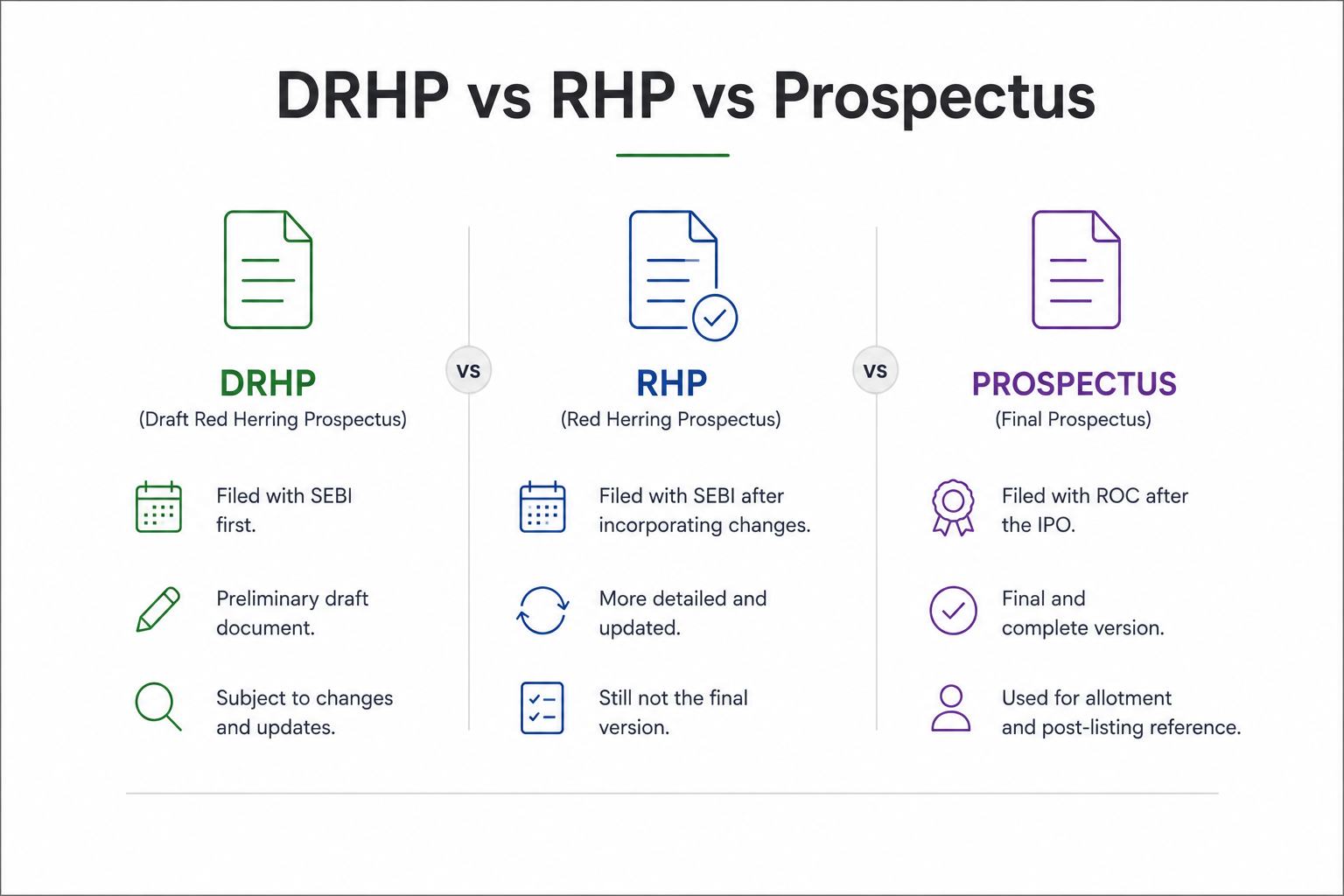
When a company launches an IPO in India, you may come across three similar-sounding documents: the DRHP, RHP, and prospectus. The simplest difference is timing and completeness. The DRHP is the draft filed during the regulatory review stage; the RHP is the updated offer document available before the IPO opens; and the prospectus contains the final issue details once pricing and allotment-related information is known.
For investors, these are not just regulatory paperwork. They contain the information needed to understand the company’s business, financials, promoters, risks, use of IPO proceeds, and the terms of the public issue.
DRHP vs RHP vs Prospectus: Quick Comparison
| Feature | DRHP | RHP | Prospectus |
|---|---|---|---|
| Full form | Draft Red Herring Prospectus | Red Herring Prospectus | Prospectus |
| Stage | Draft IPO stage | Before the IPO opens | After the offer closes and final details are available |
| Main purpose | Regulatory review and initial disclosure | Helps investors evaluate the live IPO | Records final offer details |
| Filed with | SEBI during the draft filing process | Registrar of Companies before the offer | Registrar and SEBI as applicable |
| Final issue price included? | No | Generally no final issue price | Yes |
| Useful for investors? | Yes | Yes, especially when applying | Mainly for final issue information |
| Can information change later? | Yes | Some details can still be updated | Contains finalized offer information |
The progression can be understood simply:
DRHP → regulatory review and updates → RHP → IPO opens and closes → prospectus with final details
SEBI’s public-issue filings reflect these stages separately, including draft offer documents, red herring documents filed with the Registrar of Companies, and final offer documents.
What Is a DRHP in an IPO?
A Draft Red Herring Prospectus, or DRHP, is the draft offer document that a company files as part of the process of going public.
Think of it as the first detailed public version of the company’s IPO story. It gives regulators and potential investors extensive information about the issuer, but the IPO is not yet at the application stage.
A typical DRHP covers areas such as:
- The company’s business model and operations
- Industry overview
- Promoters and management
- Financial statements
- Outstanding litigation
- Material risk factors
- Objects of the issue, meaning how fresh issue proceeds will be used
- Details of an offer for sale, if applicable
- Capital structure and shareholding
- Related-party transactions
- Competitive strengths and business strategies
SEBI currently publishes DRHP filings under its public-issue filings, alongside draft abridged prospectuses where applicable.
Does a DRHP contain the IPO price?
A DRHP does not contain the final IPO issue price.
At this point, important offer details can still change as the IPO moves through the regulatory and book-building process. That is why investors should not treat every number or disclosure in the DRHP as the final terms of the IPO.
Why should investors read the DRHP?
The DRHP is particularly useful if you want to research a company before the IPO reaches the application stage.
Rather than focusing only on revenue growth or a well-known brand name, investors can use it to ask more important questions:
- Is the company consistently profitable?
- How much debt does it have?
- Where will the money raised through the fresh issue go?
- Are existing shareholders selling a large number of shares?
- What risks does management disclose?
- Are there significant legal proceedings?
- Does the company depend heavily on a few customers, suppliers, products, or regions?
The risk factors and objects of the offer are often good starting points if you do not want to read hundreds of pages from beginning to end.
What Is an RHP in an IPO?
An RHP, or Red Herring Prospectus, is the offer document issued closer to the IPO opening.
It is more relevant to someone deciding whether to apply for an IPO because it reflects the offer at a later stage than the DRHP.
Under Section 32 of the Companies Act, 2013, a company proposing to offer securities may issue a red herring prospectus before issuing the prospectus. The RHP must be filed with the Registrar at least three days before the opening of the subscription list and offer.
Why is it called a red herring prospectus?
Under the Companies Act, a red herring prospectus is a prospectus that does not contain complete particulars of the quantum or price of the securities being offered.
That missing final information is one of the main reasons an RHP should not be confused with the final prospectus.
What does an RHP contain?
The RHP contains extensive information about the company and the IPO, including:
- Business operations
- Financial statements
- Risk factors
- Promoters and management
- Use of proceeds
- Offer structure
- Issue-related information
- Legal proceedings
- Capital structure
- Updated disclosures since the DRHP
For a book-built IPO, investors will also have the price band announced for bidding, even though the final issue price is determined through the book-building process.
SEBI’s filings show RHPs, along with abridged prospectuses, for public issues approaching their subscription period.
What Is a Prospectus?
The prospectus is the final offer document that includes information that could not be included in the red herring prospectus before the issue was priced and closed.
Section 32 of the Companies Act states that after the offer closes, a prospectus stating the total capital raised, closing price of the securities, and other details not included in the RHP must be filed with the Registrar and SEBI.
In practical terms, this is where the IPO documentation reaches its final stage.
What information does the final prospectus add?
The prospectus can include final information such as:
- Final issue price
- Total amount raised
- Final number or quantum of securities issued
- Other details that were incomplete in the RHP
The Companies Act also requires variations between the RHP and prospectus to be highlighted in the prospectus.
SEBI’s filing database accordingly distinguishes final prospectuses from DRHPs and RHPs.
What Is the Main Difference Between DRHP and RHP?
The biggest difference between the DRHP and the RHP is the stage at which each document appears.
The DRHP is a draft document used earlier in the IPO process, while the RHP is the later offer document used when the IPO is moving toward subscription.
For example, information disclosed in the DRHP may be modified or supplemented in response to regulatory observations and developments at the company. By the RHP stage, investors have a more current document for evaluating the actual IPO.
That does not make the DRHP useless. It simply serves a different purpose.
What Is the Difference Between RHP and Prospectus?
The RHP precedes the IPO, so certain final offer details are unavailable.
The prospectus is issued after the offer closes and records final information, including details such as the capital raised and the closing price of the securities, as prescribed under Section 32 of the Companies Act.
A simple way to remember the difference is:
RHP = IPO ready for investors
Prospectus = final IPO details recorded
Where Do These Documents Fit in the IPO Process?
The exact IPO process involves several regulatory and procedural steps, but from an investor’s perspective, the documents broadly appear in this sequence:
1. Company prepares for the IPO
The issuer works with merchant bankers and other intermediaries to prepare its offer documents and IPO structure.
2. DRHP is filed
The Draft Red Herring Prospectus provides detailed disclosures at the draft stage and forms part of the regulatory review process.
3. Disclosures are updated
The offer document can undergo changes, clarifications, additions, and other updates before the IPO proceeds.
4. RHP is filed
The Red Herring Prospectus represents the later-stage offer document. Under the Companies Act, it must be filed with the Registrar at least three days before the subscription list and offer open.
5. Investors bid in the IPO
Eligible investors submit bids within the price band and in accordance with applicable IPO rules.
6. Final price is determined
Following the book-building process, the final issue price is established.
7. Final prospectus is filed
After the offer closes, the prospectus records the final information required under the Companies Act.
Which IPO Document Should Investors Read?
If you are researching an IPO early, start with the DRHP. If the IPO is already open or about to open, use the RHP and the latest issue-related disclosures rather than relying only on the older DRHP.
You do not necessarily need to read every page in order. Focus first on the sections that can materially affect your investment decision.
Risk factors
This section explains risks specific to the company, its industry, operations, promoters, finances, and the IPO.
Look for risks that could directly affect revenue, margins, cash flow, regulatory compliance, or future growth.
Objects of the offer
Check where the money from the fresh issue is going.
There is an important distinction between a fresh issue and an offer for sale (OFS). Fresh issue proceeds go to the company, subject to issue expenses and the stated objects. In an OFS, existing shareholders sell their shares, so the proceeds from those sales do not represent new capital raised by the company.
Financial information
Do not stop at revenue growth.
Compare:
- Revenue
- Profit or loss
- Operating margins
- Cash flows
- Borrowings
- Return ratios where relevant
- Changes across multiple financial periods
A company can report rising profits while still having weak operating cash flow or increasing debt. Context matters.
Promoters and selling shareholders
Check who owns the company before the IPO and who is selling shares.
A promoter selling shares is not automatically a negative signal. The size of the sale, the promoter’s remaining ownership, the reasons for the IPO, and the overall offer structure provide better context.
Litigation and regulatory matters
Material legal proceedings can create financial or operational risks.
Look at cases involving the company, promoters, directors, subsidiaries, and other relevant parties rather than relying solely on media summaries.
Related-party transactions
Large or unusual transactions with promoters, group entities, directors, or related businesses deserve closer examination.
They are not necessarily problematic, but investors should understand their scale and commercial purpose.
DRHP, RHP, and Abridged Prospectus: Are They the Same?
No.
An abridged prospectus is a shorter document that contains the salient features of the prospectus, rather than the full, detailed offer document.
Section 33 of the Companies Act generally requires an application form for purchasing securities to be accompanied by an abridged prospectus, subject to specified exceptions.
SEBI’s IPO filing pages regularly list an RHP alongside an abridged prospectus, showing that they are separate documents serving related purposes.
For quick reading, the abridged prospectus can be useful. For deeper research into risks, financials, litigation, and business details, the full offer document is more informative.
Why IPO Offer Documents Matter
IPO marketing tends to focus on the company’s opportunity, growth story, or brand. Offer documents provide a much broader picture.
They help investors examine what could go wrong as well as what could go right.
They also carry legal significance. The Companies Act provides for both criminal and civil liability for certain misstatements in a prospectus, underscoring why these disclosures should be taken seriously.
Still, an offer document does not tell you whether an IPO is a good investment. It gives you information with which to make that assessment.
Valuation, competitive position, financial quality, risks, and your own investment objectives still need to be considered.
FAQs About DRHP, RHP, and Prospectus
What is the full form of DRHP?
A. DRHP stands for Draft Red Herring Prospectus. It is a draft IPO offer document filed during the earlier stages of the public issue process.
What is the full form of RHP?
A. RHP stands for Red Herring Prospectus. It is an offer document issued before the final prospectus and does not contain complete particulars of the quantum or price of the securities.
Is DRHP the same as a prospectus?
A. No. A DRHP is a draft-stage IPO document. The final prospectus is filed later and contains final offer information that was unavailable earlier.
Does the DRHP mention the IPO price?
A. No, the DRHP does not contain the final IPO issue price. Pricing is finalized later in the IPO process.
Does the RHP contain the IPO price band?
A. For a book-built IPO, the price band used for bidding is available by the time investors apply. However, the final issue price is determined later through the book-building process.
Is RHP the final prospectus?
A. No. The RHP precedes the final prospectus. Under Section 32 of the Companies Act, the final prospectus filed after the offer closes includes details such as the total capital raised and closing price, along with other information not included in the RHP.
Where can investors find an IPO’s DRHP or RHP?
A. Investors can check SEBI’s public-issue filings for offer documents. SEBI categorizes filings, including draft offer documents, red herring documents, and final offer documents.
Should I read the DRHP before applying for an IPO?
A. It can be valuable for early research, particularly for understanding the business, financials, risk factors, use of proceeds, promoters, and litigation. Once the RHP is available, however, investors should also review the newer document and subsequent IPO disclosures.
Key Takeaways
- DRHP is the draft IPO offer document and provides an early, detailed view of the company and the proposed issue.
- RHP is issued later, before the IPO subscription process, and contains more current offer information.
- The prospectus records final information after the offer closes, including details that could not be included in the RHP.
- DRHP and RHP are not interchangeable, even though much of their content overlaps.
- An abridged prospectus is a shorter document containing the salient features of the full prospectus.
- Investors should pay particular attention to risk factors, financials, use of proceeds, promoter holdings, litigation, related-party transactions, and the split between the fresh issue and OFS.
- For an IPO that is about to open, use the latest RHP and subsequent disclosures rather than making a decision solely from an older DRHP.
Disclaimer
The stocks mentioned in this article are not recommendations. Please conduct your own research and due diligence before investing. Investment in securities market are subject to market risks, read all the related documents carefully before investing. Please read the Risk Disclosure documents carefully before investing in Equity Shares, Derivatives, Mutual fund, and/or other instruments traded on the Stock Exchanges. As investments are subject to market risks and price fluctuation risk, there is no assurance or guarantee that the investment objectives shall be achieved. Lemonn (Formerly known as NU Investors Technologies Pvt. Ltd) do not guarantee any assured returns on any investments. Past performance of securities/instruments is not indicative of their future performance.