
Reliance Enters Ice Cream Market With Bombay Creamery
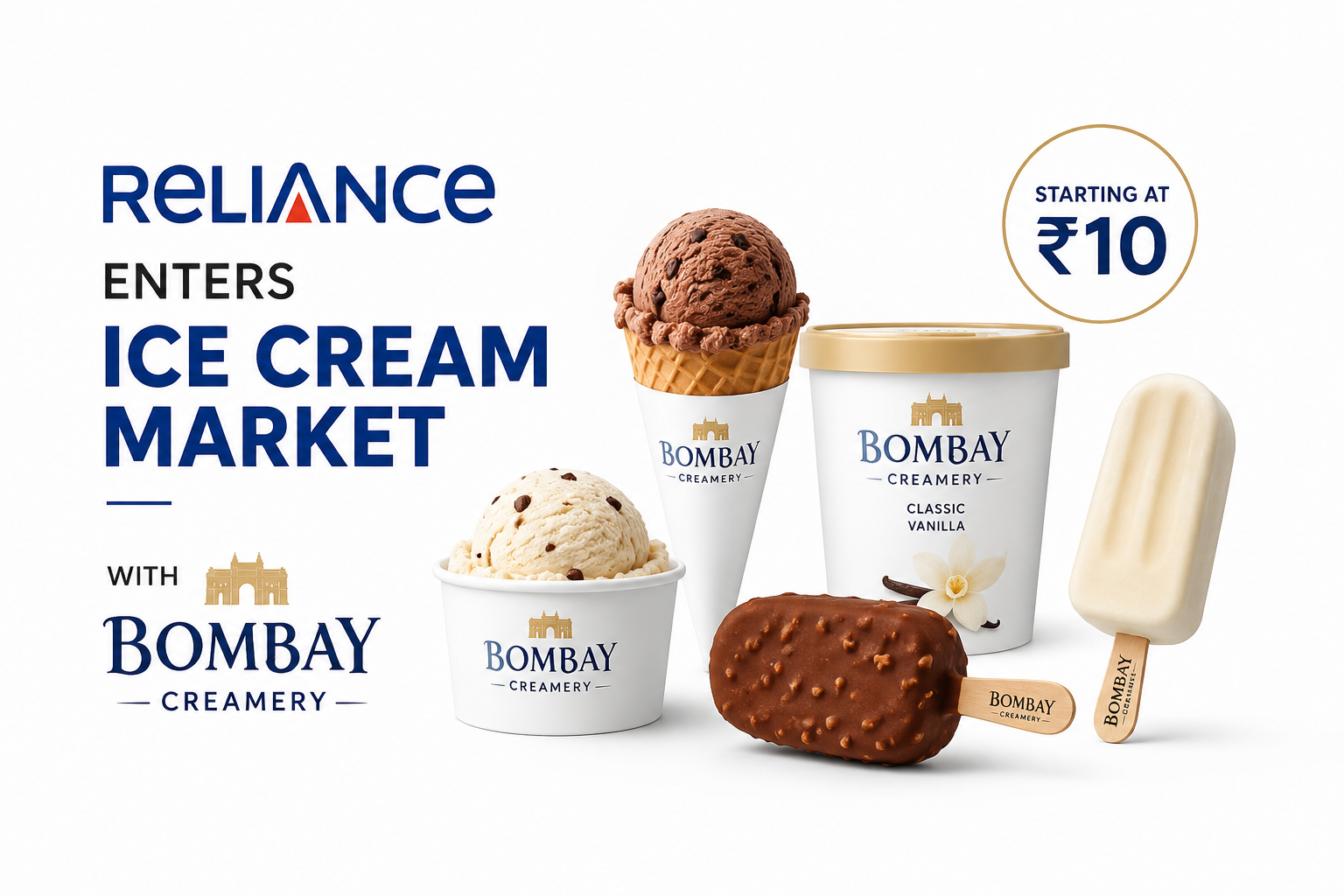
Reliance Consumer Products Limited (RCPL) has entered India’s ice cream market with Bombay Creamery, a new dairy ice cream brand with products starting at ₹10. The brand will initially be available in western India, followed by a planned nationwide rollout.
The move brings Reliance into direct competition with established ice cream brands such as Amul, Kwality Wall’s, Mother Dairy, Vadilal and Arun. It also expands RCPL’s presence in packaged consumer goods, where the company has already built businesses across beverages and daily essentials.
What Is Bombay Creamery?
Bombay Creamery is the new ice cream brand launched by Reliance Consumer Products, the FMCG arm of Reliance Industries.
RCPL announced its entry into the category on September 1, 2026. The company is positioning Bombay Creamery as an affordable dairy ice cream brand that combines real dairy ingredients with mass-market pricing.
The initial product range covers several popular formats:
- Cones
- Cups
- Tubs
- Bars
- Sticks
Prices start at ₹10, which puts the brand within reach of consumers looking for inexpensive impulse purchases as well as larger take-home formats.
Where Will Bombay Creamery Ice Cream Be Available?
Reliance is starting the Bombay Creamery rollout in western India before expanding distribution across the country.
RCPL has confirmed plans for a pan-India rollout, although it has not publicly provided a detailed state-by-state launch schedule.
This phased approach gives Reliance an opportunity to test consumer demand, distribution and cold-chain operations before scaling the brand nationally.
“Start investing with confidence! Explore
Lemonn
and grow your wealth.”
Why Is Reliance Entering the Ice Cream Market?
Ice cream fits naturally into Reliance Consumer Products’ growing FMCG portfolio.
The company has been expanding across categories where high-volume distribution, competitive pricing and brand visibility can create an advantage. Its portfolio already includes businesses such as Campa beverages and a range of everyday consumer products.
Ice cream offers another large consumer category where Reliance can combine retail reach with affordable pricing.
India’s market is also highly competitive rather than being controlled by a single company. Euromonitor estimates that Amul, operated by Gujarat Cooperative Milk Marketing Federation, will account for around 19% of retail value sales in 2026, while Kwality Wall’s India will hold about 9%. Several other major players have shares in the 4% to 6% range.
That fragmentation gives a well-funded new entrant room to compete.
Why Is the ₹10 Price Important?
Bombay Creamery’s ₹10 starting price could become one of its strongest tools for attracting consumers.
Ice cream is often an impulse purchase. A low entry price makes it easier for customers to try a new brand without switching completely from an existing favourite.
The strategy also resembles Reliance’s broader approach in some other consumer categories, where affordable entry-level products help build distribution and trial quickly.
Reuters noted that Reliance previously used aggressive pricing while expanding Jio and later increased competition in soft drinks after reviving Campa.
That does not necessarily mean Reliance will start an ice cream price war. However, established companies may need to watch pricing, pack sizes and retailer incentives more closely as Bombay Creamery expands.
Is Bombay Creamery Made With Real Dairy Cream?
RCPL says Bombay Creamery products are made using real dairy cream.
This positioning is important because consumers often use the terms “ice cream” and “frozen dessert” interchangeably, even though product formulations can differ significantly.
Reliance is putting dairy ingredients at the centre of Bombay Creamery’s brand proposition while still maintaining an entry price of ₹10.
The combination appears designed to position the product above purely price-led offerings without pushing it outside the mass market.
Who Will Reliance Compete With?
Bombay Creamery enters a market with several national and regional competitors.
| Company or brand | Position in the Indian market |
|---|---|
| Amul | Major national dairy and ice cream player |
| Kwality Wall’s | Large branded ice cream company |
| Mother Dairy | Strong dairy and ice cream presence |
| Arun Icecreams | Major brand from Hatsun Agro |
| Vadilal | Established Indian ice cream manufacturer |
| Havmor | Large branded ice cream business |
| Bombay Creamery | New entrant from Reliance Consumer Products |
Reuters identifies Amul, Vadilal, Mother Dairy, Kwality Wall’s and Hatsun Agro’s Arun among the prominent companies operating in the category.
Competition is also evolving beyond traditional brands. Newer businesses have been targeting niches such as low-calorie, high-protein and premium ice creams, while quick-commerce platforms have made frozen products easier to order on demand.
Could Reliance Disrupt India’s Ice Cream Industry?
Reliance has several advantages, but success is not guaranteed.
1. Large distribution network
Reliance operates a sizeable consumer and retail ecosystem. That could help Bombay Creamery secure shelf space and reach customers quickly as it moves beyond western India.
2. Aggressive entry pricing
Products starting at ₹10 can encourage trial and put pressure on competitors in price-sensitive segments.
3. Multiple product formats
Launching cones, cups, bars, sticks and tubs allows Bombay Creamery to compete across both impulse and family-consumption occasions.
4. Strong capital backing
Cold-chain distribution is expensive. Products must remain frozen during storage, transport and retail.
Reliance’s financial and distribution resources could help it build this infrastructure at scale.
However, India’s established ice cream companies have long-standing distributor relationships, regional brand loyalty and deep experience managing refrigerated supply chains. Reliance will still need to prove that consumers will repeatedly choose Bombay Creamery once the novelty of the launch fades.
How Have Investors Reacted to Reliance’s Entry?
Reliance’s announcement has already attracted attention in the stock market.
Shares of Kwality Wall’s India fell as much as around 3% on September 2, 2026, with investor concerns focused partly on increased competition following Reliance’s entry.
Vadilal also traded lower during the session as markets assessed what a large new competitor could mean for existing ice cream companies.
A one-day share-price move does not establish the long-term impact of Bombay Creamery. Still, the reaction shows that investors are taking Reliance’s entry seriously.
What Does Reliance’s Ice Cream Entry Mean for Consumers?
For consumers, greater competition could mean more choices across price points, flavours and formats.
Existing brands may respond through:
- Competitive pricing and pack sizes
- New flavours and products
- Higher retailer incentives
- Wider distribution
- Premium and health-focused offerings
- Faster delivery through quick-commerce platforms
Reliance’s biggest challenge will be turning initial product trials into repeat purchases.
In ice cream, pricing may bring a customer to the freezer once. Taste, quality, availability and consistency are what usually determine whether they come back.
Summary
Reliance Consumer Products entered India’s ice cream market on September 1, 2026, through its new brand, Bombay Creamery.
Products start at ₹10 and include cones, cups, tubs, bars and sticks. The brand is launching first in western India before a wider national rollout.
The entry puts Reliance up against Amul, Kwality Wall’s, Mother Dairy, Vadilal, Arun and other established brands in a competitive and fragmented market.
Bombay Creamery’s affordable pricing, focus on real dairy cream and Reliance’s distribution capabilities could make it a significant challenger. Its longer-term success, however, will depend on consumer preference, cold-chain execution and how effectively established brands respond.
FAQs About Reliance Entering the Ice Cream Market
Has Reliance launched an ice cream brand?
Yes. Reliance Consumer Products Limited launched Bombay Creamery in September 2026, marking its entry into India’s ice cream market.
What is the name of Reliance’s ice cream brand?
Reliance’s new ice cream brand is called Bombay Creamery.
What is the starting price of Bombay Creamery ice cream?
Bombay Creamery products start at ₹10. The portfolio includes cups, cones, sticks, bars and tubs.
Where is Bombay Creamery available?
Bombay Creamery is initially being rolled out in western India. Reliance Consumer Products plans to expand the brand across India afterward.
Is Bombay Creamery made with dairy cream?
RCPL says the Bombay Creamery range is made with real dairy cream and is positioned around genuine dairy ingredients.
Is Reliance competing with Amul in ice cream?
Yes. Bombay Creamery competes in the same Indian ice cream market as Amul, along with companies such as Kwality Wall’s, Mother Dairy, Vadilal and Arun.
Will Bombay Creamery launch across India?
Yes. RCPL has said Bombay Creamery will initially launch in western India before a planned nationwide rollout. A detailed timeline for every market has not yet been announced.
Key Takeaways
- Reliance Consumer Products has entered India’s ice cream market with Bombay Creamery.
- The brand was announced on September 1, 2026.
- Bombay Creamery prices start at ₹10.
- Its range includes cones, cups, tubs, bars and sticks.
- RCPL says the products use real dairy cream.
- The initial launch is focused on western India, with a national rollout planned.
- Reliance will compete with established brands including Amul, Kwality Wall’s, Mother Dairy, Vadilal and Arun.
- Reliance’s pricing and distribution reach could intensify competition across India’s ice cream industry.
Disclaimer
The stocks mentioned in this article are not recommendations. Please conduct your own research and due diligence before investing. Investment in securities market are subject to market risks, read all the related documents carefully before investing. Please read the Risk Disclosure documents carefully before investing in Equity Shares, Derivatives, Mutual fund, and/or other instruments traded on the Stock Exchanges. As investments are subject to market risks and price fluctuation risk, there is no assurance or guarantee that the investment objectives shall be achieved. Lemonn do not guarantee any assured returns on any investments. Past performance of securities/instruments is not indicative of their future performance.
To read the RA disclaimer
Research Analyst - Gaurav Garg
Related Posts


Download Lemonn
Download my share market app for stock trading—trade stocks effortlessly in the market.



