
Swing Trading in India: Setups, Holding Period, Risk
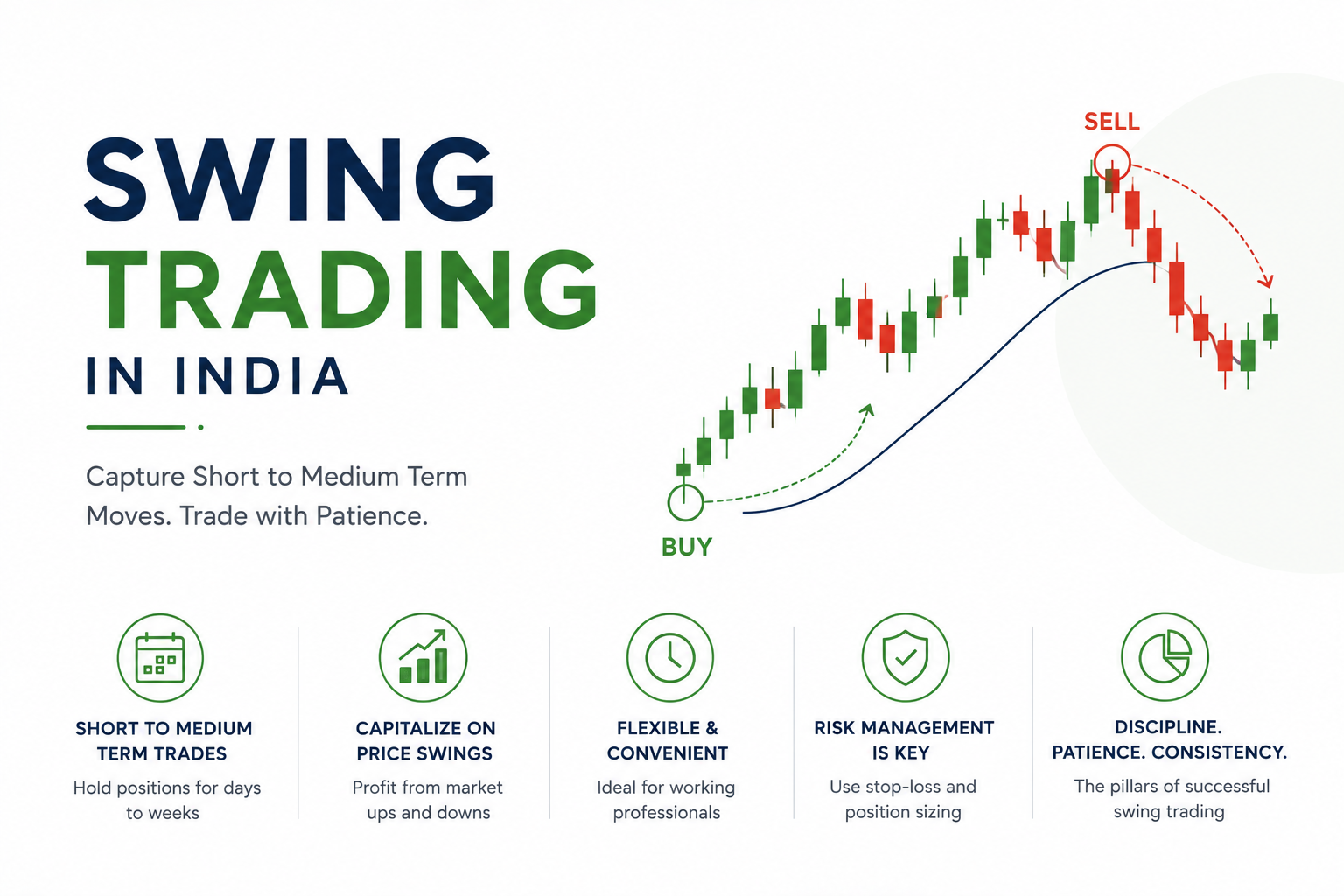
Swing trading in India is a trading approach in which traders aim to capture price moves that develop over several days or weeks. Instead of closing every position before the market shuts, as an intraday trader would, a swing trader typically holds stocks overnight until the expected move plays out or the trade setup fails.
The holding period is flexible, but many swing trades last anywhere from 2 days to a few weeks. The bigger challenge is not finding stocks that move. It is choosing repeatable setups, deciding where a trade becomes invalid, and controlling how much money is at risk.
This guide explains practical swing trading setups, holding periods, entry and exit rules, position sizing, and risk management for the Indian stock market.
What Is Swing Trading?
Swing trading involves buying or selling a security to capture a relatively short-term price movement.
A trader may, for example, notice a stock consolidating near resistance. If the stock breaks above that resistance with convincing volume, the trader could enter expecting momentum to continue over the next several sessions.
Unlike investing, the decision is based primarily on the trade setup rather than on the company’s long-term potential.
Unlike intraday trading, the position does not have to be closed before the end of the trading session.
| Trading style | Typical holding period | Main focus |
|---|---|---|
| Intraday trading | Minutes to hours | Same-day price movements |
| Swing trading | Days to weeks | Short-term trends and price swings |
| Positional trading | Weeks to months | Larger market trends |
| Long-term investing | Years | Business growth and valuation |
These are practical descriptions rather than regulatory definitions. A swing trade can occasionally finish within a day or remain open longer than originally expected.
How Does Swing Trading Work in India?
A swing trader generally starts by identifying liquid stocks with a clear technical structure.
The process can look like this:
- Screen stocks for a suitable setup.
- Identify the entry price.
- Decide the stop-loss before entering.
- Calculate position size based on the permitted loss.
- Define the initial target or exit method.
- Enter only if the setup triggers.
- Monitor the position without constantly changing the original plan.
- Exit when the target, stop-loss, or another predefined condition is reached.
For delivery-based equity trades, settlement mechanics are also relevant. NSE Clearing currently follows a T+1 settlement cycle for regular rolling settlements, while an optional T+0 settlement cycle is available for eligible securities.
Settlement should not, however, determine whether a swing setup is good or bad. Your trading decision should come from the setup and risk plan.
“Start investing with confidence! Explore
Lemonn
and grow your wealth.”
What Is the Typical Swing Trading Holding Period?
There is no fixed holding period for swing trading. A position might remain open for two or three sessions, while another setup may need several weeks.
The holding period should ideally be determined by the price structure and trading timeframe.
For example:
- A breakout on a daily chart might develop over several trading sessions.
- A broader trend-following setup may take a few weeks.
- A failed breakout might require an exit the very next day.
This is why deciding in advance that you will hold every swing trade for exactly five or ten days can create problems. The market does not follow your calendar.
Should you hold a swing trade over the weekend?
You can, but doing so introduces overnight and weekend risk.
Important news may arrive while the Indian market is closed. Global market movements can also cause a stock to open significantly above or below its previous closing price.
If you hold a ₹500 stock with a stop-loss at ₹480, for example, there is no guarantee that your maximum loss will remain ₹20 per share. The stock could react to unexpected news and open at ₹465.
SEBI’s risk disclosures specifically warn that news announcements, liquidity conditions, and volatility can produce sudden price movements.
That gap risk needs to be considered when deciding position size.
5 Common Swing Trading Setups in India
No chart pattern guarantees a profitable trade. A useful setup simply gives you a repeatable framework for deciding when to enter, where the idea is invalidated, and whether the potential reward justifies the risk.
Here are five setups commonly used by swing traders.
1. Breakout Trading Setup
A breakout happens when price moves beyond an established resistance level or trading range.
Suppose a stock repeatedly struggles around ₹1,000. It then closes at ₹1,025 with stronger-than-usual volume.
A trader might interpret that move as a breakout.
What to look for
Look for:
- Clearly defined resistance
- Several tests of the level
- A decisive move above resistance
- Increased trading volume
- A supportive broader market trend
Avoid treating every small move above resistance as a genuine breakout.
A stock that trades at ₹1,002 for a few minutes after repeatedly facing resistance at ₹1,000 has not necessarily confirmed anything.
2. Pullback in an Uptrend
Not every trader wants to buy after a stock has already surged.
A pullback strategy attempts to enter an existing uptrend when the price temporarily declines toward an important support area.
Potential reference points include:
- Previous resistance that has turned into support
- A rising moving average
- A trendline
- A previous swing low
- A demand or consolidation zone
Imagine a stock moves from ₹700 to ₹850, then falls back toward a previous breakout area around ₹810.
If buyers begin returning to near ₹810, a trader may consider entering while placing the invalidation level below the relevant support structure.
The advantage is that the stop can sometimes be placed closer to the entry than in a late breakout trade.
3. Range Breakout Setup
Some stocks spend days or weeks moving sideways.
For example, a stock might repeatedly trade between ₹420 and ₹450. Neither buyers nor sellers have established clear control.
A close above ₹450 could signal the beginning of a new upward swing.
The important point is to distinguish between a meaningful range and random market noise.
A cleaner range usually has:
- Visible support and resistance
- Multiple price reactions around those levels
- Sufficient liquidity
- Enough consolidation to make the breakout meaningful
Volume expansion can provide additional confirmation, although volume alone should not determine the trade.
4. Moving Average Trend Setup
Moving averages can help traders identify the direction of an existing trend.
A trader might look for stocks trading above a rising 20-day or 50-day moving average and then wait for a pullback toward that average.
The moving average itself is not magical support.
Think of it as a reference point. Price structure should still matter.
If a stock falls through a moving average and simultaneously breaks an important swing low, that provides more information than the moving-average crossover alone.
5. Relative Strength Setup
Relative strength in this context means identifying stocks that are outperforming their benchmark or peers.
Suppose the Nifty 50 declines 2% over several sessions while a particular large-cap stock remains close to its recent high.
That resilience can be worth watching.
If the broader market recovers, stocks already showing relative strength may offer interesting swing setups.
This should not be confused with the Relative Strength Index (RSI). Relative performance and RSI are different concepts.
How Should You Choose a Swing Trading Entry?
A good entry is not simply the lowest available price.
It is a price at which the trade setup has provided enough confirmation while still allowing sensible risk management.
Consider a hypothetical breakout:
- Resistance: ₹500
- Entry: ₹505
- Stop-loss: ₹490
- Initial target: ₹535
The risk is ₹15 per share.
The potential reward is ₹30 per share.
That produces a 1:2 risk-reward ratio before costs and slippage.
This does not mean the trade will work. It simply means the planned upside is twice the initial amount at risk.
Where Should You Place a Stop-Loss?
A swing trading stop-loss should ideally sit at a level where your original trade idea is no longer valid.
For a breakout trade, that might be below the breakout structure.
For a pullback trade, it might be below the relevant swing low.
Avoid choosing stops purely because a percentage looks convenient.
For example, saying “I always use a 2% stop” can be problematic if a stock’s normal daily movement is 4%.
Stop-loss orders have limitations
A stop-loss controls the exit process, but it cannot guarantee the exact exit price.
SEBI explains that once a predetermined stop price is reached, a stop-loss order may convert into the applicable market or limit order. A stop-limit order may also remain unexecuted if the price moves through the specified level without a suitable execution.
This is especially important for swing traders, as positions are held overnight.
How Much Should You Risk Per Swing Trade?
Risk should be decided before deciding how many shares to buy.
A common approach is to risk only a small predetermined percentage of trading capital on an individual trade. The appropriate percentage depends on the trader’s strategy, drawdown tolerance, portfolio size, and experience.
Consider an example where a trader voluntarily limits risk to 1% per trade.
Trading capital = ₹5,00,000
Maximum planned risk = 1%
Maximum loss budget = ₹5,000
Suppose:
Entry price = ₹500
Stop-loss = ₹480
Risk per share = ₹20
Position size can be estimated as:
₹5,000 ÷ ₹20 = 250 shares
The position value would therefore be ₹1,25,000.
The important distinction is that position value is not the same as capital at risk.
The position is worth ₹1,25,000, but the planned price risk between entry and stop is ₹5,000, excluding gaps, slippage, brokerage, taxes, and other trading costs.
Why Position Sizing Matters More Than Finding the Perfect Setup
Imagine two traders take the same losing trade.
Trader A risks 1% of capital.
Trader B risks 10%.
The chart pattern is identical, but the impact on their accounts is dramatically different.
Large losses also require disproportionately larger gains to recover.
| Portfolio loss | Gain needed to recover |
|---|---|
| 5% | 5.3% |
| 10% | 11.1% |
| 20% | 25% |
| 30% | 42.9% |
| 50% | 100% |
This is why survival matters.
You do not need every swing trade to work. You need individual losing trades to remain manageable enough that you can continue following your strategy.
What Risk-Reward Ratio Is Good for Swing Trading?
There is no universally correct risk-reward ratio.
A strategy targeting 1:3 can still lose money if very few trades reach the target. A strategy averaging 1:1 can potentially make money if its win rate and execution are sufficiently strong.
Risk-reward and win rate need to be considered together.
For example, assume 10 hypothetical trades each risk ₹1,000.
Six lose ₹1,000 each, creating a ₹6,000 loss.
Four make ₹2,000 each, producing ₹8,000 in gains.
The result before trading costs is:
₹8,000 profit – ₹6,000 loss = ₹2,000 net profit
The trader was wrong more often than right, yet the payoff structure still produced a positive result.
That is why judging a strategy solely by its win rate can be misleading.
What Are the Main Risks of Swing Trading?
Overnight gap risk
Swing traders cannot react while the market is closed.
Results, regulatory developments, global events, management announcements, or sector news can cause the next session to open sharply away from the previous closing price.
False breakouts
A stock may cross resistance, attract buyers, and quickly reverse below the breakout level.
Waiting for confirmation can reduce some false signals, but it cannot eliminate them.
Liquidity risk
Less-liquid stocks can have wider bid-ask spreads and poor execution.
This can make the actual exit substantially different from the theoretical exit shown on a chart.
Concentration risk
Owning five stocks does not necessarily mean you have five independent trades.
If all five are banking stocks, for example, a sector-specific event could affect all positions simultaneously.
Excessive leverage
Leverage magnifies both gains and losses.
India’s market framework also requires applicable upfront margins to be collected before trades where margin requirements apply.
For beginners, learning position sizing and risk control without relying heavily on leverage is generally easier to manage.
Should Swing Traders Use Indicators?
Indicators can help, but adding more indicators does not automatically improve a strategy.
Useful tools can include:
- Moving averages for trend direction
- Volume for participation
- Average True Range (ATR) for volatility
- RSI for momentum
- Relative performance against an index
- Support and resistance levels
The key is knowing what each tool contributes.
Using RSI, MACD, three moving averages, Bollinger Bands, and several momentum indicators together may create the illusion of confirmation, as many of them measure similar price information.
A simple system that you can consistently execute is often easier to evaluate.
A Simple Swing Trading Checklist
Before entering a swing trade, ask:
- What is the setup?
Can I describe the reason for entering in one or two sentences? - Where is my entry?
What exactly needs to happen before I buy? - Where is the trade invalidated?
Identify the stop before entering. - How much money am I risking?
Calculate rupee risk, not just percentage movement. - What is my position size?
Derive quantity from the risk limit and stop distance. - What is the potential reward?
Check whether the expected upside makes sense relative to the downside. - Is an event approaching?
Results or major announcements can increase overnight risk. - Am I already exposed to the same sector?
Multiple correlated positions can behave like one oversized trade. - What will make me exit?
Decide whether you are using a fixed target, a trailing stop, a technical exit, or a combination.
Example of a Swing Trading Plan
Consider a purely hypothetical stock trading near ₹750.
A trader identifies resistance around ₹760 and decides to enter only after a convincing breakout.
The plan could look like this:
| Trade parameter | Example |
|---|---|
| Breakout level | ₹760 |
| Planned entry | ₹765 |
| Stop-loss | ₹740 |
| Risk per share | ₹25 |
| Target | ₹815 |
| Potential reward | ₹50 |
| Risk-reward | 1:2 |
| Maximum account risk | ₹5,000 |
| Position size | 200 shares |
The trader now has rules before money is committed.
If the breakout never occurs, there is no trade.
If the trade triggers and subsequently reaches the invalidation level, the trader exits as planned rather than inventing a new reason to hold.
Actual losses can still exceed the planned ₹5,000 because of gaps, slippage, execution issues, and charges.
Common Swing Trading Mistakes to Avoid
Entering without knowing the exit
Buying first and deciding what to do later turns a structured trade into an emotional decision.
Set the invalidation point before entering.
Moving the stop-loss farther away
A trader enters at ₹500 with a stop at ₹480.
The price reaches ₹482, and the stop suddenly moves to ₹465 because the trader “wants to give it room.”
Unless the trading system specifically includes such adjustments, this increases risk after the trade has already gone against you.
Taking oversized positions
A high-conviction setup can still fail.
Confidence should not replace position sizing.
Chasing extended stocks
A good company can still offer a poor entry.
If a stock has already moved sharply above the intended breakout point, entering late may leave you with limited upside relative to the stop distance.
Averaging down without a predefined rule
Adding to a losing trade increases exposure.
If scaling into positions is part of a tested strategy, the maximum total risk should still be decided beforehand.
Trading every chart pattern
More trades do not automatically mean more profits.
Waiting for setups that match predefined rules makes it easier to measure whether the strategy actually works.
How Can Beginners Start Swing Trading in India?
Start with the process rather than the profit target.
Choose one or two straightforward setups and record how they perform over a meaningful sample of trades.
Maintain a trading journal containing:
- Stock and sector
- Setup
- Entry price
- Stop-loss
- Position size
- Target
- Reason for entry
- Reason for exit
- Profit or loss
- Screenshot of the chart
- Mistakes or observations
After enough trades, patterns become easier to spot.
You might discover that your breakout trades perform well in trending markets but poorly in sideways markets. Or you may find that most of your losses come from entering too far above the intended breakout.
Those observations are more useful than constantly switching indicators after a few losing trades.
Is Swing Trading Profitable?
Swing trading can be profitable, but profitability is not guaranteed.
Results depend on the quality of the trading strategy, risk per trade, execution, trading costs, market conditions, and the trader’s ability to follow the same rules consistently.
A strategy should therefore be evaluated on a meaningful sample rather than judged by a single successful trade.
Track metrics such as:
- Win rate
- Average winning trade
- Average losing trade
- Maximum drawdown
- Average risk-reward achieved
- Expectancy per trade
- Trading costs
- Performance by setup
A profitable-looking chart pattern is not enough. What matters is whether the complete trading process has positive expectancy after realistic costs and losses.
FAQs About Swing Trading in India
What is the best holding period for swing trading in India?
A. There is no single best holding period. Swing trades commonly last from a few days to several weeks. The exit should ideally depend on the setup, stop-loss, target, and changing price structure rather than a fixed number of days.
How much money do I need for swing trading in India?
A. There is no universal amount required to learn swing trading. Your available capital affects position sizing and diversification, but risk management matters more than simply starting with a large account.
Is swing trading better than intraday trading?
A. Neither is automatically better. Intraday traders close positions within the trading session, while swing traders accept overnight risk in exchange for the opportunity to capture multi-day movements. The better choice depends on your strategy, available time, temperament, and risk tolerance.
Which timeframe is best for swing trading?
A. Daily charts are commonly used to identify multi-day swing setups. Some traders combine them with weekly charts to identify the broader trend and shorter timeframes to time entries. More timeframes do not necessarily produce better decisions.
Can I do swing trading with stocks?
A. Yes. Liquid listed equities are commonly used for swing trading. NSE’s regular equity rolling settlement operates on a T+1 basis, with optional T+0 settlement available for eligible securities.
Is stop-loss necessary for swing trading?
A. Having a predefined exit for an invalid trade is an important risk-control practice. A stop-loss order can help execute that plan, although it cannot guarantee the exact exit price, particularly during gaps or fast-moving markets.
What is the biggest risk in swing trading?
A. Oversized losses are one of the most damaging risks because they can significantly increase portfolio drawdowns. Swing traders also face overnight gaps, false breakouts, liquidity problems, correlated positions, and execution risk.
Can beginners learn swing trading?
A. Yes, but beginners should focus first on understanding setups, position sizing, stop-losses, and record-keeping rather than trying to maximize returns immediately. Testing a simple strategy and maintaining a trading journal can make the learning process more measurable.
Key Takeaways
- Swing trading in India typically involves holding positions for several days to several weeks to capture short-term price movements.
- Breakouts, pullbacks, ranges, trend setups, and relative strength are common swing trading approaches.
- Decide the entry, invalidation point, position size, and exit plan before taking the trade.
- Position size should reflect how much capital you are prepared to risk, not how confident you feel about a setup.
- A stop-loss cannot guarantee the exact exit price because overnight gaps, volatility, and liquidity can affect execution.
- Risk-reward should be assessed together with win rate and actual strategy performance.
- Keep a trading journal and evaluate a meaningful sample of trades before drawing conclusions about a strategy.
- Swing trading carries market risk, and no setup or indicator guarantees profits.
Disclaimer
The stocks mentioned in this article are not recommendations. Please conduct your own research and due diligence before investing. Investment in securities market are subject to market risks, read all the related documents carefully before investing. Please read the Risk Disclosure documents carefully before investing in Equity Shares, Derivatives, Mutual fund, and/or other instruments traded on the Stock Exchanges. As investments are subject to market risks and price fluctuation risk, there is no assurance or guarantee that the investment objectives shall be achieved. Lemonn do not guarantee any assured returns on any investments. Past performance of securities/instruments is not indicative of their future performance.
To read the RA disclaimer
Research Analyst - Gaurav Garg
Related Posts



Download Lemonn
Download my share market app for stock trading—trade stocks effortlessly in the market.



