
Best Banking Stocks in India 2026: Top Bank Shares to Watch
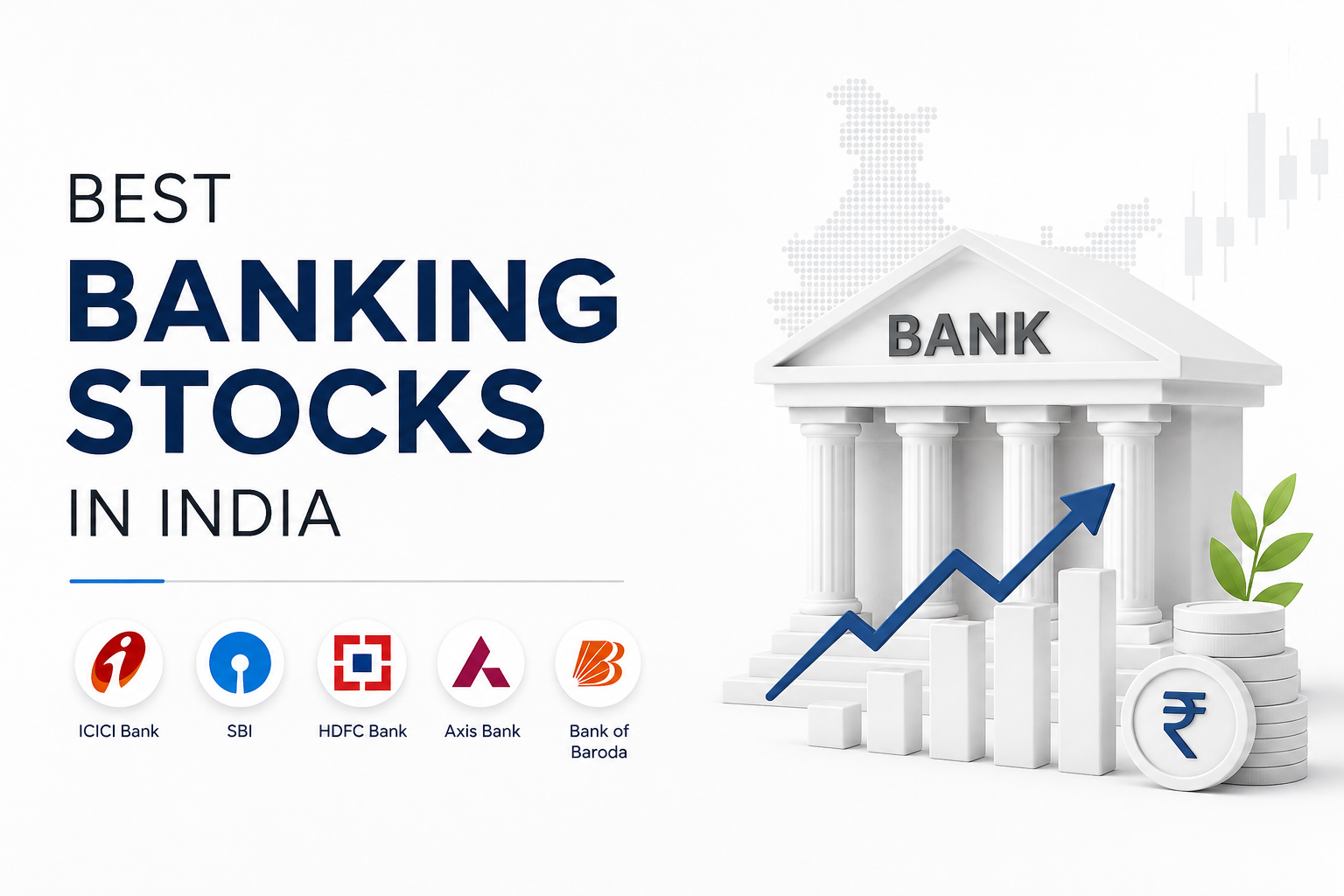
India’s banking sector is at the heart of the country’s economic growth story. Rising credit demand, increasing financial inclusion, digital banking adoption, improving asset quality and expansion in retail and corporate lending have created opportunities for both private-sector and public-sector banks.
But finding the best banking stocks in India requires more than looking at share-price performance. Banks need to be evaluated differently from ordinary businesses because deposits and borrowings are fundamental to their business model. Metrics such as Return on Assets (ROA), Return on Equity (ROE), Net Interest Margin (NIM), Gross and Net NPA ratios, credit costs, capital adequacy, loan growth and valuation are particularly important.
Based on these factors, this article examines some of the top banking stocks in India in 2026, including ICICI Bank, State Bank of India, HDFC Bank, Axis Bank and Bank of Baroda.
Quick takeaway: ICICI Bank ranks as the strongest overall banking stock in this analysis, while SBI stands out for its combination of profitability and valuation. HDFC Bank could be an interesting contrarian opportunity following its valuation reset, although investors should monitor its leadership transition and profitability closely.
Best Banking Stocks in India 2026 – Overview
| Rank | Banking Stock | Research Score | Key Strength | Key Risk |
|---|---|---|---|---|
| 1 | ICICI Bank | 89/100 | Profitability and asset quality | Premium valuation |
| 2 | State Bank of India | 87/100 | ROE, scale and valuation | PSU and credit-cycle risks |
| 3 | HDFC Bank | 84/100 | Strong banking franchise | Leadership transition |
| 4 | Axis Bank | 78/100 | Improving long-term fundamentals | Earnings volatility |
| 5 | Bank of Baroda | 76/100 | Low valuation | Lower structural profitability |
The research scores above are analytical estimates rather than ratings issued by the banks or a credit-rating agency.
Why India’s Banking Sector Matters
Banks are one of the most direct ways investors can participate in India’s economic expansion.
As households consume more, businesses invest in capacity and infrastructure spending increases, demand for housing loans, vehicle loans, business credit, working capital and other financial services can grow.
Several long-term trends could support the Indian banking sector.
Credit growth: Economic expansion can increase demand for loans from individuals as well as businesses.
Digital banking: Mobile banking, UPI and digital financial services have significantly changed how Indian consumers interact with banks.
Improving asset quality: Several major Indian banks have substantially cleaned up their balance sheets compared with the stressed-loan cycle of the previous decade.
Financial inclusion: Greater formalisation and access to banking products can expand the addressable market for lenders.
Cross-selling opportunities: Large banks increasingly generate business from credit cards, wealth management, insurance distribution, payments and other financial products.
These opportunities don’t eliminate risk. Banking is highly leveraged, and changes in interest rates, funding costs and loan defaults can significantly affect profitability.
“Start investing with confidence! Explore
Lemonn
and grow your wealth.”
How We Selected the Best Banking Stocks
A conventional stock-ranking framework based on operating margins, debt-to-equity and free cash flow isn’t appropriate for banks.
Debt and deposits effectively provide the funding banks use to generate loans and investments. Therefore, this analysis uses a specialised banking stock scoring methodology.
Banking Stock Scoring Framework
| Factor | Weight |
|---|---|
| Earnings and loan growth | 20% |
| ROA and ROE | 20% |
| Asset quality and credit costs | 20% |
| NIM and funding franchise | 15% |
| Capital adequacy | 10% |
| Market position and competitive advantage | 5% |
| Valuation versus banking peers | 10% |
| Total | 100% |
Banks were also assessed for consistent profitability and disclosures, adequate capital, liquidity, asset-quality trends and major unresolved governance concerns.
Valuation alone does not determine the ranking. A bank trading at a low price-to-book ratio may deserve that discount if its profitability, asset quality or growth prospects are materially weaker than those of its competitors.
1. ICICI Bank – Best Overall Banking Stock in India
Research Score: 89/100
ICICI Bank takes the top position in our list of the best banking stocks in India because of its combination of profitability, asset quality, scale and execution.
The bank has developed a strong retail and corporate banking franchise while maintaining relatively healthy balance-sheet metrics.
Why ICICI Bank Ranks First
One of ICICI Bank’s major attractions is its profitability. Recent comparative market data put its ROE at roughly 16%.
The bank has also built a strong deposit and lending franchise and substantially improved its asset quality compared with its position many years ago.
Its strengths include:
- Strong profitability
- Healthy asset quality
- Diversified retail and corporate loan book
- Large banking franchise
- Strong digital capabilities
- Consistent execution
The trade-off is valuation.
Around early September 2026, market-data providers placed ICICI Bank at approximately 17-19 times earnings and around 2.8 times book value, although exact multiples vary depending on the price date and whether standalone or consolidated numbers are used.
That represents a significant premium to several PSU banks.
Key Risk
ICICI Bank’s quality is widely recognised by the market. Consequently, investors purchasing the shares at premium valuations face the risk of valuation compression if earnings growth disappoints or credit costs increase.
Verdict: ICICI Bank is our strongest overall pick for investors prioritising banking quality over deep-value characteristics.
2. State Bank of India – Best Value Among Large Banks
Research Score: 87/100
State Bank of India, or SBI, is India’s dominant public-sector banking franchise and ranks second in our analysis.
The investment case has changed significantly as SBI’s profitability and asset quality have improved.
SBI’s Five-Year Improvement
| Financial Year | ROA | ROE | Gross NPA | Net NPA |
|---|---|---|---|---|
| FY21 | 0.48% | 9.94% | 4.98% | 1.50% |
| FY22 | 0.67% | 13.92% | 3.97% | 1.02% |
| FY23 | 0.96% | 19.43% | 2.78% | 0.67% |
| FY24 | 1.04% | 20.32% | 2.24% | 0.57% |
| FY25 | 1.10% | 19.87% | 1.82% | 0.47% |
Source: State Bank of India financial highlights.
The numbers illustrate an important transformation. SBI’s ROA more than doubled between FY21 and FY25, while gross and net NPA ratios declined substantially.
In Q1 FY26, SBI reported net profit of approximately ₹19,160 crore, up 12.5% year over year. Reported ROA stood at 1.14% and ROE at approximately 19.7%.
Why SBI Looks Attractive
The biggest attraction is the combination of profitability and valuation.
Around early September 2026, SBI traded at roughly 12 times trailing earnings and around 1.6 times book, depending on the market-data provider.
That leaves it at a considerable valuation discount to ICICI Bank despite its strong recent ROE.
Key Risks
SBI still carries risks associated with government ownership, exposure to economic and corporate credit cycles and potentially greater earnings cyclicality than premium private-sector banks.
Verdict: SBI is one of the most compelling banking stocks for investors seeking a balance between quality, profitability and valuation.
3. HDFC Bank – Contrarian Large-Cap Banking Opportunity
Research Score: 84/100
HDFC Bank has historically been considered one of India’s highest-quality banking franchises.
Its current investment case, however, is more nuanced.
Following its merger with HDFC Ltd., the bank has been working through balance-sheet changes and funding dynamics. More recently, leadership transition has added another variable investors need to consider.
Why HDFC Bank Is Interesting
The most important factor is valuation.
After a significant share-price correction, HDFC Bank’s valuation became considerably less demanding. Around early September 2026, market data indicated a valuation of roughly 14 times earnings and 1.8 times book value, though exact multiples vary.
That compares favourably with the premiums HDFC Bank commanded historically and with some other high-quality private banks.
In Q1 FY26, HDFC Bank reported core NIM of approximately 3.35%. Gross NPAs were 1.40%, while net NPAs were 0.47%.
Leadership Transition
Investors should also monitor management succession. CEO Sashidhar Jagdishan has indicated that he will not seek another term after his existing tenure concludes in October 2026.
A smooth transition could reduce uncertainty, while any disruption could weigh on sentiment.
Key Risks
The main issues to watch are NIM normalisation, deposit growth, post-merger balance-sheet optimisation and leadership succession.
Verdict: HDFC Bank is arguably the most interesting contrarian quality-bank opportunity on this list, but it carries more near-term uncertainty than ICICI Bank.
4. Axis Bank – Private Bank Recovery Opportunity
Research Score: 78/100
Axis Bank ranks fourth among our top bank stocks in India.
The bank has achieved a substantial improvement in profitability and asset quality over the longer term.
In FY25, Axis Bank reported ROA of approximately 1.74% and ROE of 16.52%. Gross NPAs had fallen to around 1.28%.
For comparison, in FY21 its ROA was only 0.70%, ROE was 7.55% and gross NPA ratio stood at 3.70%.
This represents a major improvement in the bank’s financial profile.
Why Axis Bank Isn’t Ranked Higher
Recent results have demonstrated that profitability isn’t necessarily a straight-line story.
In Q2 FY26, Axis Bank reported PAT of approximately ₹5,090 crore, down 26% year over year. Annualised standalone ROA was 1.23%, while ROE was approximately 11.06%.
The bank therefore needs to demonstrate that it can restore profitability closer to previous levels.
Key Risk
Earnings volatility and changes in credit costs could affect the rerating thesis.
Verdict: Axis Bank offers a potentially attractive middle ground between premium private banks and cheaper PSU banks, but execution needs to improve.
5. Bank of Baroda – Deep-Value PSU Banking Stock
Research Score: 76/100
Bank of Baroda makes our top five primarily because of its valuation.
Around early September 2026, market-data providers placed Bank of Baroda at roughly 6-8 times earnings and around 0.7-0.8 times book value.
That is dramatically cheaper than India’s leading private-sector banks.
Recent market data also indicated an ROE of approximately 13-4%.
Why Is Bank of Baroda So Cheap?
A low valuation doesn’t automatically mean a stock is undervalued.
Bank of Baroda’s profitability remains structurally below that of some leading private banks. Comparative data indicated ROA of roughly 0.9%, versus materially higher levels for leading private-sector peers.
Consequently, some valuation discount is justified.
The investment question is whether the current discount is larger than the fundamental quality gap.
Key Risk
Bank of Baroda faces PSU-related risks, economic cyclicality and lower structural profitability compared with India’s premium private banks.
Verdict: Bank of Baroda is better suited to a value-oriented banking strategy than a quality-at-any-price strategy.
What About Kotak Mahindra Bank?
Kotak Mahindra Bank narrowly misses our top-five ranking despite being one of India’s strongest banking franchises.
Its balance sheet remains a major strength.
In Q1 FY26, Kotak reported capital adequacy of approximately 23%, CET1 of 21.8%, gross NPAs of 1.48% and net NPAs of only 0.34%.
The main issue is valuation relative to profitability.
Around early September 2026, market data put Kotak at approximately 20-21 times earnings and 2.1-2.3 times book, while recent ROE estimates were around 11-12%.
At those levels, we find the risk-reward more compelling in ICICI Bank, SBI and HDFC Bank.
Best Banking Stocks in India: Valuation Comparison
Approximate market valuations around late August/early September 2026:
| Bank | Approx. P/E | Approx. P/B | Valuation Assessment |
|---|---|---|---|
| Bank of Baroda | 6-8× | 0.7-0.8× | Very cheap |
| SBI | ~12× | ~1.6× | Attractive |
| HDFC Bank | ~14× | ~1.8× | Attractive after correction |
| Axis Bank | ~16× | — | Reasonable |
| ICICI Bank | 17-19× | ~2.8× | Premium |
| Kotak Mahindra Bank | 20-21× | 2.1-2.3× | Relatively expensive |
Important: P/E and P/B multiples change daily with share prices. Figures also vary between data providers because of differences in trailing periods, standalone versus consolidated earnings and book-value calculations. Investors should verify current valuations before making decisions.
Private Bank Stocks vs PSU Bank Stocks: Which Are Better?
There is no universally correct answer.
Private banks such as ICICI Bank, HDFC Bank, Axis Bank and Kotak Mahindra Bank generally command higher valuations because investors may assign premiums to their profitability, execution, technology, retail franchises and historical asset quality.
PSU banks such as SBI and Bank of Baroda generally trade at lower valuations.
That discount can create opportunities when their profitability and asset quality improve faster than the market expects.
However, PSU banks can carry additional risks relating to government ownership, economic cycles and historical asset-quality volatility.
Instead of deciding that one category is always superior, investors can compare the ROA, ROE, NPA ratios, NIM, loan growth, capital adequacy and valuation of each bank.
Key Metrics to Check Before Buying Banking Stocks
Understanding banking ratios is essential before investing in bank shares.
1. Return on Assets (ROA)
ROA measures how efficiently a bank generates profit from its asset base.
Because banks operate with substantial leverage, even seemingly small differences in ROA can have a major impact on shareholder returns.
2. Return on Equity (ROE)
ROE measures profit relative to shareholder equity.
Higher ROE can support higher valuations, provided the returns aren’t being generated through excessive risk.
3. Net Interest Margin (NIM)
NIM measures the spread between interest earned on assets and the cost of funding them.
Persistent NIM compression can hurt bank profitability.
4. Gross and Net NPAs
Non-performing asset ratios provide insight into loan-book quality.
Investors should examine both the absolute NPA ratio and its trend.
5. Credit Cost
Credit costs indicate how much profitability is being consumed by provisions for potential loan losses.
A sudden increase can materially reduce earnings.
6. Capital Adequacy
Banks need sufficient capital to absorb unexpected losses and support future lending growth.
CET1 is particularly important when evaluating capital strength.
7. Deposit and Loan Growth
Strong loan growth can increase earnings, but aggressive lending without adequate underwriting can create future NPAs.
Deposit growth is equally important because deposits provide a crucial funding source.
8. Price-to-Book Ratio
P/B is one of the most commonly used valuation measures for banks.
But it should never be considered independently.
A bank generating a sustainable 18-20% ROE may reasonably deserve a substantially higher P/B multiple than a bank producing a single-digit ROE.
Which Is the Best Banking Stock in India?
Based on our bank-specific scoring framework, ICICI Bank ranks as the best overall banking stock in India in 2026, with a research score of 89/100.
However, “best” depends on what an investor is looking for.
For overall quality: ICICI Bank
For quality plus valuation: SBI
For a contrarian private-bank opportunity: HDFC Bank
For a recovery opportunity: Axis Bank
For deep value: Bank of Baroda
For balance-sheet strength: Kotak Mahindra Bank
These categories describe the investment characteristics of the stocks rather than personalised buy recommendations.
Major Risks of Investing in Banking Stocks
Banking stocks can deliver strong returns during favourable credit cycles, but their leverage also magnifies problems.
Investors should monitor:
- Rising gross and net NPAs
- Higher credit costs
- Falling NIMs
- Deposit competition
- Rapid unsecured lending growth
- Economic slowdown
- Corporate defaults
- Regulatory changes
- Interest-rate movements
- Management and governance issues
- Excessively expensive valuations
Another important risk is extrapolation.
A bank with exceptionally low NPAs today will not necessarily maintain the same asset quality throughout an economic cycle. Investors should therefore examine performance across multiple years rather than relying exclusively on the latest quarter.
How Can Investors Approach Banking Stocks?
One approach is to avoid making the entire investment thesis dependent on a single factor.
For example, a portfolio concentrated exclusively in inexpensive PSU banks is heavily exposed to similar macroeconomic and credit-cycle risks.
Likewise, buying only premium private banks can expose an investor to valuation compression.
Investors can instead research whether combining different banking franchises provides a better balance- for example, a high-quality private lender alongside a large PSU bank.
Entry valuation remains important even when the underlying bank is excellent.
Frequently Asked Questions
Which is the No. 1 banking stock in India?
Based on the methodology used in this analysis, ICICI Bank ranks No. 1 with a research score of 89/100 because of its combination of profitability, asset quality, franchise strength and execution. Its premium valuation remains the main risk.
Which bank stock is best for long-term investment in India?
ICICI Bank, SBI and HDFC Bank are among the leading large-cap banking stocks worth researching for long-term investing. ICICI scores highest in our overall framework, while SBI offers an attractive combination of profitability and valuation.
Which PSU bank stock is best?
Among the PSU banks analysed here, State Bank of India ranks first because of its scale, strong ROE, improving asset quality and relatively reasonable valuation.
Which private bank stock is best?
ICICI Bank ranks first among private-sector banks in this analysis. HDFC Bank is also worth watching following its valuation correction, while Axis Bank offers a potential recovery opportunity.
Which banking stock is undervalued?
Bank of Baroda and SBI trade at substantially lower valuation multiples than premium private banks. HDFC Bank’s valuation has also reset considerably. However, a low P/E or P/B ratio alone does not prove that a stock is undervalued.
Is HDFC Bank a good stock to buy in 2026?
HDFC Bank has a powerful franchise and a more attractive valuation following its correction. Investors should nevertheless monitor profitability, NIM, post-merger balance-sheet optimisation and its leadership transition. It ranks third in our current framework rather than first.
Is SBI better than ICICI Bank?
They offer different investment propositions. ICICI Bank currently scores higher on overall quality and asset-quality characteristics, while SBI looks more attractive on valuation and offers strong recent ROE. Which is preferable depends partly on the investor’s tolerance for valuation and PSU/cyclical risks.
What is the best metric for analysing bank stocks?
There is no single metric. ROA, ROE, NIM, gross and net NPAs, credit costs, CET1/capital adequacy, loan and deposit growth, and P/B valuation should be analysed together.
Final Verdict
India’s leading banks have significantly different investment characteristics.
ICICI Bank takes the No. 1 position because of its combination of profitability, asset quality and execution.
SBI follows closely and may offer the most attractive balance between profitability and valuation among India’s largest banks.
HDFC Bank has become a potentially interesting contrarian opportunity after its valuation reset, although its leadership transition and profitability trajectory require monitoring.
Axis Bank offers a recovery-oriented opportunity, while Bank of Baroda provides the deepest value proposition among the five shortlisted banks.
The ranking is therefore:
1. ICICI Bank — 89/100
2. State Bank of India — 87/100
3. HDFC Bank — 84/100
4. Axis Bank — 78/100
5. Bank of Baroda — 76/100
Investors shouldn’t interpret this list as a prediction of which stock will deliver the highest return. A great bank purchased at an excessive valuation can produce disappointing investment returns, while a cheaper bank can remain cheap if its profitability fails to improve.
The most useful approach is to evaluate business quality and valuation together.
Readers should verify the latest quarterly results, annual reports and market valuations before making an investment decision.
Disclaimer
This article is for educational and informational purposes only and should not be considered investment advice, a stock recommendation or an offer to buy or sell securities. The rankings and scores represent an analytical framework and involve judgement. Stock-market investments are subject to market, business, credit, regulatory and valuation risks. Past performance does not guarantee future returns. Investors should conduct independent research and consider consulting a SEBI-registered investment adviser before making investment decisions.
Disclaimer
The stocks mentioned in this article are not recommendations. Please conduct your own research and due diligence before investing. Investment in securities market are subject to market risks, read all the related documents carefully before investing. Please read the Risk Disclosure documents carefully before investing in Equity Shares, Derivatives, Mutual fund, and/or other instruments traded on the Stock Exchanges. As investments are subject to market risks and price fluctuation risk, there is no assurance or guarantee that the investment objectives shall be achieved. Lemonn do not guarantee any assured returns on any investments. Past performance of securities/instruments is not indicative of their future performance.
To read the RA disclaimer
Research Analyst - Gaurav Garg
Related Posts


Download Lemonn
Download my share market app for stock trading—trade stocks effortlessly in the market.



