
MSCI Rejig Erases 40% of Recent FPI Inflows in India
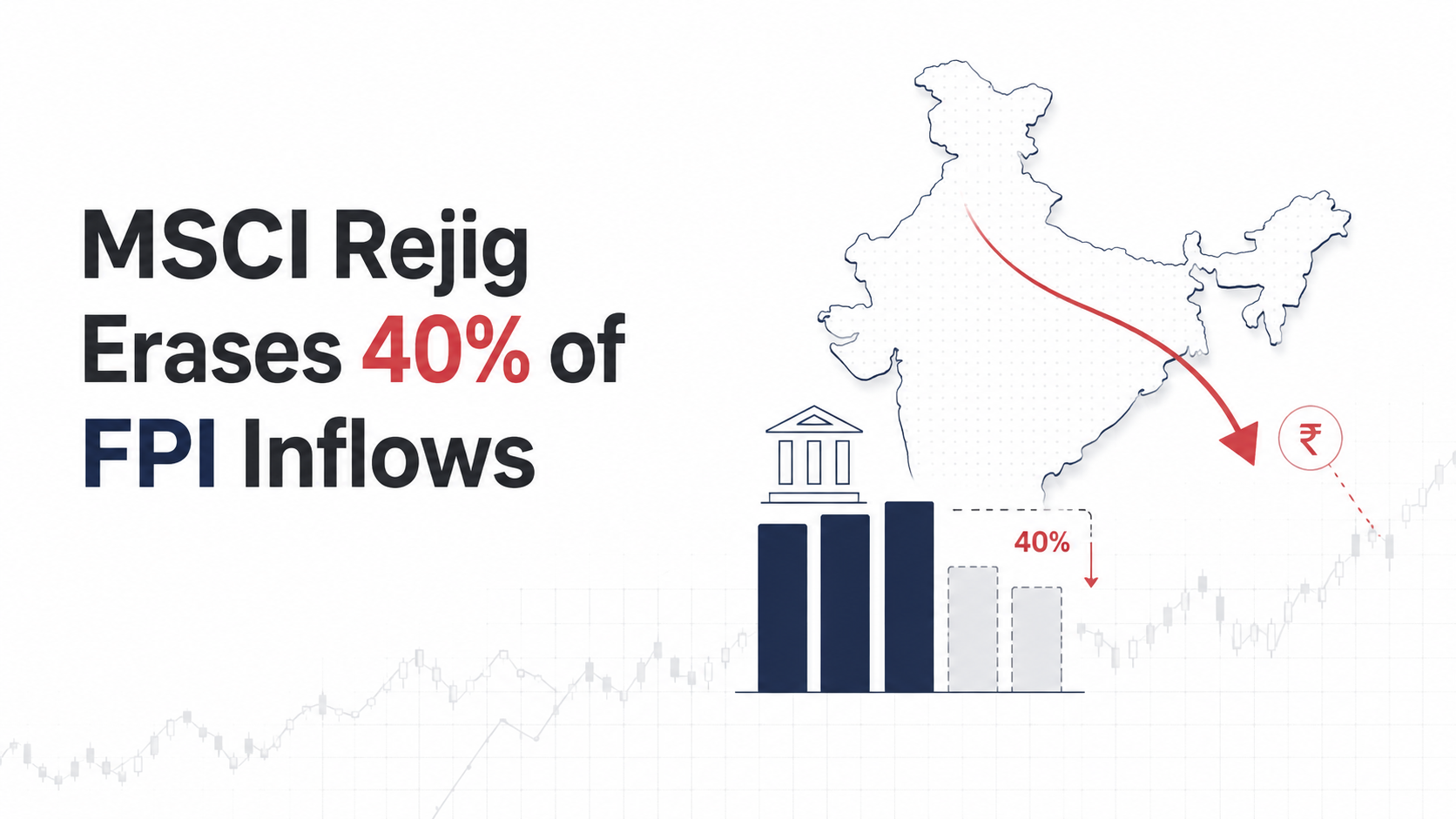
Foreign portfolio investors (FPIs) sold a net ₹7,986 crore of Indian equities on August 31, wiping out nearly 40% of the foreign buying recorded since July. The sharp exit coincided with the first major MSCI index rebalance conducted through India’s new Closing Auction Session (CAS).
The selling was large enough to reverse August’s modest foreign inflow into a net outflow. Domestic institutional investors (DIIs), however, stepped in with net purchases of about ₹4,589 crore, cushioning part of the pressure.
The episode highlights two important trends in Indian equities: MSCI rebalancing can produce large mechanical foreign flows, and domestic institutions are increasingly capable of absorbing some of that selling.
How Much Did FPIs Sell During the MSCI Rejig?
FPIs sold ₹7,985.88 crore of Indian equities on August 31 as MSCI-linked portfolio adjustments dominated trading.
It was one of the largest single-day foreign sell-offs of 2026.
Here is the flow picture:
| Market flow indicator | Amount |
|---|---|
| FPI selling on August 31 | ₹7,986 crore |
| DII buying on August 31 | ₹4,589 crore |
| July FPI buying | About ₹20,200 crore |
| July plus recent August FPI buying | ₹20,654 crore |
| August FPI net flow after selling | About -₹7,532 crore |
| August DII net purchases | ₹58,268 crore |
| CAS turnover | ₹39,718 crore |
The ₹7,986 crore sell-off erased close to 40% of the ₹20,654 crore in net foreign buying accumulated during July and the first three weeks of August.
“Start investing with confidence! Explore
0 demat account
and grow your wealth.”
Why Did the MSCI Rejig Trigger Heavy FPI Selling?
A significant portion of the selling was linked to index rebalancing rather than a sudden change in the fundamentals of the Indian economy.
MSCI periodically reviews its indices and adjusts their constituents and weights. Funds that track those indices must then modify their portfolios accordingly.
That creates three main types of trades:
- Funds buy stocks newly included in an MSCI index.
- Funds sell stocks removed from an index.
- Funds increase or reduce holdings when a stock’s index weight changes.
These transactions can involve billions of dollars because large global passive funds use MSCI indices as benchmarks.
The August rebalance was particularly important because it was the first major MSCI review after India’s new Closing Auction Session became operational.
Which Stocks Were Affected by the MSCI Rebalancing?
The latest MSCI review resulted in several notable changes to Indian stocks.
Among the additions were:
- Laurus Labs
- Lenskart Solutions
- Adani Energy Solutions
- Billionbrains Garage Ventures, the parent company of Groww
Among the deletions were:
- Balkrishna Industries
- SBI Cards and Payment Services
- Astral
Reliance Industries was also expected to face a significant passive outflow because of a reduction in its index weight, while Adani Enterprises and Adani Ports were among stocks expected to receive additional index-linked buying.
The important point is that an MSCI rebalance creates both inflows and outflows. The ₹7,986 crore FPI figure represents the net foreign institutional activity across the market, not simply selling from stocks removed from MSCI indices.
How Did CAS Amplify the MSCI Rebalancing Activity?
The Closing Auction Session, or CAS, concentrates buy and sell orders near the end of the trading day to establish closing prices.
The August 31 MSCI rebalance provided the new mechanism with its first major stress test.
CAS handled ₹39,718 crore of transactions, equivalent to around $4.2 billion. That represented 22% of the NSE’s total cash-market turnover for the session.
On ordinary trading days during August, CAS had accounted for only about 1% of turnover.
That means the MSCI session produced an extraordinary concentration of trading activity in a roughly 20-minute window.
More than 98,000 unique investors participated, while CAS turnover was about 42 times that of the previous trading session.
Why Do MSCI Rebalances Create Such Large Closing Trades?
Passive funds face a problem during index rebalances.
Suppose a stock’s MSCI weight increases. An index fund tracking that benchmark needs to buy additional shares to remain aligned with the new index composition.
Buying too early can create tracking differences if the stock moves before the revised benchmark takes effect. Buying too late risks not completing the required trade.
The closing auction gives passive managers an opportunity to transact near the official closing price.
When billions of dollars of index-linked money attempt to do this simultaneously, however, trading volumes can rise dramatically.
During the latest event, about 514 million shares changed hands across 19 affected stocks in CAS, equivalent to roughly 86% of the estimated 595 million shares of rebalance-related volume tracked by brokerages.
Did FPIs Really Reverse Their Recent Comeback?
To a significant extent, yes.
Foreign investors had been heavy sellers earlier in 2026, withdrawing more than ₹1.7 lakh crore during the first half of the year. They returned as buyers in July, investing about ₹20,200 crore.
That raised hopes that the foreign selling cycle was easing.
The August 31 MSCI session changed the picture considerably.
Before the final trading day, August had recorded only about ₹454 crore of net FPI buying. The ₹7,986 crore sell-off pushed the month’s final figure to a net outflow of roughly ₹7,532 crore.
So, while the MSCI rebalance did not erase all of July’s foreign buying, it removed a large part of the recent recovery.
Why FPI Selling Does Not Necessarily Mean Foreign Investors Turned Bearish
A large one-day outflow can look alarming, but the context matters.
MSCI rebalancing creates rules-based portfolio adjustments. Passive funds are not necessarily deciding that a company or India as a whole has become a worse investment.
They are changing their holdings because the benchmark they track has changed.
That distinction matters when interpreting the ₹7,986 crore outflow.
The selling came on the same day that billions of dollars of MSCI-linked trades were being executed through CAS. This makes it difficult to treat the one-day number as a clean indicator of foreign investor sentiment.
A better assessment requires looking at FPI flows over several weeks after the rebalance.
How Did Domestic Investors Respond?
Domestic institutions once again acted as an important counterweight to foreign selling.
DIIs purchased a net ₹4,588.88 crore of equities on August 31. Their net purchases for August reached approximately ₹58,268 crore.
That domestic demand helped absorb a substantial portion of the foreign selling.
The trend extends beyond a single trading session.
According to ownership analysis cited by Moneycontrol, DII ownership of the Nifty 500 reached a record 21% in the June 2026 quarter, while foreign institutional ownership fell to an all-time low of 17%.
This marked the first time domestic institutions had clearly moved ahead of foreign investors in ownership of the broader index.
Why Is Rising DII Ownership Important?
For years, large FPI inflows and outflows had an outsized influence on Indian equities.
That relationship is gradually changing.
Growing mutual fund assets, systematic investment plan contributions, insurance money and other domestic institutional capital provide a deeper local pool of equity demand.
This does not make India immune to FPI selling.
It does mean that a foreign sell-off may have a smaller impact on benchmark indices when domestic institutions are willing to take the other side of the trade.
The August 31 session offered a useful example.
FPIs sold almost ₹8,000 crore, yet DIIs bought close to ₹4,600 crore. The Nifty 50 fell 95 points, or around 0.39%, to close at 24,080.40, rather than experiencing a decline proportional to the size of the foreign selling.
What Happened to the Market During the FPI Exit?
The broader market reaction was relatively contained compared with the size of the foreign outflow.
On August 31:
- Nifty 50 fell 0.39% to 24,080.40.
- Sensex declined about 307 points, or 0.40%, to 76,957.27.
- Nifty Bank gained 0.92%.
- Nifty Midcap 100 gained 0.24%.
- Nifty Smallcap 100 declined 0.74%.
The headline indices therefore did not experience a broad sell-off comparable with the magnitude of the ₹7,986 crore FPI withdrawal.
Stock-level movements during CAS were considerably more volatile.
That difference reinforces the role of index-specific flows. The pressure was concentrated in securities affected by MSCI changes and in stocks where auction liquidity was uneven.
How Did the Previous MSCI Rebalance Compare?
The August event was not the largest FPI sell-off associated with an MSCI rebalance in 2026.
On May 29, FPIs sold about ₹21,106 crore, making that session the year’s largest foreign sell-off linked to a major MSCI rebalancing event. An early-June session also recorded selling of roughly ₹8,800 crore.
The comparison shows why investors should be cautious when interpreting FPI data around index review dates.
Large outflows on these days may reflect benchmark mechanics as much as changes in investor conviction.
What Does the FPI Exit Mean for Retail Investors?
For long-term investors, a single day of heavy FPI selling should not automatically be treated as a signal to sell.
Three distinctions are useful.
1. Index Flows Are Different From Fundamental Selling
An MSCI-driven transaction can happen even if nothing has changed in a company’s revenue, earnings, balance sheet or long-term prospects.
Passive funds are following benchmark rules.
2. Stock-Level Volatility Can Be Temporary
Stocks facing large additions, deletions or weight changes can experience unusually strong demand or supply around the rebalance date.
Prices may therefore move sharply without a corresponding corporate announcement.
3. Sustained FPI Trends Matter More
If foreign investors continue selling heavily for weeks after the MSCI adjustment, that would provide stronger evidence of a broader change in sentiment.
One rebalance session alone cannot establish that trend.
What Could Influence FPI Flows From Here?
The next phase of foreign investment will depend on factors beyond MSCI mechanics.
Indian Equity Valuations
Foreign investors compare Indian equities with opportunities in other emerging and developed markets.
If Indian stocks trade at high valuations relative to expected earnings growth, global funds may allocate capital elsewhere.
Corporate Earnings
Improving earnings growth can make Indian equities more attractive even when valuations appear elevated.
Weak earnings, on the other hand, can make premium valuations harder to justify.
US Interest Rates and the Dollar
Higher US yields can make dollar-denominated assets more attractive and reduce investor appetite for emerging-market equities.
A weaker dollar and lower global interest rates can have the opposite effect.
Crude Oil Prices
India imports much of its crude oil requirement. Rising oil prices can increase inflationary pressure, affect the current account and influence expectations for interest rates.
Geopolitical Risk
Trade tensions and geopolitical conflicts can push global investors toward safer assets, resulting in withdrawals from emerging markets.
These factors will matter more for the medium-term FPI trend than a mechanical MSCI rebalance.
Does the FPI Sell-Off Change India’s Equity Market Story?
Not by itself.
The MSCI event highlights the continuing importance of foreign capital, but it also shows how India’s investor base is evolving.
FPIs can still generate significant volatility, particularly around major index events. At the same time, domestic institutions are holding a larger share of the market and providing substantial liquidity when foreign investors sell.
That creates a different market structure from one in which foreign flows dominate price direction.
For investors, the more useful question is not whether FPIs sold ₹7,986 crore on one day.
It is whether foreign investors resume sustained buying after the MSCI adjustment, and whether domestic institutions continue absorbing supply if they do not.
FAQs
How much did FPIs sell during the latest MSCI rebalance?
FPIs sold a net ₹7,986 crore of Indian equities on August 31, 2026, making it one of the largest single-day foreign sell-offs of the year.
How much of the recent FPI inflows were erased?
The selling erased nearly 40% of the ₹20,654 crore of net foreign buying recorded during July and the first three weeks of August.
Why did FPIs sell after the MSCI rejig?
A substantial part of the activity was caused by passive and index-tracking funds adjusting their portfolios to reflect MSCI additions, deletions and weight changes. The selling therefore should not be interpreted entirely as a bearish view on India.
What was India’s FPI flow in August 2026?
The sharp August 31 selling pushed foreign institutional activity for August to a net outflow of about ₹7,532 crore, reversing the small net inflow recorded through August 28.
How much did DIIs buy during the FPI sell-off?
Domestic institutional investors bought approximately ₹4,589 crore of equities on August 31, partly offsetting the ₹7,986 crore of foreign selling.
What is MSCI rebalancing?
MSCI rebalancing is the periodic adjustment of stocks and weights within MSCI indices. Funds tracking those indices must buy or sell securities to align their portfolios with the updated benchmark.
What is CAS in the Indian stock market?
CAS stands for Closing Auction Session. It is an end-of-day auction mechanism designed to concentrate liquidity and establish closing prices for eligible securities. The latest MSCI rebalance was the first major MSCI review after CAS began operating in India.
Does heavy FPI selling mean the stock market will fall?
Not necessarily. Market performance depends on the reason for the selling, domestic institutional demand, company fundamentals and broader economic conditions. On August 31, the Nifty declined only about 0.39% despite FPIs selling nearly ₹8,000 crore.
Can MSCI inclusion increase a stock’s price?
MSCI inclusion can create buying demand from passive funds tracking the index, but it does not guarantee a price increase. Existing expectations, liquidity, active investor positioning and the balance of auction orders can all affect the stock’s price.
Key Takeaways
- FPIs sold ₹7,986 crore of Indian equities during the August 31 MSCI rebalancing session.
- The selling erased nearly 40% of ₹20,654 crore in recent foreign buying accumulated since July.
- August flipped from a small FPI inflow before the final trading day to a net outflow of about ₹7,532 crore.
- India’s new Closing Auction Session handled ₹39,718 crore, or about $4.2 billion, of trades, representing 22% of NSE cash-market turnover.
- DIIs bought around ₹4,589 crore during the session, helping offset foreign selling.
- DII ownership of the Nifty 500 had risen to 21%, compared with FII ownership of 17% in the June 2026 quarter.
- Investors should distinguish mechanical MSCI rebalancing flows from a sustained change in foreign investor sentiment.
- FPI activity in the weeks following the rebalance will offer a clearer signal about the direction of foreign capital in Indian equities.
Disclaimer
The stocks mentioned in this article are not recommendations. Please conduct your own research and due diligence before investing. Investment in securities market are subject to market risks, read all the related documents carefully before investing. Please read the Risk Disclosure documents carefully before investing in Equity Shares, Derivatives, Mutual fund, and/or other instruments traded on the Stock Exchanges. As investments are subject to market risks and price fluctuation risk, there is no assurance or guarantee that the investment objectives shall be achieved. Lemonn (Formerly known as NU Investors Technologies Pvt. Ltd) do not guarantee any assured returns on any investments. Past performance of securities/instruments is not indicative of their future performance.
Related Posts



Download Lemonn
Download my app for share market trading, ipo investment, trading account, and all your investment needs.



