
What Are DISCOMs? Power Distribution and Smart Meters
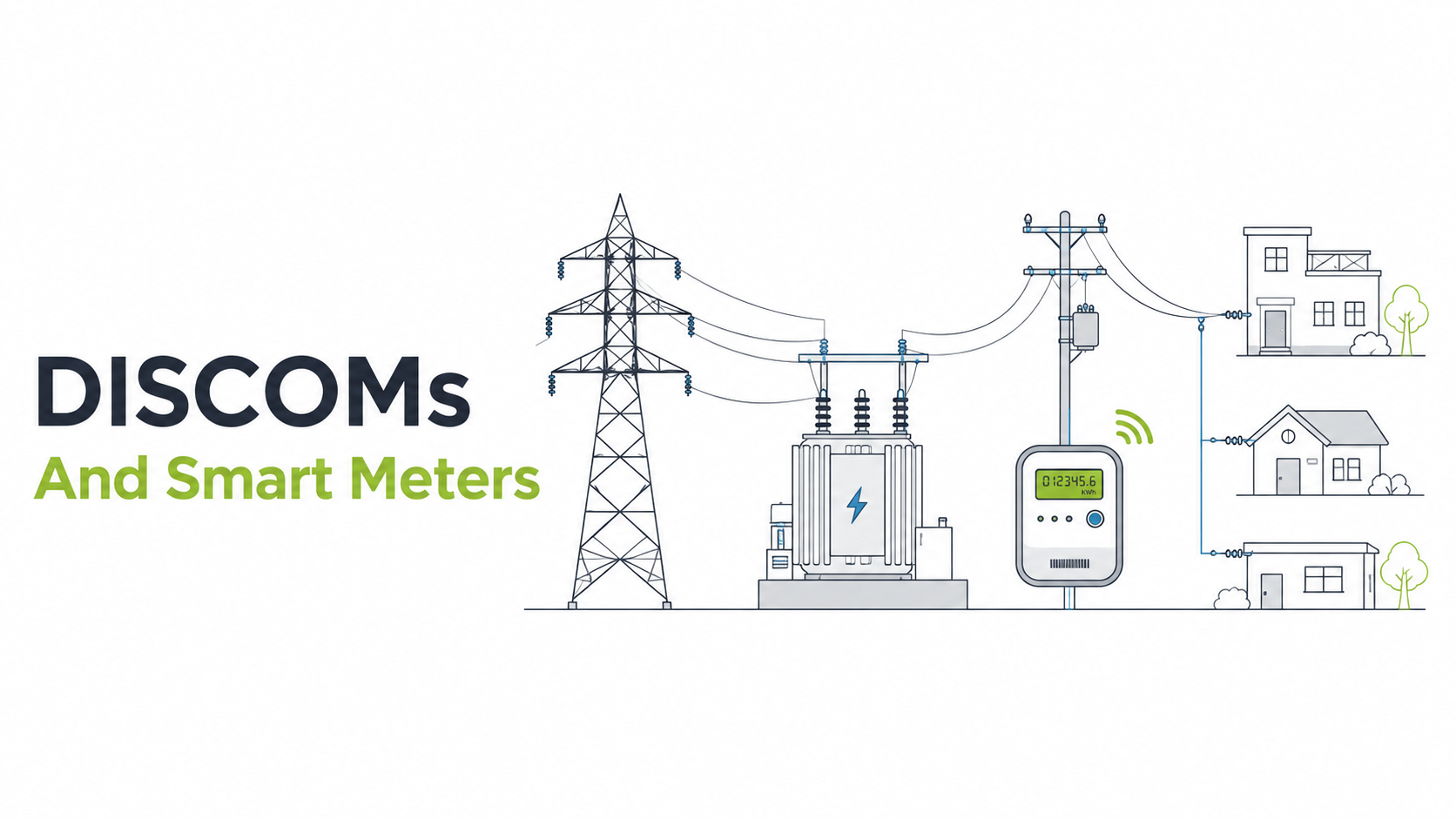
DISCOMs, short for electricity distribution companies, deliver electricity from the transmission network to homes, shops, offices, factories and other consumers.
They are the final commercial link in India’s electricity supply chain. Their financial health matters because electricity generation alone is not enough. Power must also be distributed, measured, billed and paid for efficiently.
India is using smart meters and schemes such as the Revamped Distribution Sector Scheme, or RDSS, to improve this part of the power system.
What is a DISCOM?
A DISCOM is an electricity distribution utility.
Its job generally includes:
- receiving electricity from transmission networks,
- operating local distribution networks,
- maintaining transformers and power lines,
- providing consumer connections,
- metering electricity,
- issuing bills,
- collecting payments,
- handling outages and complaints.
Some DISCOMs are owned by state governments, while private distribution utilities operate in certain areas.
How does India’s electricity system work?
India’s electricity value chain can broadly be divided into three stages.
“Start investing with confidence! Explore
Lemonn
and grow your wealth.”
1. Generation
Power producers generate electricity from sources such as:
- coal,
- natural gas,
- hydro,
- nuclear,
- solar,
- wind.
2. Transmission
High-voltage networks carry bulk electricity over long distances from generating stations to different regions and load centres.
3. Distribution
DISCOMs take power from the transmission system and deliver it to individual users through lower-voltage networks.
Distribution is the stage at which electricity finally becomes a consumer service.
Why are DISCOMs so important?
A financially weak distribution company can create problems throughout the electricity ecosystem.
If a DISCOM cannot recover enough money from customers, it may struggle to pay power-generating companies.
Generators can then face delayed receivables and cash-flow pressure.
The DISCOM may also have less money available for:
- network maintenance,
- transformer upgrades,
- new connections,
- digital systems,
- outage reduction,
- infrastructure expansion.
Healthy electricity distribution is therefore essential for reliable power supply.
Why have many Indian DISCOMs faced financial problems?
Several factors can contribute.
High technical losses
Some electricity is lost naturally when power moves through wires and transformers.
Old or overloaded infrastructure can increase these losses.
Electricity theft
Illegal connections and meter tampering create commercial losses.
Inaccurate billing
Manual meter reading and estimated bills can create errors.
Poor collection efficiency
A bill does not help a DISCOM if it remains unpaid.
Tariff issues
Electricity prices for some consumer categories may not fully reflect the cost of supply.
Delayed subsidy payments
Governments may subsidise electricity for certain groups.
If promised subsidy payments are delayed, DISCOM cash flows can weaken.
What are AT&C losses?
AT&C stands for Aggregate Technical and Commercial losses.
This is an important measure of distribution efficiency.
AT&C losses can reflect:
- technical electricity losses,
- theft,
- unmetered consumption,
- billing problems,
- collection failures.
Imagine a DISCOM supplies electricity with an economic value of ₹100 but effectively realises only ₹85 after these losses.
The missing ₹15 represents a serious financial problem when repeated across millions of consumers.
Reducing AT&C losses is therefore a central goal of distribution reform.
What is a smart meter?
A smart meter is a digital electricity meter that can record consumption and electronically communicate usage information.
Traditional meters often require someone to physically visit the property to record a reading.
A smart meter can automate much of this process.
Depending on the system, it can support:
- remote meter reading,
- more accurate billing,
- prepaid electricity,
- remote connection management,
- outage detection,
- consumption monitoring,
- energy analytics.
What is a prepaid smart meter?
A prepaid meter allows consumers to pay for electricity before or as they consume it.
It works somewhat like a prepaid mobile connection.
The consumer adds money to an account, and charges are deducted based on electricity use.
This can improve payment collection for DISCOMs because large unpaid bills are less likely to accumulate.
Consumers can also get better visibility into their electricity consumption.
What is RDSS?
The Revamped Distribution Sector Scheme is a Government of India programme focused on improving the operational efficiency and financial sustainability of distribution utilities.
Smart metering and distribution infrastructure upgrades are major components of the programme.
The Ministry of Power maintains an RDSS dashboard and monitoring systems covering smart-metering and loss-reduction projects.
Because the dashboard is continuously updated and can contain project-specific views, current installation numbers should always be quoted with a clear date and source.
How can smart meters help DISCOMs?
Better billing
Automated readings reduce dependence on manual meter visits.
This can lower billing errors and estimated consumption.
Better collection
Prepaid systems can reduce outstanding consumer dues.
Faster loss detection
Smart data can help identify areas where electricity supplied does not match electricity billed.
Better outage information
Digital meters can provide data that helps utilities locate interruptions.
Consumption visibility
Consumers can monitor their usage more closely.
Better grid planning
Detailed data can help utilities understand when and where demand occurs.
Can smart meters reduce electricity theft?
They can help, but they are not a complete solution.
Smart meters may reveal unusual patterns, tampering or discrepancies between power supplied and recorded consumption.
However, preventing theft also requires:
- enforcement,
- secure infrastructure,
- feeder monitoring,
- distribution upgrades,
- consumer cooperation.
Technology alone cannot eliminate every commercial loss.
Are smart meters good for consumers?
They can offer several benefits.
Consumers may receive:
- more accurate bills,
- easier digital payment,
- better consumption information,
- fewer estimated readings,
- faster service response.
However, implementation quality matters.
Poorly explained prepaid systems, incorrect meter configuration or weak grievance handling can frustrate users.
Consumer education is therefore important.
What are the risks and concerns?
Billing disputes
Consumers may challenge unexpectedly high bills.
Digital connectivity
Meters need reliable communication networks.
Cybersecurity
A more digital electricity grid creates cybersecurity risks.
Data privacy
Electricity consumption data can reveal detailed behavioural patterns and therefore needs safeguards.
Consumer acceptance
Some households may be uncomfortable with prepaid billing or automated disconnection mechanisms.
Implementation cost
Large-scale replacement of conventional meters requires substantial investment and operational capability.
Can smart meters fix DISCOM finances?
Not by themselves.
Smart meters can improve measurement, billing and collection.
But they cannot independently solve structural problems such as:
- tariffs below the cost of supply,
- delayed subsidies,
- high power-purchase costs,
- inefficient planning,
- weak governance.
Smart metering works best as part of a broader reform programme.
Why does DISCOM reform matter for investors?
Improving distribution finances can benefit several parts of the power ecosystem.
Potential beneficiaries include:
- electricity generators,
- renewable energy companies,
- smart-meter manufacturers,
- cable companies,
- transformer manufacturers,
- grid-technology providers,
- power-finance institutions.
Stronger DISCOM cash flows can also reduce payment risk for companies selling electricity to them.
Why will distribution become more important?
India’s electricity system is becoming more complex.
Demand is rising due to:
- economic growth,
- urbanisation,
- industrial expansion,
- air-conditioning,
- data centres,
- electric vehicles.
At the same time, more renewable electricity and rooftop solar are entering the grid.
The distribution network therefore needs better monitoring, flexibility and digital control.
FAQs
What is the full form of DISCOM?
DISCOM stands for electricity distribution company.
What does a DISCOM do?
It distributes electricity to end consumers, operates local networks, meters usage, issues bills and collects payments.
What are AT&C losses?
They measure technical and commercial losses, including electricity loss, theft, billing inefficiencies and collection failures.
What is a smart electricity meter?
It is a digital meter that records electricity consumption and can communicate usage information electronically.
What is a prepaid smart meter?
It allows electricity charges to be deducted from a prepaid balance based on actual usage.
What is RDSS?
RDSS is the Revamped Distribution Sector Scheme, a government programme intended to strengthen electricity distribution efficiency and financial sustainability.
Key takeaways
- DISCOMs are responsible for delivering electricity to consumers.
- Their finances affect generators and the wider power sector.
- AT&C losses are a major measure of distribution inefficiency.
- Smart meters can improve billing, monitoring and collection.
- RDSS supports smart metering and distribution upgrades.
- Smart meters help, but wider tariff, subsidy and governance reforms remain necessary.
Disclaimer
The stocks mentioned in this article are not recommendations. Please conduct your own research and due diligence before investing. Investment in securities market are subject to market risks, read all the related documents carefully before investing. Please read the Risk Disclosure documents carefully before investing in Equity Shares, Derivatives, Mutual fund, and/or other instruments traded on the Stock Exchanges. As investments are subject to market risks and price fluctuation risk, there is no assurance or guarantee that the investment objectives shall be achieved. Lemonn do not guarantee any assured returns on any investments. Past performance of securities/instruments is not indicative of their future performance.
To read the RA disclaimer
Research Analyst - Gaurav Garg
Related Posts
Download Lemonn
Download my share market app for stock trading—trade stocks effortlessly in the market.



