
Sterlite Technologies ₹2,750 Crore Order Explained
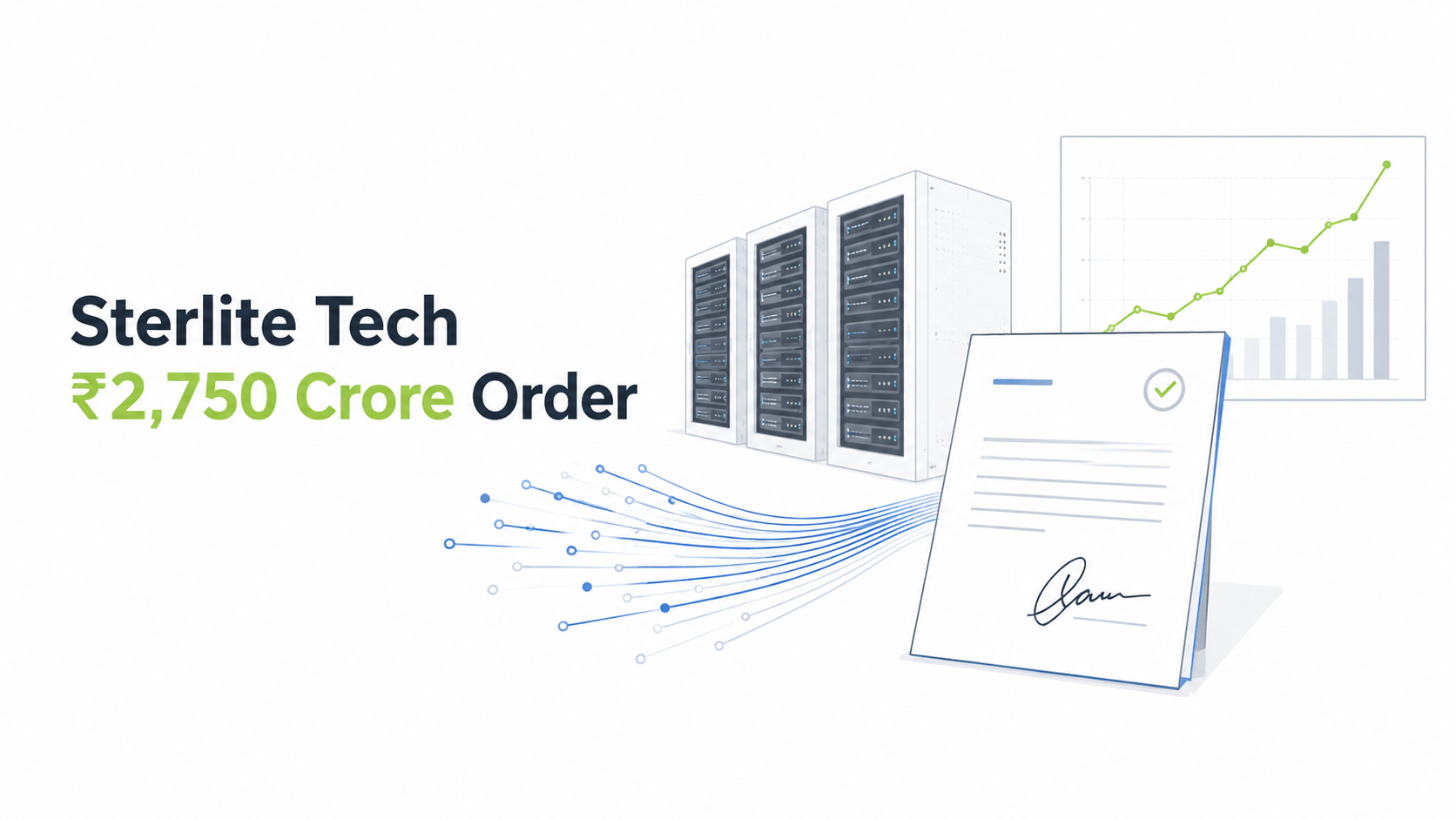
Sterlite Technologies Limited, or STL, shares came into focus after the company announced a $288 million long-term contract with a leading hyperscaler for high-density optical fibre cable products.
The important detail is that $288 million is the official contract value disclosed by STL. Rupee figures such as ₹2,750 crore are approximate currency conversions and can change depending on the exchange rate. Investors should therefore treat the dollar value as the primary disclosed number.
The agreement covers supplies from calendar year 2027 through 2029 and may be extended for another two years with mutual consent.
What did Sterlite Technologies announce?
STL signed a long-term agreement worth approximately $288 million with a leading hyperscaler.
Under the agreement, the company will supply high-density optical fibre cable products according to customer specifications during calendar years 2027, 2028 and 2029.
Purchase orders will be released periodically during the contract period.
The agreement can also be extended by another two years if both parties agree.
Is it really a ₹2,750 crore order?
The official company disclosure gives the contract value in US dollars at approximately $288 million.
₹2,750 crore is an indicative conversion based on a particular dollar-rupee exchange rate.
At a different exchange rate, the rupee value will change.
For example, another market report converted the same $288 million contract to about ₹2,400 crore using a different conversion assumption.
For accuracy, the contract should therefore be described as:
$288 million, or roughly ₹2,700 crore to ₹2,800 crore at applicable exchange rates.
“Start investing with confidence! Explore
Lemonn
and grow your wealth.”
What will STL supply?
The contract covers high-density optical fibre cable products.
These cables are important for modern data centres because AI and cloud infrastructure must move enormous volumes of information between:
- servers,
- processors,
- network switches,
- storage systems,
- data-centre clusters.
Traditional connectivity requirements are increasing sharply as AI workloads grow.
This creates demand for higher fibre density and greater bandwidth.
What is a hyperscaler?
A hyperscaler is a company that operates very large computing and data-centre infrastructure.
Typical hyperscalers provide services such as:
- cloud computing,
- internet platforms,
- AI infrastructure,
- data storage,
- streaming,
- enterprise technology.
Hyperscale facilities can contain enormous numbers of processors and servers.
The more computing capacity these facilities add, the greater the demand for high-speed networking infrastructure.
Why do AI data centres require so much fibre?
Artificial intelligence models require many processors to work together.
Moving data quickly between those processors is critical.
High-performance AI clusters therefore need extremely fast and low-latency connectivity.
Optical fibre offers advantages including:
- very high bandwidth,
- low signal loss,
- longer transmission distance,
- high data capacity,
- ability to scale as networks become more complex.
This is why optical connectivity has become an important part of AI infrastructure spending.
Investors sometimes focus almost entirely on GPUs and processors, but the networking layer is also essential.
Why is the $288 million contract significant for STL?
The contract is important for several reasons.
It improves long-term revenue visibility
The supply period extends across three calendar years from 2027 to 2029.
That gives STL visibility into future customer demand, although actual revenue recognition will depend on purchase orders, deliveries and accounting rules.
It strengthens hyperscaler exposure
Hyperscaler data centres are becoming a major source of connectivity demand.
A large agreement can help establish STL as a meaningful supplier in this market.
It increases exposure to AI infrastructure
The contract connects STL’s optical-fibre business to the broader AI investment cycle.
It may strengthen international business
Large global customers can provide diversification beyond traditional telecom network spending.
What is the risk-sharing mechanism?
One particularly interesting part of the agreement is its reciprocal risk-sharing framework.
STL said the contract defines mutual, capped financial liabilities if there are demand shortfalls or supply-capacity shortages.
In simple terms, the agreement creates obligations for both sides.
If customer demand is significantly below agreed levels or STL cannot provide required supply capacity, defined financial consequences may apply.
This gives the contract more structure than a simple headline order value.
Is the $288 million contract the same as STL’s earlier hyperscaler announcement?
Investors should avoid assuming that.
STL has announced other large hyperscaler-related business wins in 2026.
The $288 million agreement disclosed on August 31 should be treated as a separate disclosed event unless the company explicitly connects it to an earlier contract.
Because STL has not publicly identified the hyperscaler customer, investors should also avoid speculating about whether the customer is Google, Microsoft, Amazon, Meta or another company.
How did Sterlite Technologies shares react?
STL shares rose after the announcement.
Business Standard reported that the stock advanced 2.05% to ₹738 following the disclosure. The stock also touched an intraday record high of ₹757.70 according to Upstox reporting.
Short-term share-price moves, however, should not be confused with long-term business value.
How strong is STL’s current order book?
According to market reporting based on company disclosures, STL’s open order book stood at approximately ₹18,618 crore at the end of the June 2026 quarter.
A large order book can provide revenue visibility, but investors should ask how quickly orders convert into sales and at what margin.
Does a $288 million order mean equivalent profit?
No.
This distinction is crucial.
Order value is not profit.
Revenue will generally be recognised as STL supplies products and satisfies contractual obligations.
The eventual profit contribution depends on:
- raw-material costs,
- production costs,
- logistics,
- product mix,
- currency movements,
- pricing,
- utilisation,
- operating expenses.
A large order can still produce weak returns if margins are poor.
What should investors track next?
Investors should monitor:
- Conversion of the $288 million contract into purchase orders.
- Revenue growth from data-centre customers.
- EBITDA margins.
- Cash flow.
- Capital expenditure.
- Debt.
- Customer concentration.
- Further hyperscaler wins.
- Execution against the CY2027 to CY2029 schedule.
What are the key risks?
Customer concentration
Large contracts can increase dependence on a few major customers.
Execution risk
STL must meet technical specifications and delivery requirements.
Capacity risk
Insufficient production capacity could create contractual consequences under the risk-sharing framework.
Demand risk
If hyperscaler spending slows, future opportunities could weaken.
Margin risk
Strong order intake does not guarantee high profitability.
Currency risk
International contracts can create foreign-exchange exposure.
Valuation risk
A rapidly rising share price can build in expectations that future earnings may not meet.
FAQs
What is the value of STL’s hyperscaler contract?
The officially disclosed value is approximately $288 million.
Is the order worth exactly ₹2,750 crore?
No. ₹2,750 crore is an approximate currency conversion. The official contract value is in US dollars.
How long is the contract?
It covers CY2027 to CY2029 and can be extended for another two years by mutual consent.
What products will STL supply?
High-density optical fibre cable products.
Why do AI data centres need optical fibre?
AI systems require large amounts of data to move rapidly between processors, servers and network equipment.
Is the hyperscaler customer known?
No. STL has described the customer as a leading hyperscaler but has not publicly named it in the cited disclosure.
Key takeaways
- STL officially announced a $288 million hyperscaler contract.
- ₹2,750 crore is an approximate currency conversion, not the official disclosed contract value.
- The contract runs from CY2027 to CY2029.
- It can be extended by two additional years.
- STL will supply high-density optical fibre cables.
- The deal strengthens its exposure to AI and data-centre infrastructure.
- Investors should watch revenue conversion, margins and execution rather than the headline order value alone.
Disclaimer
The stocks mentioned in this article are not recommendations. Please conduct your own research and due diligence before investing. Investment in securities market are subject to market risks, read all the related documents carefully before investing. Please read the Risk Disclosure documents carefully before investing in Equity Shares, Derivatives, Mutual fund, and/or other instruments traded on the Stock Exchanges. As investments are subject to market risks and price fluctuation risk, there is no assurance or guarantee that the investment objectives shall be achieved. Lemonn do not guarantee any assured returns on any investments. Past performance of securities/instruments is not indicative of their future performance.
To read the RA disclaimer
Research Analyst - Gaurav Garg
Related Posts

Download Lemonn
Download my share market app for stock trading—trade stocks effortlessly in the market.



