
Dividend Stocks India: Income and Tax Explained
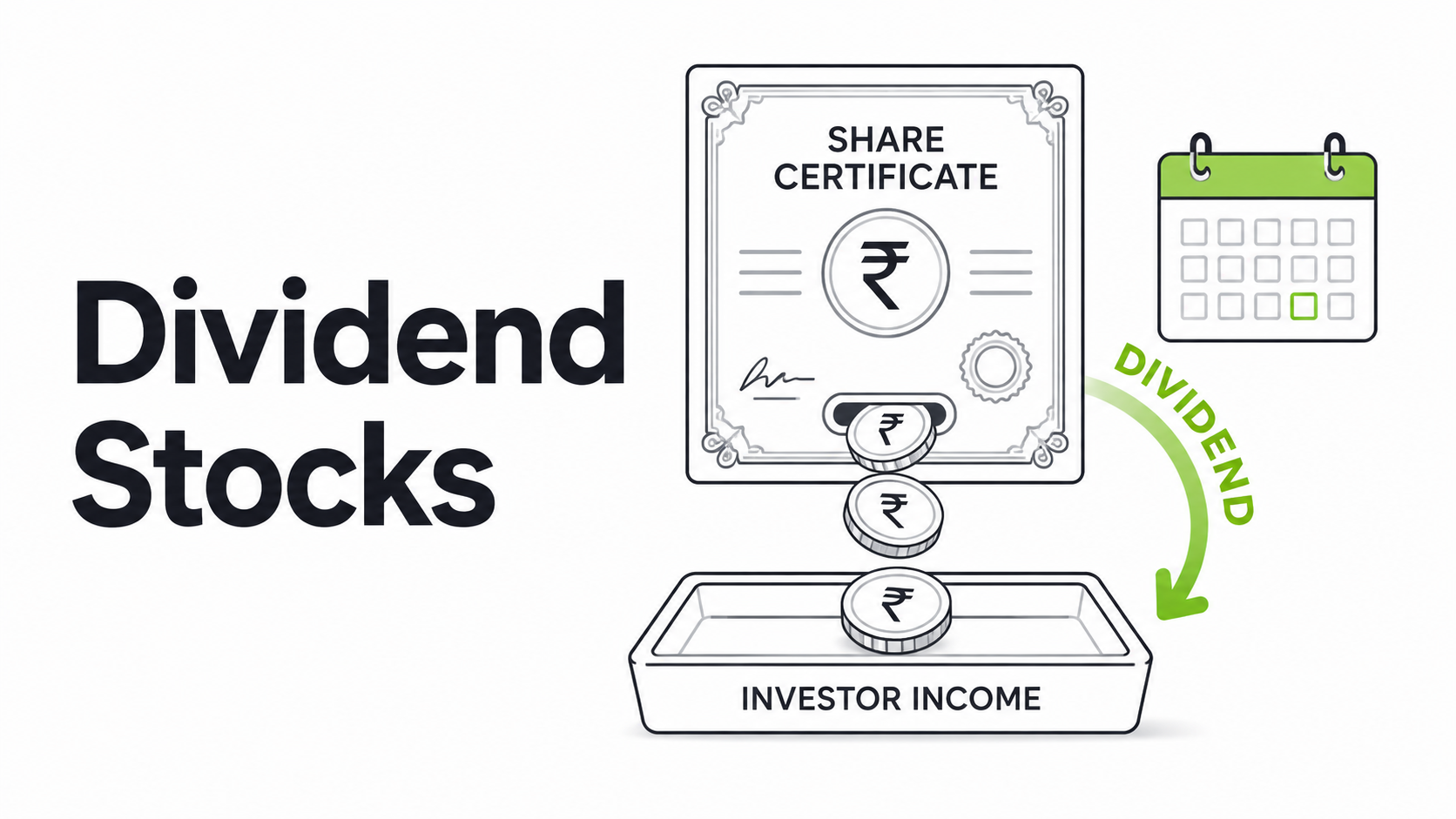
Dividend stocks are shares of companies that distribute part of their profits or available reserves to shareholders. They can provide periodic cash income, but dividend yield alone should never be the reason to buy a stock.
In India, dividend income is generally taxable in the shareholder’s hands under applicable income-tax rules.
What Is a Dividend?
A dividend is a distribution made by a company to eligible shareholders.
A profitable company can choose to use cash in several ways:
- Reinvest in the business
- Repay debt
- Acquire another company
- Buy back shares, subject to applicable rules
- Pay dividends
A dividend is therefore one capital-allocation choice.
Why Do Companies Pay Dividends?
Mature companies may generate more cash than they can reinvest at attractive returns.
Returning part of that cash to shareholders can be sensible.
Companies in stable industries may develop a pattern of regular dividends.
However, dividends are not guaranteed.
“Start investing with confidence! Explore
Lemonn
and grow your wealth.”
What Is an Interim Dividend?
An interim dividend can be declared during the financial year according to corporate-law requirements.
What Is a Final Dividend?
A final dividend is generally associated with the company’s year-end dividend process and relevant shareholder approval requirements.
For investors, the practical concern is the actual distribution, eligibility date, and sustainability.
What Is Dividend Yield?
Dividend yield measures annual dividend relative to the market price.
Formula:
Dividend yield = Annual dividend per share ÷ Share price × 100
Suppose:
- Share price: ₹400
- Annual dividend: ₹16
Then:
Dividend yield = 4%
Is a 10% Dividend Yield Better Than 3%?
Not necessarily.
A high yield can result from a collapsing share price.
Example:
A stock paid ₹20 per share last year.
Its price falls from ₹500 to ₹200 because profits are declining.
The historical dividend yield now appears to be 10%.
But if earnings have collapsed, the company may cut the next dividend.
The high yield could be a warning rather than an opportunity.
What Is Dividend Payout Ratio?
The payout ratio compares dividends with earnings.
A simplified formula is:
Dividend payout ratio = Dividends ÷ Net profit
A company earning ₹100 crore and distributing ₹30 crore has a 30% payout ratio.
A very high payout can be sustainable for some mature businesses but dangerous for a company requiring heavy reinvestment.
What Is Dividend Cover?
Dividend cover looks at how comfortably earnings support the dividend.
The concept helps investors ask:
Does the company actually earn enough to maintain this distribution?
Cash flow can be even more important than accounting profit.
Why Free Cash Flow Matters
A company can report profits but struggle to produce cash.
Before relying on dividends, examine whether the business consistently generates enough operating cash after necessary investment.
A dividend funded repeatedly through borrowing is less reassuring than one funded through genuine free cash flow.
How Are Dividends Taxed in India?
Dividend income is generally taxable in the shareholder’s hands under current rules.
The applicable tax depends on the taxpayer’s situation and relevant provisions.
Investors should report taxable dividend income in their ITR rather than assuming the company has settled the final tax obligation.
Is TDS the Final Dividend Tax?
No.
TDS is a tax collection mechanism.
Your final tax liability depends on:
- Total taxable income
- Applicable rate
- Nature of taxpayer
- Relevant tax provisions
- Credits available
A taxpayer may owe additional tax or be eligible for a refund after adjusting TDS.
Can Expenses Be Deducted Against Dividend Income?
The Income Tax Department’s guidance states that interest expenditure incurred for earning dividend income can be deductible subject to the statutory conditions and a ceiling linked to dividend income. Investors should apply the current provision rather than deducting arbitrary personal expenses.
What Is a Record Date?
A company uses a record date to determine eligible shareholders for a corporate action such as a dividend.
Investors should also understand exchange settlement mechanics and the ex-dividend date.
Buying simply because a dividend has been announced does not create free money.
What Happens to the Share Price After a Dividend?
All else equal, a company’s value is reduced by the cash distributed.
The market price can adjust around the ex-dividend event.
Actual price movement can differ because thousands of other market factors operate simultaneously.
This is why buying a stock just to “capture” a dividend is not automatically profitable.
What Makes a Good Dividend Stock?
Look for a combination of:
- Sustainable earnings
- Strong cash generation
- Manageable debt
- Reasonable payout ratio
- Consistent capital allocation
- Durable business economics
Dividend history can help, but future capacity matters more than past habit.
Should You Buy the Highest-Yield Stocks?
Usually, a yield-only strategy is incomplete.
A very high yield can signal:
- Falling share price
- Temporary windfall dividend
- Unsustainable payout
- Cyclical peak earnings
- Business deterioration
Start with business quality.
Then evaluate the dividend.
Dividend Growth vs High Yield
Consider two companies.
Company A
Yield: 8%
Dividend is flat and profits are declining.
Company B
Yield: 2.5%
Profits and dividends are growing steadily.
Over a long period, Company B could potentially produce a better total result despite the lower starting yield.
This is why dividend growth matters.
What Is Yield on Cost?
Yield on cost compares current annual dividend with your original purchase price.
If you bought a stock at ₹100 and it later pays ₹10 per year, your yield on original cost is 10%.
This can be psychologically interesting, but investment decisions should generally focus on current value and future prospects.
Dividend Stocks vs Fixed Deposits
A dividend stock is not an FD.
Dividend stocks have:
- Equity-market volatility
- Business risk
- No guaranteed dividend
- Potential capital appreciation
- Potential capital loss
An FD offers a contractual interest rate under its terms and does not move with stock-market prices.
Dividend Stocks vs Growth Stocks
A growth company often reinvests most of its profits.
A mature dividend company may distribute more cash.
Neither approach is inherently better.
What matters is whether management can earn attractive returns on retained capital.
If a company can reinvest ₹1 and create ₹2 of long-term value, retaining earnings can be rational.
What Should Retirees Consider?
Dividend stocks can contribute to portfolio income, but relying entirely on dividends creates risk.
A diversified retirement strategy may also consider:
- Fixed income
- Cash reserves
- Systematic withdrawals
- Asset allocation
- Inflation
Dividend cuts can occur precisely when the economy is weak.
Common Dividend Investing Mistakes
Avoid:
- Buying solely for high yield
- Ignoring debt
- Using last year’s dividend as a guarantee
- Ignoring tax
- Buying just before the record date expecting free income
- Overconcentrating in traditional high-dividend sectors
- Ignoring total return
FAQs
Are dividends tax-free in India?
Dividend income is generally taxable in the shareholder’s hands under applicable rules.
What is a good dividend yield?
There is no universal ideal. Sustainability and business quality are more important than the headline yield.
Can a company stop paying dividends?
Yes. Dividends are not guaranteed.
Does a stock always fall by the dividend amount?
The dividend affects economic value, but actual market prices are influenced by many factors.
Are dividend stocks safe?
They remain equities and can suffer large capital losses.
Is dividend income better than capital gains?
Neither is inherently better. They represent different ways shareholder returns can be delivered and can have different tax consequences.
Key Takeaways
- Dividend yield is dividend per share divided by market price.
- High yield does not automatically mean good value.
- Dividend income is generally taxable to Indian shareholders.
- TDS and final tax liability are different.
- Check free cash flow and payout sustainability.
- Dividend stocks still carry full equity-market risk.
- Focus on total shareholder return, not dividend income alone.
Disclaimer
The stocks mentioned in this article are not recommendations. Please conduct your own research and due diligence before investing. Investment in securities market are subject to market risks, read all the related documents carefully before investing. Please read the Risk Disclosure documents carefully before investing in Equity Shares, Derivatives, Mutual fund, and/or other instruments traded on the Stock Exchanges. As investments are subject to market risks and price fluctuation risk, there is no assurance or guarantee that the investment objectives shall be achieved. Lemonn do not guarantee any assured returns on any investments. Past performance of securities/instruments is not indicative of their future performance.
To read the RA disclaimer
Research Analyst - Gaurav Garg
Related Posts



Download Lemonn
Download my share market app for stock trading—trade stocks effortlessly in the market.



