
50/30/20 Budget Rule: Manage Your Salary in India
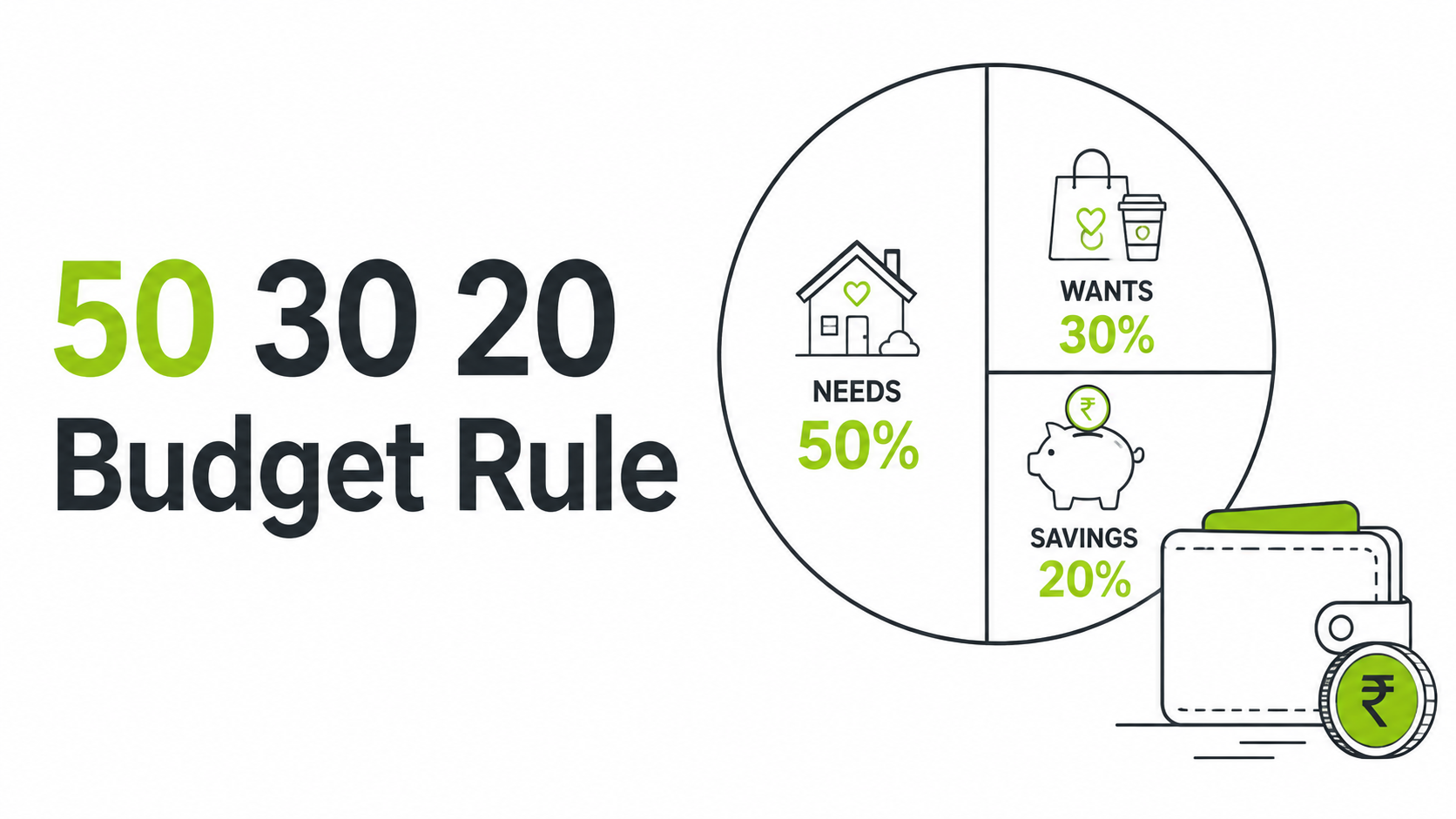
The 50/30/20 budget rule is a simple way to divide your take-home salary. About 50% goes toward essential needs, 30% toward lifestyle wants, and 20% toward savings, investments, and financial goals.
It is best treated as a starting framework rather than a rigid rule. Someone paying high rent in Mumbai may need a different split from someone living with family in Indore.
What Is the 50/30/20 Budget Rule?
The framework divides your usable monthly income into three broad categories:
- 50% for needs
- 30% for wants
- 20% for savings and financial goals
The purpose is not mathematical perfection.
It gives every rupee a broad role and prevents lifestyle spending from quietly consuming your entire salary.
Example for a ₹50,000 Monthly Salary
If your monthly take-home income is ₹50,000:
| Category | Percentage | Amount |
|---|---|---|
| Needs | 50% | ₹25,000 |
| Wants | 30% | ₹15,000 |
| Savings and investments | 20% | ₹10,000 |
You do not need to spend the full ₹15,000 on wants.
If your lifestyle expenses are lower, the difference can go toward investments or faster debt repayment.
“Start investing with confidence! Explore
0 demat account
and grow your wealth.”
Example for a ₹1 Lakh Monthly Salary
For ₹1 lakh take-home income:
- Needs: ₹50,000
- Wants: ₹30,000
- Savings and investments: ₹20,000
Someone earning more should be careful not to let every salary increment automatically increase lifestyle costs.
Your ability to save can improve rapidly when income grows faster than essential expenses.
What Counts as a Need?
A need is an expense you reasonably require for basic living and financial stability.
Examples include:
- Rent
- Basic groceries
- Electricity
- Water
- Essential transport
- Basic mobile and internet costs
- Health insurance
- Necessary medical costs
- Minimum loan repayments
- School expenses
- Essential household costs
Be strict with classification.
A car EMI may be necessary if the vehicle is essential for work, but an expensive upgrade chosen for status is partly a lifestyle decision.
What Counts as a Want?
Wants are discretionary expenses that improve comfort or enjoyment.
Examples include:
- Dining out
- Food delivery
- Premium subscriptions
- Holidays
- Fashion shopping
- Gaming purchases
- Gadgets
- Frequent cab rides
- Expensive memberships
- Entertainment
There is nothing inherently wrong with wants.
The problem begins when they crowd out emergency savings, insurance, debt reduction, and investing.
What Goes Into the 20% Savings Bucket?
This category should improve your future financial position.
It may include:
- Emergency fund contributions
- Mutual fund SIPs
- PPF
- NPS
- Retirement investments
- Goal-based savings
- Extra loan repayment
- Down-payment savings
The right order depends on your situation.
What Should You Prioritise First?
For many beginners, a sensible sequence is:
- Cover essential bills.
- Build a basic emergency reserve.
- Obtain essential insurance.
- Pay expensive debt.
- Invest for long-term goals.
- Increase investments as income rises.
Someone carrying high-interest credit-card debt may benefit more from repaying it than investing aggressively while the debt continues compounding.
How Large Should Your Emergency Fund Be?
There is no universal number.
A common planning range is several months of essential expenses, but the appropriate amount depends on:
- Job stability
- Dependants
- Health costs
- Insurance coverage
- Single vs dual income
- Freelance vs salaried income
A freelancer with volatile income may need a larger reserve than a dual-income household with stable jobs.
Does Loan EMI Count as a Need?
It depends.
Minimum contractual payments on essential debt usually belong in the needs bucket because they must be paid.
Extra repayments can be classified as financial goals.
For example:
Home-loan EMI: Need.
Additional ₹10,000 voluntary prepayment: Savings or financial-goal bucket.
What if Your Needs Are More Than 50%?
Do not force the rule.
Suppose you take home ₹60,000 and your essential costs are:
- Rent: ₹20,000
- Groceries: ₹7,000
- Transport: ₹5,000
- Insurance: ₹2,000
- Utilities: ₹3,000
Needs already total ₹37,000, around 62%.
You could temporarily use a:
60/20/20 structure
or
60/25/15 structure
The goal is to create a workable budget while gradually improving the numbers.
How Can You Reduce the Needs Percentage?
Large expenses matter more than tiny cuts.
Focus first on:
- Housing
- Transport
- Debt
- Insurance
- Recurring bills
Saving ₹500 on coffee is useful, but reducing rent by ₹5,000 creates a much larger recurring improvement.
How Can You Control Wants Without Feeling Restricted?
Create a fixed guilt-free spending amount.
If ₹8,000 per month is available for discretionary spending, you can decide whether to use it for:
- Restaurants
- Shopping
- Trips
- Hobbies
Once the amount is used, wait until the next budget cycle.
This can feel less restrictive than evaluating every purchase emotionally.
Should Investments Be Automated?
Automation can reduce the temptation to spend first and save whatever remains.
A salary-day flow could be:
- Salary arrives.
- SIPs and savings transfers happen automatically.
- Bills are funded.
- Remaining discretionary money is available to spend.
This turns saving into the default.
What Is the “Pay Yourself First” Method?
Instead of:
Income minus expenses = savings
use:
Income minus savings = spending limit
The 50/30/20 framework works particularly well when the 20% allocation is moved early in the month.
Can You Use 50/30/20 With an Irregular Income?
Yes, but use percentages rather than fixed rupee values.
A freelancer can calculate the split every time income arrives.
It also helps to:
- Maintain a larger emergency fund
- Budget from a conservative monthly income estimate
- Separate business and personal money
What if You Want to Retire Early?
A 20% saving rate may not be enough for an aggressive early-retirement goal.
Someone pursuing financial independence may target a much higher savings rate.
The 50/30/20 rule is designed for simplicity, not maximum wealth accumulation.
50/30/20 vs 70/20/10
A 70/20/10 budget often uses categories such as:
- 70% living expenses
- 20% saving and investing
- 10% giving or debt, depending on the version
The best system is the one you can actually follow.
How Should a Beginner Start?
Track one month of actual spending.
Then categorise every expense as:
- Need
- Want
- Future financial goal
If the result is 70/25/5, do not panic.
Try moving gradually toward:
- 65/25/10
- 60/25/15
- 55/25/20
Sustainable improvement beats an unrealistic budget abandoned after two weeks.
Common 50/30/20 Budgeting Mistakes
Avoid:
- Using gross CTC instead of usable income
- Calling every EMI a need
- Treating investments as leftover money
- Ignoring annual expenses
- Forgetting insurance premiums
- Creating a budget with no fun money
- Refusing to adjust percentages for your city or family situation
FAQs
Should 50/30/20 use gross or take-home salary?
Take-home income is usually easier for practical household budgeting because it represents money available to allocate.
Is SIP part of the 20%?
Yes. Long-term SIP investments can form part of the savings and financial-goal category.
Where does credit-card repayment go?
Required repayment is an obligation. Additional accelerated repayment can be treated as a financial goal.
Can I save more than 20%?
Yes. If your needs and wants are lower, increasing savings can materially improve long-term wealth.
Is the 50/30/20 rule suitable for low salaries?
It can still provide a framework, but the ratios may need substantial adjustment when essential costs consume most income.
Key Takeaways
- Use 50% for needs as a starting target.
- Reserve around 30% for lifestyle wants.
- Direct at least 20% toward savings and financial goals when feasible.
- Adjust the ratios to match your real cost of living.
- Automating savings makes the system easier to maintain.
- Focus on major recurring expenses before tiny cuts.
- A workable budget is better than a mathematically perfect one you cannot sustain.
Disclaimer
The stocks mentioned in this article are not recommendations. Please conduct your own research and due diligence before investing. Investment in securities market are subject to market risks, read all the related documents carefully before investing. Please read the Risk Disclosure documents carefully before investing in Equity Shares, Derivatives, Mutual fund, and/or other instruments traded on the Stock Exchanges. As investments are subject to market risks and price fluctuation risk, there is no assurance or guarantee that the investment objectives shall be achieved. Lemonn (Formerly known as NU Investors Technologies Pvt. Ltd) do not guarantee any assured returns on any investments. Past performance of securities/instruments is not indicative of their future performance.
Related Posts

Download Lemonn
Download my app for share market trading, ipo investment, trading account, and all your investment needs.



