
Capital Gains Tax India: STCG vs LTCG Explained
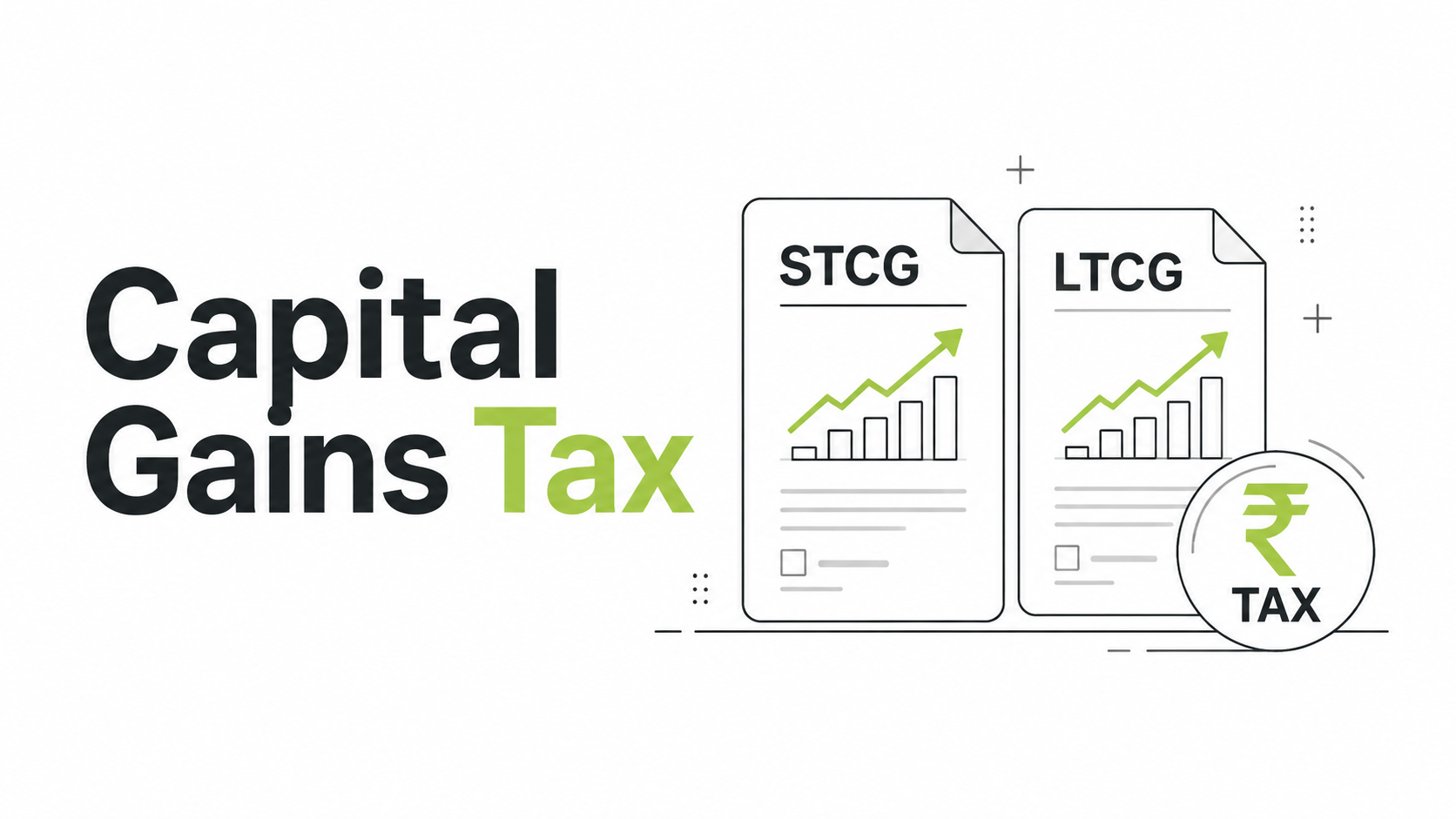
Capital gains tax is the tax you may have to pay when you sell an investment or capital asset for a profit. In India, the amount of tax depends mainly on the asset you sell, how long you held it, and the tax provision that applies to that transaction.
For listed equity shares, equity-oriented mutual funds, and eligible business trust units covered by Section 111A, short-term capital gains are taxed at 20% for transfers on or after 23 July 2024. Long-term capital gains covered by Section 112A are taxed at 12.5% on aggregate eligible gains above ₹1.25 lakh in a financial year.
Here is how STCG and LTCG work in practical terms.
What Is Capital Gains Tax in India?
A capital gain arises when you transfer a capital asset for more than its eligible cost.
A simplified calculation is:
Capital gain = Sale consideration minus cost of acquisition and eligible expenses
For some assets, additional rules may affect the calculation.
Capital assets can include:
- Shares
- Mutual fund units
- Land
- Buildings
- Gold
- Certain bonds
- Unlisted shares
- Other investment assets
A gain does not become taxable merely because the market value of your investment has increased. Normally, the tax event occurs when you transfer or sell the asset, subject to the specific provisions of the Income Tax Act.
What Is STCG?
STCG stands for short-term capital gain.
It generally means a profit from selling a capital asset that you held for a period that falls within the short-term classification applicable to that asset.
The holding period is important because different assets can have different rules.
“Start investing with confidence! Explore
0 demat account
and grow your wealth.”
STCG on Listed Equity Shares
For listed equity shares and eligible equity-oriented mutual fund units covered by Section 111A, gains qualify for the special STCG treatment when the relevant conditions, including Securities Transaction Tax requirements, are met.
For transfers on or after 23 July 2024, the applicable Section 111A rate is 20%.
STCG Example
Suppose you buy listed shares for ₹2,00,000 and sell them several months later for ₹2,60,000.
Ignoring transaction costs for simplicity:
STCG = ₹2,60,000 minus ₹2,00,000 = ₹60,000
If the transaction qualifies under Section 111A, the applicable base tax at 20% would be:
₹60,000 × 20% = ₹12,000
Applicable surcharge and health and education cess may increase the final liability.
What Is LTCG?
LTCG stands for long-term capital gain.
It applies when you sell an asset after holding it beyond the prescribed short-term period for that category.
For listed equity shares, equity-oriented fund units, and eligible business trust units covered by Section 112A, long-term gains are taxed at 12.5% to the extent aggregate eligible LTCG exceeds ₹1.25 lakh for applicable transfers on or after 23 July 2024.
LTCG Example
Suppose you earn ₹2,00,000 in qualifying long-term equity gains during a financial year.
The Section 112A threshold is ₹1,25,000.
So:
₹2,00,000 minus ₹1,25,000 = ₹75,000 taxable LTCG
Base tax:
₹75,000 × 12.5% = ₹9,375
This example ignores surcharge and cess for simplicity.
STCG vs LTCG at a Glance
| Factor | STCG on eligible listed equity | LTCG on eligible listed equity |
|---|---|---|
| Holding period | Short-term classification | Long-term classification |
| Applicable section | Section 111A | Section 112A |
| Current special rate | 20% | 12.5% |
| Annual exemption threshold | No ₹1.25 lakh Section 112A threshold | ₹1.25 lakh aggregate eligible gains |
| STT conditions | Relevant | Relevant |
These equity rules should not be copied blindly to property, gold, bonds, or other investments.
How Are Other Long-Term Capital Gains Taxed?
India’s capital gains framework changed substantially from 23 July 2024.
For many long-term capital assets transferred on or after that date, a 12.5% rate without indexation applies under the general LTCG framework.
There is an important protection for certain resident individuals and Hindu Undivided Families who sell land or buildings acquired before 23 July 2024. In qualifying cases, the law provides grandfathering so the taxpayer does not suffer a higher tax solely because of the transition from the previous indexation regime.
Because different assets have special rules, calculate tax asset by asset.
What Is Indexation?
Indexation was historically used to adjust an asset’s acquisition cost for inflation before calculating certain long-term capital gains.
For many transfers made on or after 23 July 2024, the general 12.5% LTCG framework does not provide indexation.
That can make the calculation simpler, but the impact on an individual taxpayer depends on the asset, original purchase date, appreciation, and applicable grandfathering rules.
Can You Set Off Capital Losses?
Yes, eligible capital losses can reduce taxable capital gains.
Broadly:
- Short-term capital loss can generally be set off against both STCG and LTCG.
- Long-term capital loss can generally be set off only against LTCG.
- Eligible losses that cannot be fully set off may generally be carried forward subject to tax-return filing rules.
This can matter significantly for active investors.
Example
Suppose you make:
- ₹1,20,000 STCG on one investment
- ₹40,000 short-term capital loss on another
Your net short-term capital gain could become ₹80,000, assuming the losses qualify for set-off.
Keep broker statements and transaction records so the figures can be reconciled correctly.
Does Your Income Tax Slab Affect Capital Gains?
It depends on the type of gain.
Some capital gains are taxed at special rates, such as eligible gains under Sections 111A and 112A.
Other short-term capital gains may be added to your normal taxable income and taxed according to applicable slab rates.
Do not assume every profit from an investment attracts the same percentage.
Can You Save Tax by Reinvesting Capital Gains?
Certain provisions provide exemptions when specified conditions are met.
Examples can include eligible reinvestment relating to residential property or specified assets.
However, simply selling shares and buying another stock does not automatically exempt the original gain from tax.
Each exemption has its own:
- Eligible asset rules
- Investment conditions
- Deadlines
- Maximum limits
- Holding requirements
Review the relevant section before relying on an exemption.
What Records Should Investors Keep?
Maintain:
- Contract notes
- Broker capital gains statements
- Purchase and sale records
- Mutual fund statements
- Corporate action records
- Property purchase documents
- Improvement-cost evidence
- Previous ITRs
- Capital loss carry-forward information
Broker tax reports are convenient, but you remain responsible for the accuracy of your return.
Common Capital Gains Tax Mistakes
Ignoring Gains Because No Money Was Withdrawn
Tax treatment usually depends on the sale transaction, not whether the money remains inside your brokerage account.
Forgetting Losses
Capital losses can have tax value. Failing to report them correctly may prevent you from using them later.
Applying Equity Rules to Every Investment
Gold, property, unlisted shares, bonds, and mutual funds can have different tax treatments.
Assuming the Broker Pays Capital Gains Tax
A broker may collect statutory transaction charges, but that does not mean your final income-tax liability has been settled.
Using Old Tax Rates
Capital gains rates changed from 23 July 2024. Older articles mentioning 15% STCG and a ₹1 lakh LTCG threshold may no longer reflect the rules applicable to newer transfers.
FAQs
What is the current STCG tax rate on listed shares in India?
Eligible short-term capital gains covered by Section 111A are taxed at 20% for transfers on or after 23 July 2024.
What is the current LTCG tax rate on listed equity?
Eligible long-term gains under Section 112A are taxed at 12.5% on aggregate gains exceeding ₹1.25 lakh, subject to the section’s conditions.
Is the ₹1.25 lakh exemption available for STCG?
No. The ₹1.25 lakh threshold discussed here applies to eligible LTCG under Section 112A.
Can I adjust stock market losses against gains?
Eligible short-term and long-term capital losses can be set off subject to the Income Tax Act’s rules.
Is capital gains tax automatically deducted by my broker?
Usually, resident investors need to calculate and report their own capital gains tax liability through the tax process. Specific withholding rules can differ for certain taxpayers and transactions.
Key Takeaways
- Capital gains tax applies when eligible capital assets are transferred at a profit.
- STCG and LTCG treatment depends on the asset and holding period.
- Eligible Section 111A STCG is taxed at 20% for transfers on or after 23 July 2024.
- Eligible Section 112A LTCG is taxed at 12.5% above the ₹1.25 lakh aggregate threshold.
- Capital loss set-off can reduce taxable gains.
- Property, gold, bonds, and other assets may follow different rules.
- Always check the rules applicable to the financial year in which the sale occurs.
Disclaimer
The stocks mentioned in this article are not recommendations. Please conduct your own research and due diligence before investing. Investment in securities market are subject to market risks, read all the related documents carefully before investing. Please read the Risk Disclosure documents carefully before investing in Equity Shares, Derivatives, Mutual fund, and/or other instruments traded on the Stock Exchanges. As investments are subject to market risks and price fluctuation risk, there is no assurance or guarantee that the investment objectives shall be achieved. Lemonn (Formerly known as NU Investors Technologies Pvt. Ltd) do not guarantee any assured returns on any investments. Past performance of securities/instruments is not indicative of their future performance.
Related Posts
Download Lemonn
Download my app for share market trading, ipo investment, trading account, and all your investment needs.



