Lenskart’s ₹1,857 Crore Block Deal Explained Simply
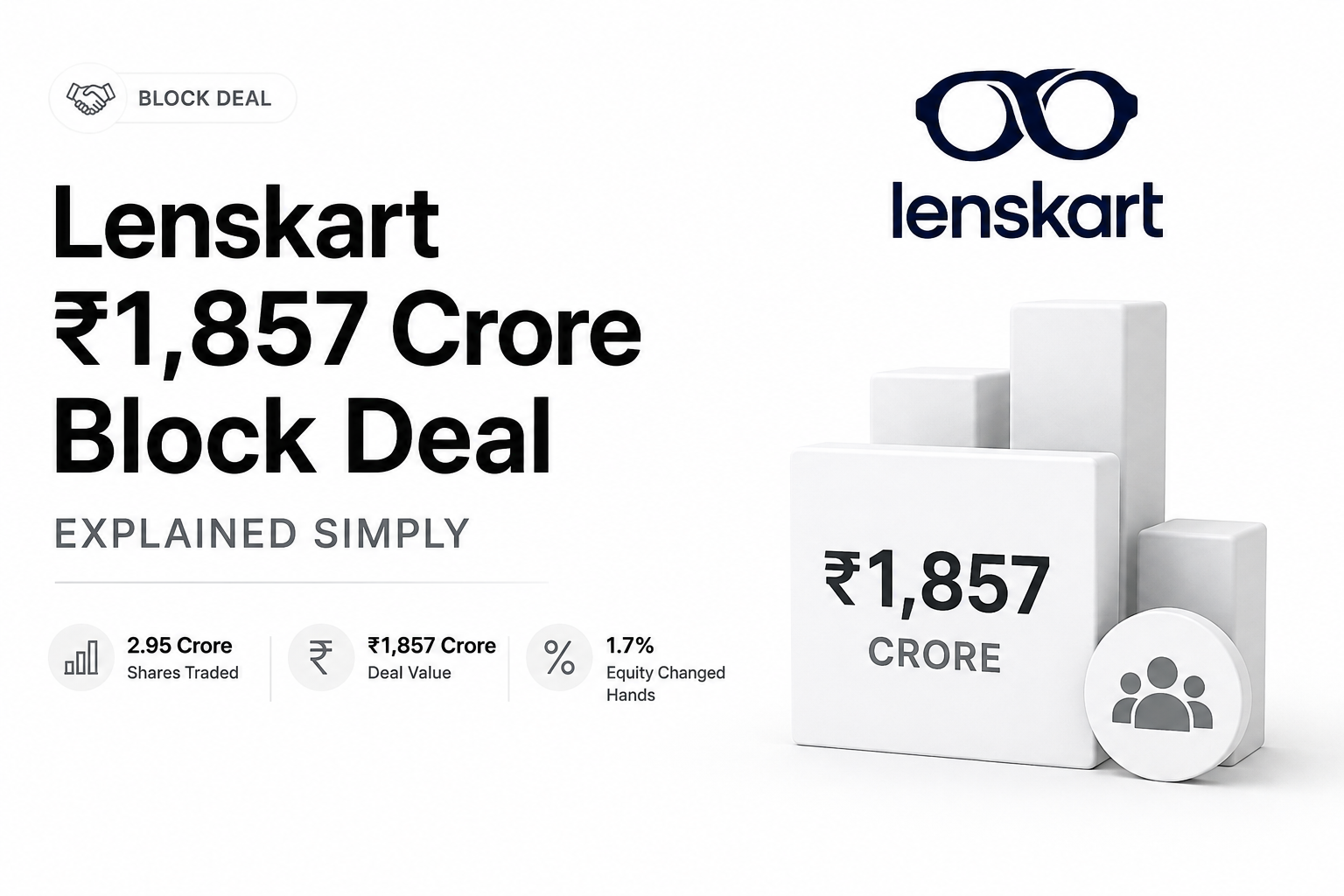
Lenskart Solutions saw a major block deal on August 28, 2026, with about 2.95 crore shares changing hands for roughly ₹1,857 crore. The shares were traded at ₹630 apiece, around a 1.65% discount to Lenskart’s previous closing price of ₹640.60.
The transaction represented roughly 1.7% of Lenskart’s equity. Alpha Wave Ventures II was widely reported as a likely seller, but the identities of all buyers and sellers involved in the ₹1,857 crore transaction were not immediately confirmed.
Here is what happened, why the deal matters, and what Lenskart investors should watch next.
What happened in the Lenskart block deal?
Around 2.95 crore Lenskart shares were traded through the block deal window on August 28.
The key numbers are:
| Detail | Lenskart block deal |
|---|---|
| Shares traded | Around 2.95 crore |
| Deal value | Around ₹1,857 crore |
| Transaction price | ₹630 per share |
| Previous closing price | ₹640.60 |
| Approximate discount | 1.65% |
| Equity changing hands | Around 1.7% |
The ₹630 transaction price was below Lenskart’s August 27 closing price, which is common in large block transactions because sellers may offer a modest discount to attract enough institutional demand.
Lenskart shares consequently came under some pressure. The stock fell around 1.5% during Friday’s trading following the large transaction.
Who sold Lenskart shares in the ₹1,857 crore deal?
Alpha Wave Ventures was reported as a likely seller, but investors should distinguish between the planned sale and the total shares that eventually changed hands.
Before the transaction, reports indicated that Alpha Wave Ventures II could sell up to 2.08 crore Lenskart shares, representing roughly 1.2% of the company. The proposed deal was valued at up to ₹1,313 crore, with a floor price of ₹630 per share.
However, the actual block-deal volume was considerably larger.
About 2.95 crore shares ultimately changed hands, compared with the approximately 2.08 crore shares mentioned in the reported Alpha Wave transaction terms.
That difference matters.
It means investors should not automatically assume that Alpha Wave sold the entire 2.95 crore shares. Alpha Wave may have been one of the sellers, while additional shareholders could have participated.
At the time the transaction was reported, the complete identities of the buyers and sellers had not been officially established.
Why was the Lenskart block deal priced at ₹630?
The ₹630 price represented approximately a 1.65% discount to Lenskart’s August 27 closing price of ₹640.60.
Large investors looking to sell millions of shares cannot always exit through ordinary market trades without affecting the share price.
A block deal provides a more efficient route.
Why do large shareholders use block deals?
Block deals allow large quantities of shares to move between investors through a dedicated trading mechanism.
For a seller, the benefits can include:
- exiting or reducing a large investment relatively quickly
- avoiding repeated selling in the normal market
- getting institutional buyers for a large quantity of shares
- executing the transaction around an agreed price range
Buyers, meanwhile, may get access to a meaningful stake at a small discount to the prevailing market price.
A discount does not automatically mean that investors believe the company is worth less. It can simply be the price required to place a very large number of shares at once.
Does Lenskart receive the ₹1,857 crore?
No. A secondary block deal between existing shareholders and buyers does not mean Lenskart receives ₹1,857 crore.
This distinction is important for retail investors.
In a fresh share issue, a company issues new shares and receives the money raised, subject to the structure of the transaction.
In this case, the reported Alpha Wave transaction was structured as a 100% secondary sale. Money paid for the shares therefore goes to the selling shareholder, not to Lenskart.
So the ₹1,857 crore headline should not be interpreted as fresh capital entering Lenskart’s balance sheet.
Why did Lenskart shares fall after the block deal?
Lenskart shares fell around 1.5% after the ₹1,857 crore block transaction, according to market reports.
There are several possible reasons large stake sales can create short-term pressure.
1. Shares were sold at a discount
The ₹630 block price was below the previous closing price of ₹640.60.
A discounted institutional transaction can temporarily influence the price at which other market participants are willing to buy shares.
2. A large amount of equity entered the market
Nearly 1.7% of Lenskart’s equity changing hands in one transaction is significant.
Large supply events can affect near-term sentiment, even when there is enough institutional demand to absorb the shares.
3. Early investors have been reducing their holdings
The Alpha Wave-linked transaction was not an isolated event.
Just days earlier, SoftBank’s SVF II Lightbulb (Cayman) sold about 2.58% of Lenskart for approximately ₹2,888 crore. Buyers included several domestic and global institutional investors.
That means investors are seeing a broader shift in Lenskart’s shareholder base as some early financial investors monetise part of their holdings.
Is the block deal bad news for Lenskart?
Not necessarily.
A large shareholder selling shares can look negative at first glance, but the reason behind the transaction matters.
Private equity, venture capital and other early-stage investors generally invest with an eventual exit in mind. Once a company is publicly listed and its shares are liquid, these investors may gradually monetise their stakes.
That does not automatically indicate a deterioration in the underlying business.
There is another side to the transaction too. For every share sold in a block deal, somebody has to buy it.
The earlier SoftBank sale illustrates this point. Its Lenskart shares were picked up by a broad set of investors, including Societe Generale, Goldman Sachs-linked entities, Motilal Oswal Mutual Fund, HDFC Mutual Fund and other institutional investors.
The more useful question for shareholders is therefore not simply, “Who is selling?”
It is also, “Who is buying, at what valuation, and what does the company’s operating performance look like?”
Why are Lenskart’s early investors selling shares?
Large investors can reduce holdings for many reasons that have little to do with a company’s immediate prospects.
A private equity or venture investor may sell to:
- return capital to its own investors
- realise gains after a long holding period
- rebalance its portfolio
- reduce exposure after a company’s listing
- take advantage of strong liquidity and higher valuations
This context is particularly relevant for Lenskart.
SoftBank’s approximately ₹2,888 crore sale came only days before the latest ₹1,857 crore transaction. Earlier in June, an ADIA-backed entity had also sold a substantial Lenskart stake through block deals.
The pattern suggests that some pre-IPO institutional shareholders are using the public market to monetise investments.
What does the block deal mean for retail investors?
Retail investors should avoid treating a block deal as an automatic buy or sell signal.
Instead, separate ownership changes from business performance.
Watch the seller’s remaining stake
If early investors repeatedly sell large quantities, additional supply could create short-term pressure on the stock.
The size and timing of future stake sales therefore matter.
Track who is buying
Strong participation from mutual funds, insurers, pension funds or foreign institutional investors can provide useful context about demand for the shares.
It does not guarantee future returns, but it shows whether large transactions are finding institutional buyers.
Focus on Lenskart’s operating numbers
Shareholder exits do not determine how many glasses Lenskart sells, how quickly revenue grows, or how efficiently the business operates.
Investors should continue tracking metrics such as:
- revenue growth
- same-store sales growth
- store expansion
- eyewear volumes
- EBITDA margins
- net profit
- cash generation
- international performance
Lenskart’s investor relations portal provides its quarterly financial results, shareholder letters and official shareholding disclosures, which are more useful for assessing the business over time than reacting to a single day’s share-price movement.
How does this deal compare with SoftBank’s Lenskart sale?
The latest transaction follows a much larger SoftBank block deal earlier in the same week.
| Deal | Approx. stake | Approx. value | Price |
| SoftBank transaction | 2.58% | ₹2,888 crore | ₹641.75 |
| August 28 block deal | 1.7% | ₹1,857 crore | ₹630 |
SoftBank’s SVF II Lightbulb sold around 5.4 crore shares in the August 24 transaction, with multiple institutional investors participating as buyers.
Taken together, the transactions show that several thousand crore rupees worth of Lenskart equity has changed hands within a short period.
That can increase short-term volatility, but it can also broaden the ownership of the company as shares move from early investors to public-market institutions.
What should investors watch next in Lenskart shares?
Three developments deserve attention after the ₹1,857 crore Lenskart block deal.
First, watch for exchange disclosures that identify the major buyers and sellers. These can clarify how much of the transaction came from Alpha Wave and whether other shareholders participated.
Second, monitor whether additional large shareholders reduce their stakes. A steady pipeline of block deals can create an overhang because the market anticipates more shares becoming available.
Third, keep the focus on Lenskart’s financial performance. Block deals change who owns the shares. Revenue, margins, cash generation and growth determine how the underlying business develops.
For long-term investors, that distinction is more important than the immediate reaction to one large trade.
FAQs About the Lenskart ₹1,857 Crore Block Deal
What is the Lenskart ₹1,857 crore block deal?
Around 2.95 crore Lenskart Solutions shares changed hands on August 28, 2026, in a block deal worth approximately ₹1,857 crore. The transaction was executed at around ₹630 per share and represented roughly 1.7% of the company’s equity.
Who sold shares in the Lenskart block deal?
Alpha Wave Ventures was reported as a likely seller. However, the total transaction involved around 2.95 crore shares, more than the approximately 2.08 crore shares included in the reported Alpha Wave sale plan. The complete buyer and seller identities were not immediately confirmed.
At what price did the Lenskart block deal happen?
The shares changed hands at approximately ₹630 each. This represented about a 1.65% discount to Lenskart’s previous closing price of ₹640.60.
How much of Lenskart changed hands?
Approximately 1.7% of Lenskart’s equity changed hands in the ₹1,857 crore block transaction.
Did Lenskart receive ₹1,857 crore from the block deal?
No. The transaction involved existing shares changing hands between shareholders and buyers. It was not a fresh issue of shares by Lenskart, so the headline transaction value should not be treated as money raised by the company.
Why do block deals happen at a discount?
Large shareholders sometimes offer shares at a modest discount to attract enough institutional buyers to absorb a significant quantity in a single transaction. A discounted block price does not, by itself, indicate a problem with the company.
Is a block deal good or bad for a stock?
Neither by default. A block deal can create short-term selling pressure, particularly when a large shareholder exits at a discount. Its longer-term significance depends on why the shareholder sold, who bought the shares, whether more sales are expected, and how the company’s business performs.
Key Takeaways
- Around 2.95 crore Lenskart shares worth ₹1,857 crore changed hands on August 28, 2026.
- The transaction price was approximately ₹630 per share, about 1.65% below the previous closing price.
- The transaction represented roughly 1.7% of Lenskart’s equity.
- Alpha Wave Ventures was reported as a likely seller, but the executed volume exceeded its previously reported sale plan.
- The complete identities of the buyers and sellers were not immediately confirmed when the transaction was reported.
- The deal was a secondary share transaction, so Lenskart itself does not receive the ₹1,857 crore consideration.
- The transaction follows SoftBank’s roughly ₹2,888 crore Lenskart stake sale earlier in the week.
- For long-term investors, future stake sales, institutional buying and Lenskart’s underlying financial performance matter more than the immediate price reaction to a single block deal.
Disclaimer
The stocks mentioned in this article are not recommendations. Please conduct your own research and due diligence before investing. Investment in securities market are subject to market risks, read all the related documents carefully before investing. Please read the Risk Disclosure documents carefully before investing in Equity Shares, Derivatives, Mutual fund, and/or other instruments traded on the Stock Exchanges. As investments are subject to market risks and price fluctuation risk, there is no assurance or guarantee that the investment objectives shall be achieved. Lemonn (Formerly known as NU Investors Technologies Pvt. Ltd) do not guarantee any assured returns on any investments. Past performance of securities/instruments is not indicative of their future performance.