
Hyundai Plans 100+ Models With Major US Hybrid Push
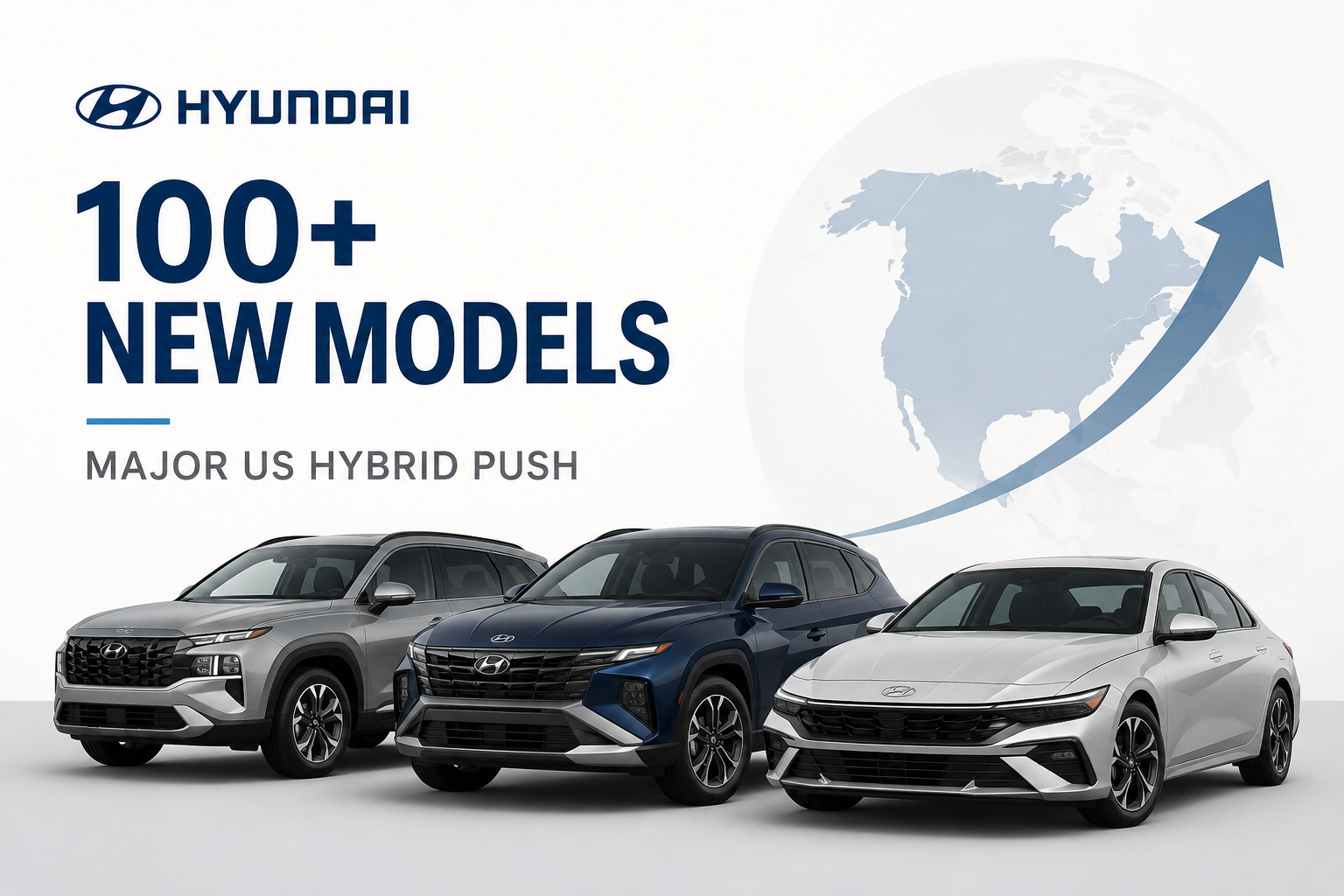
Hyundai Motor is planning its biggest product offensive yet, with more than 100 new or refreshed vehicles set to arrive globally by 2030. A major part of that strategy is North America, where Hyundai plans 58 launches and expects hybrids to account for about half of its sales by the end of the decade.
The strategy goes beyond simply adding more cars. Hyundai is expanding into new vehicle segments, increasing US production, introducing extended-range electric vehicles (EREVs), and giving buyers a wider choice of powertrains as demand patterns shift across major markets.
Hyundai plans more than 100 new and refreshed models
Hyundai announced the product roadmap at its 2026 CEO Investor Day in Seoul. The automaker plans more than 100 global vehicle launches and refreshes by 2030, including over 18 entries into new products and market segments.
The regional rollout is extensive:
| Market | Planned launches and refreshes |
|---|---|
| North America | 58 |
| South Korea | 49 |
| Europe | 41 |
| India | 26 |
| China | 22 |
These figures overlap because individual models can launch in multiple regions. They should not be added together to calculate the global total.
Among the upcoming vehicles are the new Elantra, IONIQ 3, Tucson and Tucson Hybrid, Santa Fe EREV, an A-segment electric SUV for India, and new B-segment SUVs.
Why is Hyundai making such a big hybrid push in the US?
Hyundai sees hybrids as a key route to growth in North America, particularly as consumers look for improved fuel efficiency without depending entirely on charging infrastructure.
By 2030, Hyundai expects to offer more than 10 hybrid models in North America and aims for hybrids to represent roughly 50% of its regional sales mix. The company says cumulative North American hybrid sales have already exceeded one million vehicles.
The strategy is supported by recent sales momentum. Hyundai sold 595,457 vehicles across North America during the first half of 2026, its best first-half performance in the region. US deliveries reached 489,656 vehicles, up 3%, with the Tucson and Palisade among the important contributors.
Hyundai’s US hybrid push also puts it in closer competition with Toyota, which has built a particularly strong position in hybrid vehicles.
“Start investing with confidence! Explore
Lemonn
and grow your wealth.”
Hyundai is not abandoning EVs
The hybrid expansion does not mean Hyundai is moving away from electric vehicles. Instead, the automaker is building a broader electrification strategy that includes hybrids, battery EVs and extended-range EVs.
Hyundai wants electrified vehicles to account for 60% of its global sales by 2030, compared with 23% in 2025.
Santa Fe EREV will target more than 600 miles
One of the more significant additions will be Hyundai’s first EREV, based on the Santa Fe.
An EREV primarily uses electric motors to drive the wheels but carries an internal combustion engine that can generate electricity when needed. This can provide an EV-like driving experience while reducing concerns about finding a charger on longer journeys.
Hyundai says the Santa Fe EREV is expected to provide more than 600 miles of total range. It is scheduled to arrive in the first half of 2027 and will be produced at Hyundai Motor Manufacturing Alabama.
That local production decision is important because Hyundai is simultaneously trying to increase its manufacturing footprint and localization in the US.
Hyundai will add 500,000 units of North American capacity
Supporting 58 North American launches requires significantly more production capacity.
Hyundai plans to increase global manufacturing capacity by 1.27 million vehicles by 2030. The additions include:
- 500,000 units in North America
- 320,000 units in India
- 250,000 units through CKD production sites
- 200,000 units in South Korea
Hyundai also plans to raise its North American local parts sourcing target to more than 80%, up from its previous target of 60%.
Hybrids will be produced at Hyundai Motor Manufacturing Alabama and Hyundai Motor Group Metaplant America in Georgia.
Hyundai wants to enter vehicle segments where it is underrepresented
The 100-plus-model strategy is not limited to replacements and facelifts of existing cars.
Hyundai says it is targeting market “white spaces”, categories where its current presence is relatively limited. These segments represent around 29% of automotive sales, according to the company.
Potential additions include:
- A midsize pickup
- Body-on-frame vehicles
- Light commercial vehicles
- New high-performance models
- Additional hybrid and EREV products
A midsize pickup would be particularly noteworthy in North America, putting Hyundai into a segment occupied by established models from Toyota, Ford and General Motors.
Genesis is also getting hybrids and EREVs
Hyundai’s luxury brand Genesis is part of the electrification expansion.
Genesis plans to introduce its first hybrid and first extended-range EV as it works toward annual sales of 350,000 vehicles across more than 40 markets by 2030. The flagship GV90 electric SUV will also play an important role in the brand’s next phase.
The Genesis GV80 hybrid is expected to launch in South Korea and the US, according to Yonhap.
This is a notable change for a luxury brand that had previously placed a heavy emphasis on battery-electric vehicles.
What does Hyundai’s 2030 strategy mean for buyers?
The clearest message is that Hyundai does not expect one powertrain to suit every customer or market.
Rather than making its growth strategy dependent entirely on battery EV adoption, the company is spreading its investment across conventional vehicles, hybrids, EVs and EREVs.
For US buyers, that could mean a much wider selection of Hyundai hybrids across different vehicle sizes and price points. For Hyundai, it provides flexibility if EV adoption develops more slowly or unevenly than previously expected.
The company is targeting 5.55 million global vehicle sales by 2030 and has raised its consolidated operating profit margin target to above 9%.
FAQs
Q. How many new models will Hyundai launch by 2030?
Hyundai plans more than 100 new vehicle launches and model refreshes globally by 2030. The program includes more than 18 entries into new products and market segments.
Q. How many Hyundai models are planned for North America?
Hyundai has outlined 58 launches and refreshes for North America through 2030, making it one of the biggest markets in the company’s product expansion.
Q. Is Hyundai increasing its hybrid lineup in the US?
Yes. Hyundai plans to offer more than 10 hybrid models in North America by 2030 and expects hybrids to reach around 50% of its regional sales mix.
Q. Is Hyundai moving away from electric cars?
No. Hyundai is broadening its electrification strategy rather than abandoning EVs. It expects electrified vehicles to account for 60% of global sales by 2030 and is investing in battery EVs, hybrids and EREVs.
Q. What is the Hyundai Santa Fe EREV?
The Santa Fe EREV will be Hyundai’s first extended-range electric vehicle. It is expected to offer more than 600 miles of total range and enter the market in the first half of 2027. Hyundai plans to manufacture it in Alabama.
Q. Will Hyundai launch a midsize pickup?
Hyundai has confirmed that midsize pickups are among the new segments it is targeting as part of its 2030 product strategy. Detailed specifications and launch timing have not yet been announced.
Key takeaways
- Hyundai plans more than 100 global vehicle launches and refreshes by 2030.
- North America is set to receive 58 launches and refreshes.
- Hyundai expects hybrids to make up around 50% of its North American sales by 2030.
- More than 10 hybrid models are planned for the region.
- The Santa Fe EREV is targeting more than 600 miles of total range and will be built in Alabama.
- Hyundai plans to add 500,000 units of North American production capacity.
- The automaker is also entering new segments, including midsize pickups and light commercial vehicles.
- Hyundai remains committed to EVs, targeting a 60% electrified global sales mix by 2030.
Disclaimer
The stocks mentioned in this article are not recommendations. Please conduct your own research and due diligence before investing. Investment in securities market are subject to market risks, read all the related documents carefully before investing. Please read the Risk Disclosure documents carefully before investing in Equity Shares, Derivatives, Mutual fund, and/or other instruments traded on the Stock Exchanges. As investments are subject to market risks and price fluctuation risk, there is no assurance or guarantee that the investment objectives shall be achieved. Lemonn do not guarantee any assured returns on any investments. Past performance of securities/instruments is not indicative of their future performance.
To read the RA disclaimer
Research Analyst - Gaurav Garg
Related Posts


Download Lemonn
Download my share market app for stock trading—trade stocks effortlessly in the market.



