Dhenu Buildcon: How ₹25 Crore Became ₹4,925 Crore
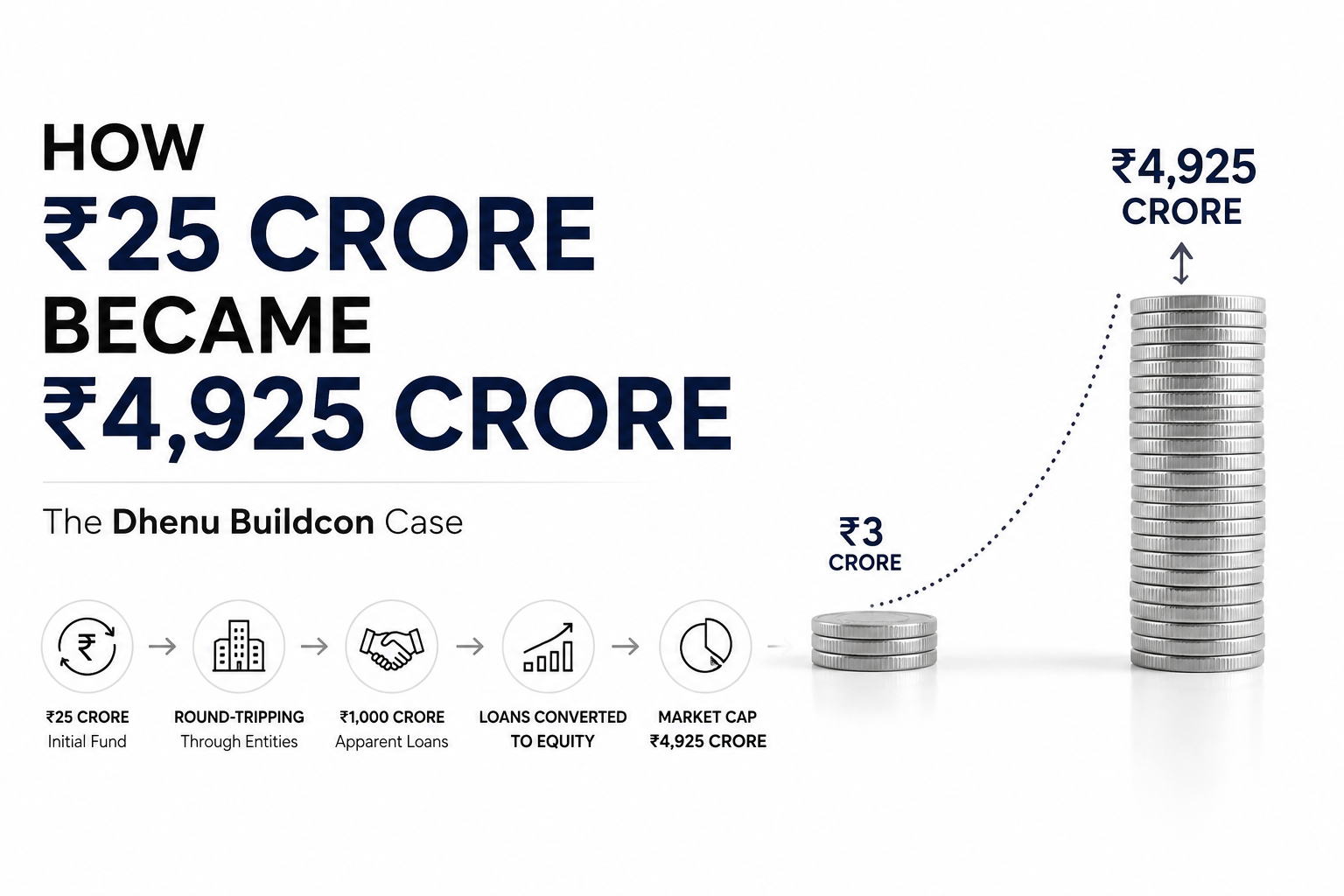
Dhenu Buildcon Infra went from a company worth only a few crore rupees to a market capitalisation of nearly ₹4,925 crore. But according to SEBI’s interim findings, this was not a story of a tiny business suddenly generating extraordinary profits.
SEBI’s case points to something very different. The regulator alleges that roughly ₹25 crore was repeatedly circulated through a network of entities, helping create the appearance of around ₹1,000 crore in unsecured loans. A large part of these loans was later converted into hundreds of crores worth of equity.
Here is how the Dhenu Buildcon case allegedly worked, and why it offers an important lesson about market capitalisation and penny stocks.
What is the Dhenu Buildcon ₹25 crore case?
Dhenu Buildcon Infra Limited is a BSE-listed company that has previously come under SEBI scrutiny. In an earlier investigation covering trading between August 2011 and May 2015, SEBI examined unusual price movements in the company’s shares.
The latest case centres on an unusual financial trail involving unsecured loans, connected entities and a massive preferential share allotment.
The numbers tell the story:
| Metric | Approximate figure |
|---|---|
| Initial market capitalisation | ₹3 crore |
| Money allegedly used in circulation | ₹25 crore |
| Purported unsecured loans | ₹1,000 crore |
| Loans converted into equity | ₹840 crore |
| New shares allotted | 591.55 crore |
| Issue price | ₹1.42 per share |
| Peak market capitalisation | ₹4,925 crore |
The crucial point is that ₹25 crore did not literally grow into ₹4,925 crore.
Instead, SEBI’s prima facie case involves the alleged recycling of funds, creation of large loan entries, conversion of debt into shares, and the resulting market value attached to those shares.
How could ₹25 crore create ₹1,000 crore of loan entries?
This is where round-tripping becomes important.
Round-tripping broadly refers to money moving through a series of transactions or entities before eventually returning to its original source or a related entity.
Imagine ₹25 crore moving like this:
₹25 crore → Company A → Company B → Company C → Dhenu Buildcon
Now suppose that money is sent out again and follows another route before returning.
The underlying ₹25 crore has not become ₹50 crore. But the cumulative value of transactions can now be much higher than the original pool of money.
Repeat the process enough times, and ₹25 crore can generate transaction entries worth hundreds of crores without an equivalent amount of fresh external capital entering the system.
That distinction is central to understanding the Dhenu Buildcon SEBI case.
How did the alleged fund circulation work?
According to SEBI’s prima facie findings, the funds were allegedly circulated repeatedly through multiple entities rather than representing independent fresh loans flowing into Dhenu Buildcon.
In simple terms:
- A pool of money moved through different entities.
- The funds eventually reached Dhenu Buildcon as purported loans.
- Money was subsequently moved out again.
- It travelled through another chain of transactions.
- Funds returned to Dhenu Buildcon.
- Repeating the process created a much larger cumulative transaction value.
This is why looking only at the total value of transactions can be misleading.
A business receiving ₹1,000 crore from independent lenders is very different from the same ₹25 crore being circulated repeatedly and appearing multiple times in transaction records.
What happened to the ₹840 crore in loans?
The next stage is what made the numbers particularly striking.
Dhenu Buildcon converted around ₹840 crore of unsecured loans into equity through a preferential allotment.
The company allotted 5,91,54,92,940 shares, or roughly 591.55 crore shares, to six non-promoter entities.
Each share was issued at ₹1.42, comprising a face value of ₹1 and a premium of ₹0.42. The total conversion was approximately ₹839.99 crore.
Who received the Dhenu Buildcon shares?
The preferential allotment went to six entities.
| Entity | Approx. post-allotment stake |
| Twinkle Mercantiles & Credits Pvt Ltd | 21.96% |
| Golkonda Aluminium Extrusions Ltd | 18.99% |
| Shanta Agencies Pvt Ltd | 18.99% |
| Tiaan Consumer Ltd | 18.99% |
| Shri Niwas Leasing & Finance Ltd | 13.65% |
| Utsav Securities Ltd | 7.12% |
Before the allotment, these entities reportedly held no shares in the company. The transaction dramatically changed Dhenu Buildcon’s capital structure.
How did Dhenu Buildcon’s market cap reach ₹4,925 crore?
The answer lies in how market capitalisation works.
The formula is straightforward:
Market capitalisation = Total outstanding shares × Market price per share
Market cap does not tell you how much cash a company has in its bank account. Nor does it necessarily tell you how much money investors collectively paid for all the shares.
This distinction becomes especially important when a company has a very large number of shares but relatively little trading liquidity.
A simple example
Suppose a company has 100 crore shares outstanding.
If its shares trade at ₹1 each:
100 crore × ₹1 = ₹100 crore market cap
If the quoted market price rises to ₹10:
100 crore × ₹10 = ₹1,000 crore market cap
That does not mean ₹900 crore of fresh money entered the company.
The market is simply valuing all 100 crore shares at the latest quoted price.
This effect becomes much larger when hundreds of crores of shares are outstanding.
Why does liquidity matter in such cases?
A stock’s quoted price and the price at which a large shareholder can actually sell its entire holding are not necessarily the same.
Consider a shareholder owning shares that are notionally worth ₹1,000 crore based on the latest market price.
If only a small number of shares trade each day, selling the entire ₹1,000 crore position could overwhelm available buyers and push the share price sharply lower.
This is why notional market value should not be confused with realisable cash value.
The distinction is particularly relevant when examining thinly traded small-cap and penny stocks.
Why is the Dhenu Buildcon case significant for investors?
The case demonstrates how dramatically a company’s headline market capitalisation can differ from the economic strength of its underlying business.
A rapidly rising share price can attract investors who assume the market knows something they do not.
But price alone tells you very little.
Before buying a small or obscure listed company, investors should examine:
1. Revenue and profit
Is the company’s valuation supported by an operating business?
Compare revenue, operating profit and net profit with the company’s market capitalisation.
A company worth thousands of crores but generating negligible business deserves much closer examination.
2. Sudden changes in share capital
Check whether the company has recently issued a huge number of shares.
Preferential allotments, warrants and debt-to-equity conversions can dramatically increase the outstanding share count and dilute existing shareholders.
3. Unsecured loans
Large unsecured loans deserve scrutiny, particularly when they appear inconsistent with the size of the business.
Ask basic questions:
- Who provided the money?
- Why was the loan given?
- What interest rate applies?
- What did the company use the funds for?
- Is the lender related to other parties involved with the company?
- Was the debt later converted into equity?
4. Trading liquidity
A rising stock price looks less convincing if only tiny quantities of shares are changing hands.
Low liquidity can make the last traded price a poor indicator of what a large block of shares could actually fetch in the market.
5. Exchange disclosures
Investors should read BSE or NSE corporate announcements rather than relying only on social media posts or stock-screening apps.
In Dhenu Buildcon’s case, the ₹840 crore debt conversion itself was a major change to the company’s capital structure. The allotment of roughly 591.55 crore shares was completed in December 2025.
Is market capitalisation the same as a company’s real value?
No.
Market capitalisation tells you what the equity market is currently pricing a company’s outstanding shares at.
It does not directly measure:
- cash in the bank
- annual revenue
- profit
- assets
- book value
- free cash flow
- money invested into the company
- amount shareholders could collectively realise by selling
For liquid, widely traded companies, market cap can provide a useful snapshot of equity value.
For highly illiquid stocks, however, investors need to be much more careful about treating the quoted market cap as an amount that could realistically be realised.
Has SEBI found Dhenu Buildcon guilty?
The distinction between an interim regulatory finding and a final determination is important.
The allegations described in SEBI’s interim proceedings should not automatically be presented as established criminal guilt. Regulatory investigations can involve further submissions, hearings and final orders.
Investors should therefore distinguish between what SEBI alleges or finds prima facie and what is ultimately established after the regulatory process is completed.
Dhenu Buildcon also has a longer history of regulatory scrutiny. In an earlier investigation, SEBI examined trading in the stock between August 2011 and May 2015. The regulator recorded that the share price had risen from ₹50 in August 2011 to ₹908.30 in October 2012 before a stock split, followed by further unusual price movements.
What can investors learn from the Dhenu Buildcon case?
The biggest lesson is simple: a rising market cap does not automatically mean a business is creating equivalent economic value.
When evaluating a stock, especially a small-cap, micro-cap or penny stock, investors should connect three things:
Business fundamentals + shareholding structure + trading activity
If the valuation is soaring while revenue and profits remain tiny, investigate why.
If hundreds of crores of new shares suddenly appear, understand who received them and what consideration was provided.
And if the stock trades in low volumes, remember that a high quoted price can create an impressive market capitalisation on paper without proving that the entire shareholding could be sold at that valuation.
FAQs
Q. How did Dhenu Buildcon go from ₹3 crore to ₹4,925 crore?
Dhenu Buildcon’s market capitalisation rose dramatically as its share structure and quoted market value changed. SEBI’s interim case alleges that roughly ₹25 crore was repeatedly circulated to create much larger unsecured loan entries, after which about ₹840 crore of debt was converted into equity.
Q. Did ₹25 crore actually become ₹4,925 crore?
No. The ₹4,925 crore figure refers to market capitalisation, not cash generated from ₹25 crore. Market cap is calculated by multiplying the outstanding number of shares by their market price.
Q. How did ₹25 crore allegedly create ₹1,000 crore in loans?
SEBI’s prima facie case involves repeated circulation of funds. When the same pool of money passes through multiple transactions and returns, cumulative transaction entries can become many times larger than the original amount without equivalent fresh capital entering the system.
Q. How many shares did Dhenu Buildcon issue?
Dhenu Buildcon allotted approximately 591.55 crore equity shares at ₹1.42 each as part of the conversion of roughly ₹840 crore in unsecured loans into equity.
Q. What is round-tripping of funds?
Round-tripping generally describes money being transferred through a series of entities or transactions before returning to its source or a related party. It can make financial flows appear larger or different from their underlying economic substance.
Q. Does a ₹4,925 crore market cap mean investors invested ₹4,925 crore?
No. Market capitalisation is the latest share price multiplied by the total number of outstanding shares. A company can reach a ₹4,925 crore market cap without investors collectively injecting ₹4,925 crore into it.
Q. What should investors check before buying a penny stock?
Investors should examine revenue, profits, cash flow, promoter holdings, preferential allotments, warrants, unsecured loans, related-party transactions, trading volumes and regulatory disclosures. Sudden price increases unsupported by business performance deserve extra scrutiny.
Key takeaways
- Dhenu Buildcon’s rise from roughly ₹3 crore to ₹4,925 crore in market capitalisation was not the same as turning ₹25 crore of cash into ₹4,925 crore.
- SEBI’s interim case alleges that roughly ₹25 crore was circulated repeatedly to help create much larger purported unsecured loan entries.
- Around ₹840 crore of unsecured loans was subsequently converted into equity.
- Dhenu Buildcon allotted roughly 591.55 crore shares at ₹1.42 per share.
- Market cap is calculated using the latest share price and total shares outstanding. It does not represent cash sitting inside the company.
- Large preferential allotments, unusual unsecured loans, weak fundamentals and low trading liquidity are signals investors should investigate carefully.
- SEBI’s allegations and interim findings should not be confused with a final determination of guilt.
Disclaimer
The stocks mentioned in this article are not recommendations. Please conduct your own research and due diligence before investing. Investment in securities market are subject to market risks, read all the related documents carefully before investing. Please read the Risk Disclosure documents carefully before investing in Equity Shares, Derivatives, Mutual fund, and/or other instruments traded on the Stock Exchanges. As investments are subject to market risks and price fluctuation risk, there is no assurance or guarantee that the investment objectives shall be achieved. Lemonn (Formerly known as NU Investors Technologies Pvt. Ltd) do not guarantee any assured returns on any investments. Past performance of securities/instruments is not indicative of their future performance.