SmartInvest for F&O traders: where no-code automation fits and where manual control still matters
 Written by Kumar Ashutosh
 Reviewed by Gaurav Garg, SEBI-registered Research Analyst
Ask ten Indian F&O traders what “algo trading” means and you will get ten different answers. One means a Python script hitting a broker API at 9:15:01. Another means a Telegram signal they copy-paste into their order window. A third means a GTT order sitting quietly at a strike price. All three call it “algo”. None of them are describing the same thing.
That confusion is expensive. It is why traders buy tools that do less than they expected, or more than they were ready to supervise. So a useful SmartInvest review needs a map first: a clean five-layer automation ladder for Indian F&O, with Lemonn’s no-code algo layer placed precisely on it.
The word “algo” is doing too much work in Indian F&O content
Most content on Indian algo trading collapses four or five genuinely different capabilities into one bucket. The result is a buyer who reads “automate your options strategy” and imagines a system that scans, decides, sizes, enters, trails, and exits while they are asleep. Then they discover the product actually sends a notification and waits for a tap.
Neither product is bad. They are just different rungs on a ladder, with different demands on your time, your capital, and your risk tolerance.
The honest framing is this: automation is a spectrum of who makes which decision. Four decisions matter in every F&O trade: what to trade, when to enter, how big, and when to exit. Every layer below simply reallocates those four decisions between you and the system.
The automation ladder: five layers Indian retail F&O traders actually choose between
- Layer 1: fully manual discretionary trading. You make all four decisions, in real time, with your own eyes on the chart.
- Layer 2: signal-led manual execution. A rules engine proposes the setup with entry, target and stop-loss. You confirm and place every order.
- Layer 3: conditional and persistent orders. Your instruction sits at the broker or exchange and fires only when a price condition is met.
- Layer 4: no-code rules-based automation. A predefined strategy with built-in risk controls runs on rules you selected, without you writing code.
- Layer 5: API and coded algos. You build, host and maintain the logic yourself, under the exchange and SEBI framework for retail algorithmic trading.
Lemonn deliberately spans several of these rungs inside one app, which is the point of the all-in-one positioning. Each rung still deserves a fair, separate assessment.
Layer 1: fully manual discretionary trading, what you keep and what it costs
Manual trading gives you the one thing no system can replicate: context. You can see that a stock is gapping on a results leak, that the index is in a thin pre-holiday session, that the option chain has gone illiquid at the strike you wanted.
What it costs you is consistency. Discretion is where revenge trades, skipped stop-losses, and “just this once, I’ll average down” live. Manual trading also demands screen time you may not have, and on expiry day, a distracted five minutes can be the difference between a planned exit and a panic exit.
Manual is the right default for anyone still learning how options behave. It is a poor default for someone who already knows their edge and keeps overriding it.
Layer 2: signal-led manual execution, and what BOLT actually is
Lemonn’s BOLT sits squarely on Layer 2. It is important not to mis-sell it as anything else.
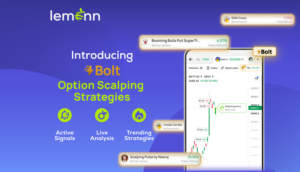
BOLT delivers real-time, indicator-driven F&O signals built around named, structured strategies: Scalping Pulse, Prime EMA Scalper, Swing King, Booming Bulls SuperTrend, Traffic Light, Inside Candle, Mean Reversion Bollinger and EMA Cross among them. Every signal arrives with a defined entry, target and stop-loss, and Auto TP/SL is preset on the trade so your exit legs are not an afterthought. These are structured signals with predefined risk levels, not personalised advice and not a promise of gains.
Two traits define this layer:
- It is broker-native. Signal discovery and order placement happen inside the same app, so you are not toggling between a chart tool, a tips channel and a separate broker window while a scalp setup decays.
- Execution stays manual. BOLT suggests; you confirm every order. It is not hands-off trading, and it should never be described as such.
You can also stack multiple strategies at once and choose between them on performance metrics. For traders migrating away from unstructured Telegram tips, Layer 2 is usually the right first step. You gain structure and predefined risk without handing over the trigger.
Layer 3: conditional and persistent orders (GTT, GTD, bracket)
This is the rung most often mislabelled as automation. A conditional order is a stored instruction, not a strategy.
- GTT (Good Till Triggered) is a resting trigger that converts into a live order when your price condition is met. It is popular for equity delivery entries and stop-losses.
- GTD (Good Till Date) is a limit order that stays valid up to a specified future date. Lemonn’s GTD supports limit orders valid up to a year, which is genuinely useful for patient entries you do not want to re-punch every morning.
- Bracket and cover orders attach exit legs to an entry so target and stop-loss are placed alongside the position.
Why this is not Layer 4: a resting order has no logic. It does not evaluate volatility, skip a trade before an event, re-enter after a stop, or adjust size. It fires at a price, or it does not fire at all. Traders who try to build systematic options selling purely out of resting triggers usually discover the gap the first time a gap-open blows through the trigger price and fills far from where they modelled it.
Persistent orders are excellent plumbing for a strategy. They are not the strategy.
Layer 4: no-code rules-based automation, where SmartInvest sits
SmartInvest is Lemonn’s algorithmic trading offering for retail investors who do not write code. It is the automation surface of the product, deliberately distinct from BOLT, which stays on the manual-execution rung.
The core idea is rules-based investing rather than discretionary tipping. You pick a strategy built on defined rules, and the strategy carries built-in stop-losses and risk controls rather than leaving exits to your mood at 2:45 pm. No scripting. No server. No library to learn.
For anyone asking how to run a systematic options strategy without coding on an Indian broker platform, Layer 4 is the honest answer. It is the rung where the rules survive your bad days, because the rules were fixed before the day started.
SmartInvest review: what the no-code layer gives an F&O trader
Assessed against the ladder, here is what Layer 4 buys you in practice:
- Rule persistence. The logic does not get renegotiated mid-session. That is the single biggest behavioural gain over Layer 1.
- Risk controls that ship with the strategy. Stop-losses are part of the design, not something you remember to add.
- Zero coding overhead. No Python, no hosting, no dependency management, no broken script at 9:20 am because a library updated overnight.
- Same app, same ledger. Because it lives inside a SEBI-registered broking environment, positions, margins and funds sit where the rest of your portfolio does.
- Lower cognitive load. You supervise a process instead of improvising a hundred micro-decisions.
That is the realistic promise of no code options trading in India: discipline and consistency of process. It is not a promise of profit, and any tool that frames it that way should be treated with suspicion.
SmartInvest review: the honest limits
A fair review has to name what the no-code layer does not do.
- You do not get arbitrary logic. No-code means predefined structure. If your edge depends on a bespoke condition nobody has built, Layer 5 is your rung.
- It does not read the news. A rules engine has no view on an RBI policy day, an unexpected geopolitical headline, or a stock-specific corporate action.
- It does not replace capital planning. Deciding how much of your capital any strategy may touch remains a human decision.
- It is not a substitute for understanding the strategy. Running rules you cannot explain is just outsourced discretion.
- Supervision is still required. Automation reduces keystrokes, not responsibility.
Anyone hunting for a true “set and forget” options selling machine should recalibrate. In Indian F&O, undefined-risk positions in particular demand monitoring regardless of which rung you are standing on.
Layer 5: API and coded algos, and who should actually go there
Layer 5 is for traders who can build and maintain software. Under SEBI’s 2025 framework for retail algorithmic trading, this rung comes with real operational obligations: algos routed through broker APIs are expected to be registered with exchanges and carry unique identifiers, broker-facilitated API access is tied to controls such as static IP whitelisting, and orders above prescribed thresholds are tagged so activity is traceable. Implementation details and timelines evolve, so verify current requirements with your broker and the exchanges before you build.
Go here if you have a genuinely bespoke edge, the engineering skill to run production systems, and the appetite for the compliance and monitoring burden. Do not go here because it sounds more serious. Most retail traders get more improvement from moving Layer 1 habits to Layer 2 or Layer 4 than from writing their first script.
Where manual control still matters
Even a committed Layer 4 user should keep their hands near the keyboard in four situations:
- Expiry-day liquidity. Spreads widen and depth thins at far strikes. A rule that assumes clean fills can behave very differently in the last hour.
- Event risk. Budget days, policy announcements, results and index rebalancing produce volatility no historical rule anticipated.
- Position sizing. How much capital a strategy is allowed to risk is a decision about your own circumstances, not about the market.
- The kill switch. You must always be able to flatten fast. Lemonn’s Exit Now and Exit All exist precisely for the moment when the right answer is “out, now, everything”.
Layer-by-layer cost model: why more automation is not automatically cheaper
Lemonn charges a flat Rs 20 per executed order across equity delivery, intraday, futures and options, which makes brokerage easy to model. The variable most traders underestimate is not brokerage. It is order count and slippage.
- Layer 1 typically has moderate order counts and highly variable slippage, because entries are improvised.
- Layer 2 adds structure, and Auto TP/SL means exit orders are planned rather than panicked.
- Layer 3 can reduce missed entries, but resting orders can also fill at prices you would have refused in the moment.
- Layer 4 is the most consistent, though a higher-frequency ruleset mechanically generates more executed orders, and every one is chargeable.
- Layer 5 adds infrastructure and maintenance costs on top of everything else.
For large F&O orders, execution quality matters more than the ticket cost. That is why Lemonn’s Slicing feature auto-splits big orders for smoother execution, and Dash acts as a smart price assistant for better entries. Automating a strategy with weak execution simply automates the leakage.
Mapping common searches to the right layer
- “Automate my strategy without coding” → Layer 4. SmartInvest is the fit.
- “Systematic options selling” → Layer 4 for the rules, Layer 3 for the resting exit plumbing, and human supervision on event days regardless.
- “Set and forget” → Realistically Layer 4 with scheduled check-ins. Nothing in Indian F&O is genuinely forgettable.
- “Conditional orders for options selling” → Layer 3. Useful, but understand it is an instruction, not a system.
A one-page decision matrix
- Small capital, low screen time, learning phase → Layer 1 with tiny size, or Layer 2 to learn structure.
- Moderate capital, part-time trader with a day job → Layer 2 for directional trades, Layer 4 for rule-based exposure.
- Moderate to larger capital, full-time trader, defined process → Layer 4 as the core, Layer 3 for resting orders, Layer 1 reserved for event days.
- Engineering skills plus a bespoke edge → Layer 5, with full awareness of the regulatory and operational load.
- Low risk tolerance overall → Reconsider F&O size before automating anything.
How Lemonn stacks the layers in one app
The practical advantage of the all-in-one approach is that you can move up and down the ladder without changing brokers or opening another account. BOLT covers signal-led manual execution. SmartInvest covers no-code rules-based automation. GTD gives you long-dated resting limit orders, and the TradingView-powered Web Terminal handles desktop-grade charting for discretionary work. Slicing, Dash, and Exit Now / Exit All handle execution quality and fast exits. All of it sits under a SEBI-registered broker with ISO/IEC 27001:2022 certification, bank-grade encryption, and a free Demat account opened with paperless KYC in minutes.
Risk note
SEBI’s own studies on the derivatives segment have consistently shown that a large majority of individual F&O traders end up with net losses. F&O and intraday trading carry high risk, and automation does not change that base rate. What a rules-based layer can do is remove some of the behavioural leakage that makes bad outcomes worse: skipped stop-losses, oversized revenge trades, exits made on feeling.
Treat every layer of this ladder as a discipline tool, not a profit engine. Investments in the securities market are subject to market risks; read all the related documents carefully before investing. Nothing here is individualised investment, tax or legal advice.
FAQs
Is no-code algo trading legal for retail investors in India?
Yes. Rules-based and algorithmic trading offered through a SEBI-registered broker is permitted for retail investors in India, within the framework the regulator and exchanges prescribe. SEBI’s 2025 retail algorithmic trading framework tightened requirements around algo registration with exchanges, unique identifiers, and broker-facilitated API access. When you use a broker-provided no-code product, the compliance plumbing sits with the broker rather than with you.
Does SmartInvest place orders on my behalf, or do I still have to confirm each one?
SmartInvest is Lemonn’s no-code algo and automation surface, built so that rules-based strategies with in-built stop-losses and risk controls can run without you writing code. This is different from BOLT, which is a manual-execution signals product where you confirm every single order yourself. Check the current in-app flow and permissions before you start, so you know exactly which actions the strategy takes and which remain with you.
What happens to an active strategy if my internet drops or my phone dies?
Orders that have already reached the exchange remain live and are not cancelled because your device disconnects, which is precisely why exits should be planned rather than improvised. Strategies with built-in stop-losses and resting exit orders are more resilient to connectivity loss than positions you intended to close manually. Keep an alternative access route ready, such as the desktop Web Terminal or your broker’s support channel, and know how to use Exit All when you need to flatten quickly.
Can I run BOLT signals and SmartInvest strategies at the same time?
They are separate surfaces inside the same app, so using both is a question of capital allocation and margin availability rather than technical conflict. The risk to watch is unintentional concentration. Signal-led trades and rules-based strategies can both end up long the same index, doubling your exposure without you noticing. Set a clear capital limit for each before you run them together.
Is a no-code algo cheaper than manual trading?
Not automatically. Brokerage on Lemonn is a flat Rs 20 per executed order across equity delivery, intraday, futures and options, so your total cost scales with how many orders your approach generates, not with whether a human or a rule triggered them. A high-frequency ruleset can easily produce more executed orders than discretionary trading, and slippage on large F&O orders often matters more than the ticket charge.
Disclaimer
The stocks mentioned in this article are not recommendations. Please conduct your own research and due diligence before investing. Investment in securities market are subject to market risks, read all the related documents carefully before investing. Please read the Risk Disclosure documents carefully before investing in Equity Shares, Derivatives, Mutual fund, and/or other instruments traded on the Stock Exchanges. As investments are subject to market risks and price fluctuation risk, there is no assurance or guarantee that the investment objectives shall be achieved. Lemonn (Formerly known as NU Investors Technologies Pvt. Ltd) do not guarantee any assured returns on any investments. Past performance of securities/instruments is not indicative of their future performance.