Gold & Silver Investment Guide: SGBs, ETFs and More
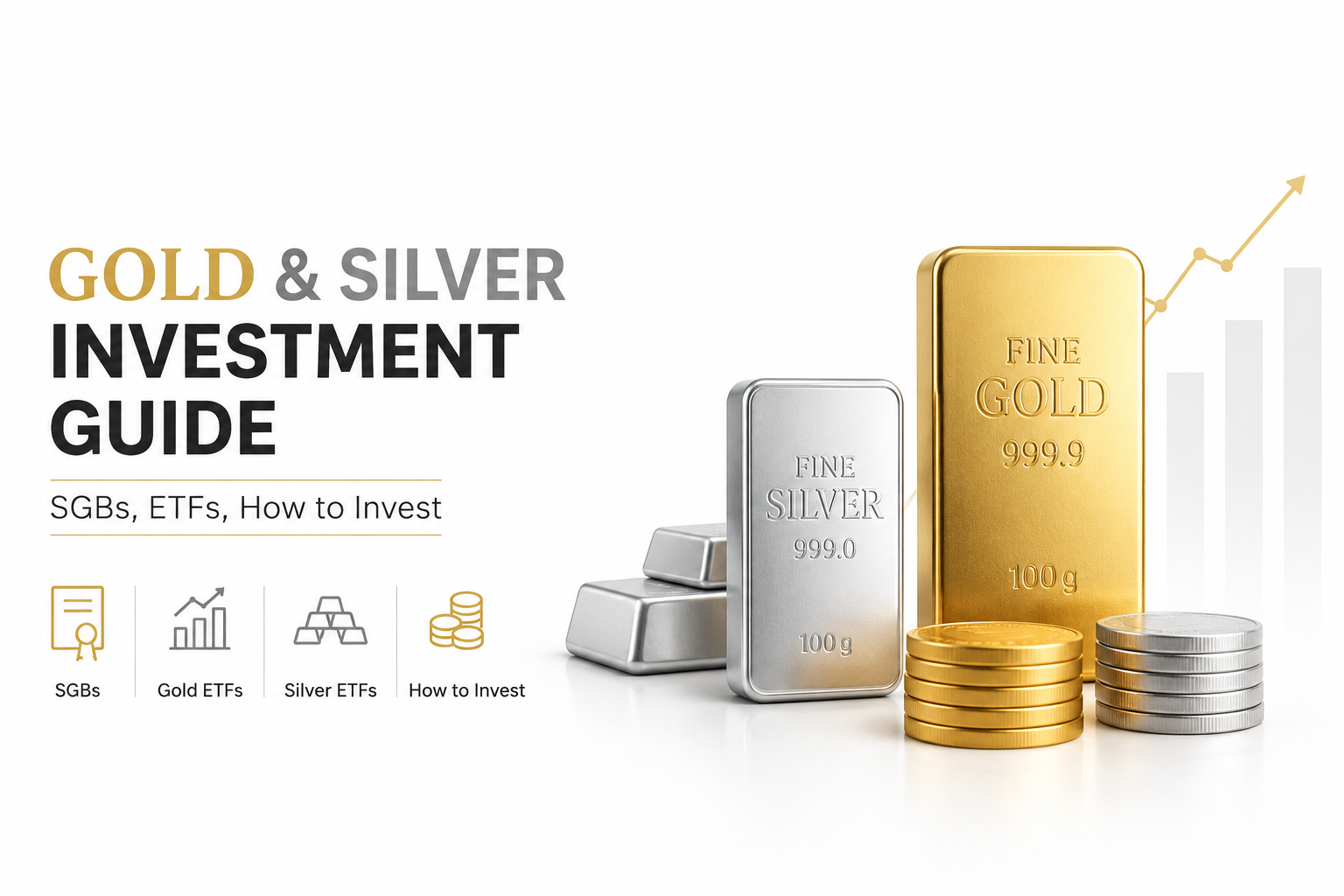
Gold and silver can add diversification to an investment portfolio, but how you invest matters almost as much as which metal you choose. For most Indian investors seeking investment exposure rather than jewellery, regulated products such as gold ETFs and silver ETFs offer a practical combination of liquidity, transparency, and convenience.
Sovereign Gold Bonds (SGBs) remain another important gold investment option for investors who already own them or are considering bonds available in the secondary market. However, SGB taxation has changed, and investors should not assume that buying an SGB on the stock exchange provides the same tax benefit as subscribing to the original issue.
This gold and silver investment guide explains the major options, their costs, risks, tax treatment, and how to choose between them.
Why invest in gold and silver?
Gold and silver are precious metals, but they can play different roles in a portfolio.
Gold is widely used as a store of value and portfolio diversifier. Its price can benefit during periods of economic uncertainty, geopolitical stress, currency weakness, or changing interest-rate expectations.
Silver also has investment demand, but industrial consumption plays a much bigger role in its market. Silver is used in electronics, solar energy, manufacturing, and other industries. That can make its price more sensitive to economic cycles.
Neither metal generates business profits, dividends, or cash flows like a company does. Returns primarily depend on changes in the underlying metal price, currency movements, and the costs associated with your chosen investment product.
What are the different ways to invest in gold in India?
Indian investors have several ways to gain exposure to gold:
- Sovereign Gold Bonds
- Gold ETFs
- Gold mutual funds or gold ETF FoFs
- Physical gold
- Digital gold
These products may all track gold in some form, but they differ significantly in liquidity, regulation, taxation, costs, and convenience.
“Start investing with confidence! Explore
0 demat account
and grow your wealth.”
What are Sovereign Gold Bonds?
Sovereign Gold Bonds are government securities denominated in grams of gold. The RBI issues them on behalf of the Government of India.
Historically issued SGBs generally carry a fixed interest rate of 2.5% per year on the nominal value, paid semi-annually. Their redemption value is linked to the market price of gold. RBI continues to publish redemption and premature redemption information for outstanding SGB tranches.
SGBs therefore combine two potential sources of return:
- Changes in the value of gold
- Fixed interest on the original investment amount
Can you still invest in SGBs?
Investors should distinguish between a new SGB issue and an existing SGB traded on an exchange.
The RBI continues to administer outstanding SGBs and publish premature and final redemption schedules. Investors considering SGBs today may encounter existing bonds in the secondary market rather than a fresh subscription window.
Secondary-market SGB prices can trade above or below their underlying gold value depending on liquidity, remaining maturity, interest payments, and demand.
This makes it important to compare the market price with the bond’s implied gold value before buying.
How long do SGBs last?
SGBs were generally issued with an eight-year maturity. Eligible tranches allow premature redemption through RBI after the fifth year on specified interest-payment dates.
The bonds can also trade on stock exchanges, subject to market liquidity.
Selling on an exchange and redeeming through RBI are not necessarily equivalent from a tax perspective.
What are Gold ETFs?
A Gold ETF is an exchange-traded fund designed to provide exposure to gold. Units are bought and sold on a stock exchange through a demat and trading account.
SEBI explains that ETFs trade on exchanges like shares, with their trading prices linked to the value of their underlying assets. Investors should also account for brokerage, demat charges where applicable, and differences between market price and NAV.
For someone who wants gold primarily as an investment, Gold ETFs avoid many of the practical problems of buying coins or jewellery.
You do not need to:
- Store gold at home
- Pay jewellery making charges
- Verify purity yourself
- Negotiate with a jeweller when selling
However, ETFs are not cost-free. They have expense ratios and may have tracking error.
What is tracking error in a Gold ETF?
Tracking error is the difference between the ETF’s performance and the performance of the gold benchmark it is trying to follow.
For example, suppose gold rises 10% over a period but your Gold ETF rises 9.4%. Costs, cash holdings, execution, and other factors may contribute to that difference.
When comparing Gold ETFs, do not look only at past returns. Consider:
- Expense ratio
- Tracking error or tracking difference
- Trading volume
- Bid-ask spread
- Assets under management
- Fund house track record
Liquidity also matters because an ETF’s exchange price can temporarily trade at a premium or discount to its underlying NAV.
How can you invest in silver in India?
Silver investors have fewer mainstream options than gold investors, but the market has become much more accessible through Silver ETFs.
The main routes include:
- Silver ETFs
- Silver ETF FoFs
- Physical silver
- Certain combined gold and silver funds
SEBI’s framework permits Silver ETFs to invest in physical silver and specified silver-related instruments.
What is a Silver ETF?
A Silver ETF is designed to provide investment exposure to silver without requiring you to purchase and store physical bars or coins yourself.
Like a Gold ETF, it trades on the stock exchange.
Silver ETFs are especially useful because storing meaningful amounts of physical silver can be more cumbersome than storing gold. Silver has a much lower value per unit of weight, so a large investment requires considerably more physical space.
SEBI’s rules allow Silver ETF portfolios to hold physical silver and permitted silver-related instruments under specified conditions.
From April 1, 2026, SEBI’s updated valuation framework requires mutual funds to value physical gold and silver using polled spot prices published by recognised stock exchanges used for settlement of physically delivered derivatives contracts.
Are silver ETFs riskier than gold ETFs?
They can be more volatile.
Silver prices depend not only on investment demand but also on industrial demand. A slowdown in manufacturing can affect silver differently from gold.
This does not automatically make silver a bad investment. It means investors should avoid treating gold and silver as interchangeable assets.
Gold vs silver: Which is better for investment?
There is no universal winner. The better choice depends on what role you want precious metals to play in your portfolio.
| Factor | Gold | Silver |
|---|---|---|
| Traditional store-of-value role | Strong | Moderate |
| Industrial demand | Lower | Significant |
| Price volatility | Generally lower | Generally higher |
| ETF availability in India | Widely available | Available |
| Physical storage | Easier for high values | Bulkier |
| Suitable for diversification | Yes | Yes, with higher volatility |
| Income generation | No, except interest on eligible SGBs | No |
Gold may suit an investor primarily looking for portfolio diversification and a precious-metal allocation.
Silver may suit someone comfortable with higher price swings who also wants exposure to industrial demand.
Owning both is possible, but that does not mean investors need to split their precious-metal allocation equally.
SGB vs Gold ETF vs physical gold
Choosing a gold investment becomes easier when you compare the products based on what you actually need.
| Feature | SGB | Gold ETF | Physical Gold |
| Gold price exposure | Yes | Yes | Yes |
| Fixed interest | Generally 2.5% on issued SGBs | No | No |
| Demat required | Depends on holding route | Yes | No |
| Storage required | No | No | Yes |
| Exchange liquidity | Can be limited | Usually better for actively traded ETFs | Depends on buyer |
| Expense ratio | No fund expense ratio | Yes | No |
| Making charges | No | No | Possible, especially jewellery |
| Purity concerns | No physical metal held by investor | No physical metal held by investor | Yes |
| Best suited for | Eligible long-term SGB investors | Convenient market exposure | Personal use or investors wanting possession |
For pure investment purposes, jewellery is usually inefficient because its purchase price may include making charges and other costs that are not recovered fully when it is sold.
How are gold and silver investments taxed in India?
Tax can materially affect your actual return, so the investment wrapper matters.
For transfers under the current capital-gains framework, long-term gains on many relevant assets are taxed at 12.5% without indexation, subject to the specific rules applying to the instrument and transaction.
A simplified comparison is below.
| Investment | Long-term holding threshold | Typical LTCG treatment |
| Gold ETF | More than 12 months | 12.5% without indexation |
| Silver ETF | More than 12 months | 12.5% without indexation |
| Gold/Silver FoF | Generally more than 24 months | 12.5% without indexation, subject to applicable rules |
| Physical gold | More than 24 months | 12.5% without indexation |
| SGB | Depends on acquisition and exit route | Special rules apply |
Gold ETF tax treatment, for example, generally provides long-term classification after the applicable 12-month holding period, while physical gold requires a longer holding period.
Short-term gains are generally taxed according to the investor’s applicable income-tax slab where these rules apply.
Tax rules can change, so investors making a significant transaction should verify the treatment applicable to their acquisition date and method of sale.
How are SGBs taxed?
SGB taxation requires extra attention following the 2026 changes.
From April 1, 2026, the capital-gains exemption on redemption is restricted to qualifying individual investors who subscribed to the SGB at original issue and continue to hold it until maturity. Buying an SGB later in the secondary market should therefore not be assumed to provide the same maturity exemption.
The 2.5% annual interest received on SGBs is taxable according to the investor’s applicable income-tax rules.
Selling an SGB on the stock exchange can also create a taxable capital gain.
This distinction matters when comparing an older SGB trading on an exchange with a Gold ETF. The SGB’s quoted discount alone does not tell you which option will produce the better post-tax return.
How to invest in Gold ETFs step by step
Buying a Gold ETF is similar to buying a listed share.
- Open a demat and trading account. Choose a SEBI-registered intermediary and complete KYC.
- Compare Gold ETFs. Check expense ratio, liquidity, tracking difference, AUM, and bid-ask spreads.
- Search for the ETF on your trading platform. Confirm that you have selected the correct exchange-traded security.
- Check the market price against indicative value or NAV. Avoid paying an unnecessarily large premium.
- Place your order. A limit order can provide greater control over your purchase price when spreads are wide.
- Monitor the investment as part of your overall allocation. Gold should be considered alongside your equity, debt, cash, and other investments rather than in isolation.
How to invest in Silver ETFs
The process is broadly similar.
After opening a demat and trading account, compare available Silver ETFs based on cost, tracking quality, liquidity, and portfolio structure.
Then buy ETF units through the exchange.
Investors without a demat account can also explore a Silver ETF fund of funds. A FoF can make SIP investing easier, but the structure can involve an additional layer of costs and different tax holding-period rules.
Should you buy physical gold or silver?
Physical metal still has a place, especially when the objective includes personal use, gifting, cultural needs, or direct possession.
For investment alone, however, consider the friction involved.
Costs of buying physical gold
Physical gold can involve:
- 3% GST on purchase
- Making charges for jewellery
- Storage or locker costs
- Insurance costs
- Buy-sell spreads
- Purity verification at resale
Physical gold and digital gold generally have a 24-month threshold for long-term capital-gains treatment under the current framework, with qualifying LTCG taxed at 12.5% without indexation.
Jewellery should therefore generally be viewed first as an item for consumption or personal use rather than the most efficient way to track gold prices.
What about physical silver?
Physical silver has similar issues, with one additional practical problem: bulk.
A meaningful silver allocation can require substantial storage space. Dealer premiums and resale spreads also affect returns.
Silver ETFs can remove much of this operational burden for investors who only want price exposure.
What about digital gold?
Digital gold allows investors to purchase small quantities of gold through apps and online platforms.
Its convenience can be attractive, but investors should understand that digital gold does not have the same investment-product regulatory framework as a SEBI-regulated Gold ETF.
Before using any digital gold product, examine:
- Who actually owns and stores the underlying gold
- Custodian arrangements
- Insurance
- Buy-sell spread
- Delivery charges
- Redemption conditions
- Platform and counterparty risk
For a long-term financial portfolio, the regulatory structure of the product should be part of the decision, not an afterthought.
How much gold and silver should you invest in?
There is no allocation percentage that works for every investor.
Your appropriate exposure depends on factors such as:
- Investment horizon
- Equity allocation
- Risk tolerance
- Existing jewellery and physical gold holdings
- Emergency fund
- Income stability
- Financial goals
A common mistake is to ignore jewellery when calculating gold exposure.
If a household already owns a substantial amount of investment-grade gold, adding a large Gold ETF allocation may create more concentration than expected.
Also remember that precious metals can go through long periods of weak or flat returns. They are portfolio assets, not guaranteed wealth creators.
Common mistakes when investing in gold and silver
Chasing prices after a sharp rally
A strong recent return does not guarantee another strong year.
Buying solely because gold or silver has just reached a record high can turn a diversification decision into a momentum bet.
Treating jewellery as a low-cost investment
Jewellery carries costs that an ETF does not. If your objective is financial exposure to gold, calculate making charges and resale deductions before comparing returns.
Ignoring ETF liquidity
Two ETFs tracking the same metal can produce different investor experiences.
An ETF with a wide bid-ask spread may effectively cost you more even if its published expense ratio looks attractive.
Buying secondary-market SGBs only for tax benefits
The tax treatment of SGBs has changed. Investors buying existing SGBs on an exchange should evaluate the current tax rules rather than relying on older explanations of SGB maturity exemptions.
Investing too much in precious metals
Gold and silver can diversify a portfolio, but they do not replace an emergency fund, suitable debt investments, or growth assets such as equities.
Which gold or silver investment option should you choose?
For many investors, the choice can be narrowed down by purpose.
Consider a Gold ETF if: you want regulated, liquid gold exposure through a demat account without storing physical metal.
Consider a Gold ETF FoF if: you want mutual-fund-style investing or SIP convenience without directly trading an ETF.
Consider an existing SGB if: you understand its market price, liquidity, remaining maturity, interest payments, and current tax implications.
Consider a Silver ETF if: you want silver exposure without storing bulky physical silver and can tolerate potentially higher volatility.
Consider physical gold or silver if: direct possession, gifting, jewellery use, or another non-investment purpose matters to you.
The cheapest product on paper is not automatically the best choice. Liquidity, taxation, tracking quality, spreads, and ease of exit all affect the return you eventually keep.
FAQs
Q. Is a Gold ETF better than an SGB?
It depends on your objective. Gold ETFs generally provide easier exchange liquidity and straightforward gold exposure. Existing SGBs provide fixed interest in addition to gold-linked value, but liquidity, maturity, acquisition price, and current tax rules must be considered.
Q. Can I buy Sovereign Gold Bonds from the stock market?
Yes, eligible listed SGBs can trade in the secondary market. Availability and liquidity vary by tranche. Before buying, compare the exchange price with the underlying gold value and understand the tax treatment applicable to secondary-market purchases.
Q. Do SGBs still give tax-free returns?
Do not assume all SGB redemptions are tax-free. From April 1, 2026, the maturity capital-gains exemption is restricted to qualifying individual investors who subscribed at original issue and held the SGB until maturity. Interest remains taxable.
Q. Do I need a demat account for a Gold ETF?
Yes, retail investors normally buy and sell Gold ETF units on a stock exchange using a demat and trading account. Investors who do not want a demat account can consider a gold ETF fund of funds.
Q. Is a Silver ETF safe?
Silver ETFs operate within SEBI’s mutual fund regulatory framework, but regulation does not remove market risk. The value of the ETF can fall when silver prices decline, and investors also face tracking and liquidity risks.
Q. Is digital gold better than a Gold ETF?
Digital gold can be convenient for small purchases, but Gold ETFs operate within SEBI’s regulated mutual fund framework and trade on recognised exchanges. Long-term investors should compare regulation, costs, spreads, taxation, custody, and liquidity before choosing.
Q. Is gold or silver better for long-term investment?
Gold generally has a stronger traditional role as a portfolio diversifier, while silver has greater exposure to industrial demand and can experience larger price swings. The better choice depends on your risk tolerance and the purpose of the allocation.
Q. Can I invest in gold every month?
Yes. Investors can make periodic purchases of Gold ETFs or use SIPs in funds that invest in Gold ETFs. Regular investing can reduce the need to predict short-term gold prices, although it does not protect against losses.
Key takeaways
- Gold and silver can diversify a portfolio, but neither offers guaranteed returns.
- Gold ETFs provide a regulated and convenient way to invest in gold without physical storage.
- Silver ETFs provide similar convenience for silver, which can be particularly useful given the storage requirements of physical silver.
- SGBs offer gold-linked value plus fixed interest, but current tax rules differ depending on how the bond was acquired and redeemed.
- From April 1, 2026, investors buying SGBs in the secondary market should not assume they will receive the same maturity capital-gains exemption as qualifying original subscribers.
- Gold and Silver ETFs can have expense ratios, tracking differences, bid-ask spreads, and liquidity risks.
- Physical precious metals involve GST, storage, resale, and potentially making or dealer charges.
- Choose the investment vehicle based on post-tax returns, costs, liquidity, and your overall asset allocation, not simply recent gold or silver performance.
Disclaimer
The stocks mentioned in this article are not recommendations. Please conduct your own research and due diligence before investing. Investment in securities market are subject to market risks, read all the related documents carefully before investing. Please read the Risk Disclosure documents carefully before investing in Equity Shares, Derivatives, Mutual fund, and/or other instruments traded on the Stock Exchanges. As investments are subject to market risks and price fluctuation risk, there is no assurance or guarantee that the investment objectives shall be achieved. Lemonn (Formerly known as NU Investors Technologies Pvt. Ltd) do not guarantee any assured returns on any investments. Past performance of securities/instruments is not indicative of their future performance.
Related Posts


Download Lemonn
Download my app for share market trading, ipo investment, trading account, and all your investment needs.