Why Paytm Shares Surged: The UPI Margin Opportunity
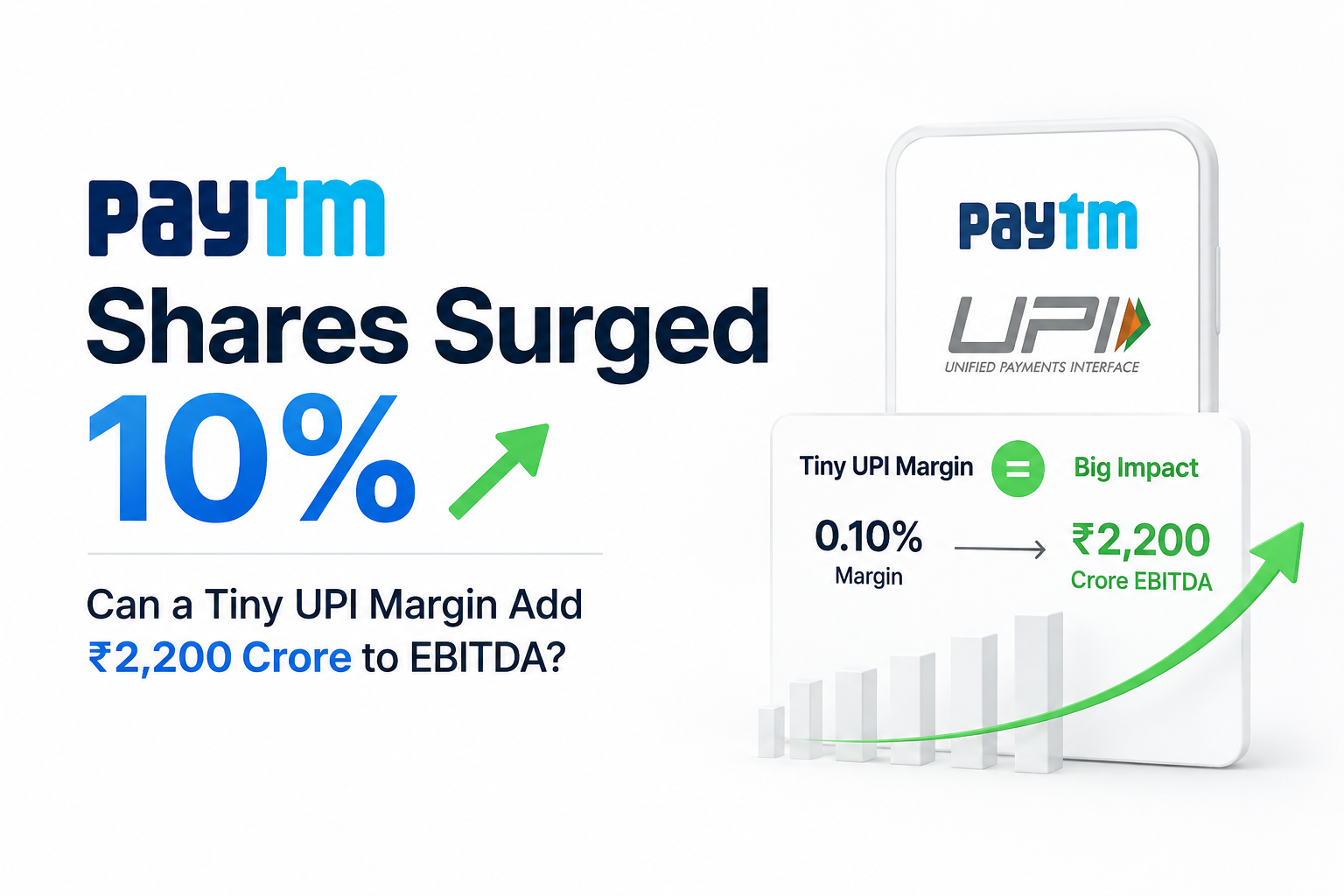
Paytm shares rallied sharply after global brokerage Bernstein raised its target price on One97 Communications to ₹2,200, its first target above Paytm’s ₹2,150 IPO issue price. The brokerage sees a combination of improving profitability, UPI monetisation and operating leverage creating significantly more earnings potential for the fintech company.
The bigger story, however, is not the ₹2,200 share-price target itself. It is what could happen to Paytm’s profits if India’s enormous UPI payment volumes start generating even a small additional margin.
Why did Paytm shares surge?
Paytm’s latest rally was primarily triggered by Bernstein raising its price target from ₹1,500 to ₹2,200, while retaining its “Outperform” rating.
The new target implied roughly 52% upside from the stock price used by the brokerage and pushed Bernstein’s valuation above Paytm’s IPO issue price for the first time.
But the brokerage upgrade arrived against a much stronger fundamental backdrop.
Paytm has gone from a company focused on reducing losses to one reporting growing revenue, positive EBITDA and profits.
In Q1 FY27, Paytm reported:
| Metric | Q1 FY27 |
|---|---|
| Operating revenue | ₹2,448 crore |
| Revenue growth | 28% YoY |
| EBITDA | ₹203 crore |
| EBITDA margin | 8% |
| Profit after tax | ₹220 crore |
| PAT growth | 79% YoY |
Paytm described the ₹203 crore EBITDA as its highest-ever quarterly EBITDA.
That improving earnings profile matters because any incremental revenue from UPI could now fall into a business with much better operating leverage.
Why is UPI suddenly so important for Paytm’s valuation?
UPI has always been strategically important to Paytm. The problem has been monetisation.
Standard UPI transactions operate under India’s zero-MDR framework. That means a payments company can process enormous volumes without earning the kind of transaction fee traditionally associated with cards.
This is why even a small change in UPI economics can matter.
The government is now considering allowing a Merchant Discount Rate, or MDR, on certain higher-value UPI transactions, reportedly focusing on payments above ₹2,000 to larger merchants. No final implementation decision has been announced.
The government has also indicated that any proposed MDR would be limited in scope and that person-to-person UPI transactions would remain free. Consumers would not directly pay the proposed merchant charge.
For Paytm, that creates an interesting possibility: a payment network that already handles substantial merchant volumes could become more profitable without needing equivalent growth in operating costs.
How can a tiny UPI margin make such a big difference?
Payments is a scale business.
When the underlying transaction value runs into lakhs of crores of rupees, even a few basis points can translate into meaningful revenue.
One basis point, or 1 bps, equals 0.01%.
So:
- 5 bps = 0.05%
- 10 bps = 0.10%
- 25 bps = 0.25%
Paytm processed ₹23.8 lakh crore of merchant GMV in FY26, up 26% year on year. Its net payment revenue for the year was ₹2,318 crore, and the company said it was earning more than 4 bps on overall GMV.
That gives investors a useful way to understand the sensitivity.
Illustrative margin impact on ₹23.8 lakh crore GMV
| Additional effective margin | Illustrative annual amount |
| 1 bps | ₹238 crore |
| 3 bps | ₹714 crore |
| 5 bps | ₹1,190 crore |
| 8 bps | ₹1,904 crore |
| 10 bps | ₹2,380 crore |
These figures are illustrative, not forecasts. They simply apply a margin to Paytm’s FY26 merchant GMV.
They also explain why investors get excited about apparently tiny changes in payment economics.
At Paytm’s scale, basis points matter.
Can UPI really add ₹2,200 crore to Paytm’s EBITDA?
It is possible to construct a scenario approaching that number, but investors should not interpret ₹2,200 crore as automatic incremental EBITDA.
For example, applying roughly 9 to 10 additional basis points to Paytm’s FY26 merchant GMV mathematically produces revenue in the ₹2,100 crore to ₹2,400 crore range.
But real-world economics would be more complicated.
Not every transaction would necessarily qualify for MDR. The government may restrict charges to larger merchants, transactions above a particular value, or specific payment categories. Revenue would also need to be divided among different participants in the UPI ecosystem.
There may also be processing, incentive and other associated costs.
So the more useful investment question is not, “Will Paytm suddenly earn ₹2,200 crore more?”
It is:
How many additional basis points of net payment margin could Paytm retain if UPI monetisation improves?
That is the variable investors need to watch.
Paytm already earns more than 4 bps on payment processing
There is another reason the market is paying attention.
Paytm’s payment economics were improving even before the latest MDR discussion.
In Q4 FY26, the company said its payment processing margin had moved comfortably above 4 bps, compared with guidance of above 3 bps.
Management attributed the improvement partly to faster growth in profitable MDR-bearing instruments, including credit cards on UPI and EMI products, along with pricing discipline.
That means the investment thesis does not depend entirely on the government introducing UPI MDR.
Paytm is already improving the mix of transactions from which it can earn money.
A favourable UPI policy could provide an additional lever.
The UPI incentive story is also improving
MDR is not the only policy-related revenue opportunity.
The government significantly increased support for low-value UPI and RuPay transactions in the Union Budget.
The revised FY26 allocation for UPI-linked incentives was raised to around ₹2,196 crore, while FY27 received an allocation of ₹2,000 crore.
This matters because UPI incentives effectively help payment companies and banks offset some of the cost of maintaining zero-MDR payment infrastructure.
For Paytm, the combination of incentives plus potential future MDR changes could improve payment economics from two directions.
Why Paytm benefits disproportionately from operating leverage
Suppose a company earns ₹100 of additional revenue but needs ₹80 of additional expenses to generate it. The EBITDA benefit is only ₹20.
Payments platforms can behave differently once their infrastructure has reached scale.
Paytm already has its app, payment gateway infrastructure, merchant QR network, Soundboxes, risk systems and distribution network.
That means incremental monetisation of transactions flowing through existing infrastructure can potentially carry attractive contribution margins.
This operating leverage is already showing up in Paytm’s results.
In FY26, revenue increased 22% to ₹8,437 crore, while EBITDA improved by ₹2,008 crore year on year to ₹502 crore.
Then Q1 FY27 produced ₹203 crore of EBITDA on ₹2,448 crore of revenue.
The market is therefore no longer valuing Paytm purely on payment volumes. Investors are increasingly asking how much profit those volumes can eventually generate.
Paytm’s merchant GMV keeps expanding
Margin expansion becomes more powerful when the underlying payment base is also growing.
Paytm’s merchant GMV reached ₹6.5 lakh crore in Q4 FY26, up 27% year on year. Subscription merchants reached 1.51 crore.
By Q1 FY27, merchant GMV had increased further to around ₹7.1 lakh crore, while net payment revenue reached ₹601 crore.
That creates a compounding effect.
If Paytm can simultaneously:
- Increase merchant payment volumes.
- Gain consumer UPI engagement.
- Improve payment processing margins.
- Grow device subscription revenue.
- Monetise users through lending and other financial products.
then revenue can grow faster than much of its fixed operating-cost base.
That is the core reason a few basis points of margin can have an outsized effect on earnings.
UPI isn’t Paytm’s only earnings driver
Focusing only on MDR would miss a significant part of the Paytm story.
Financial services distribution has become another important growth engine.
In Q4 FY26, financial services revenue increased 38% year on year to ₹750 crore.
Paytm distributes products such as merchant loans and personal loans through financial partners rather than building a large lending balance sheet itself.
That can create relatively attractive economics because the company earns distribution revenue without taking the same credit risk as a traditional lender.
Bernstein and other brokerages have previously highlighted lending growth, consumer monetisation and improving payment margins as important components of Paytm’s earnings trajectory.
Why the ₹2,200 Bernstein target matters
A brokerage target does not guarantee where a stock will trade.
But Bernstein’s ₹2,200 target is symbolically significant for Paytm because it exceeds the company’s ₹2,150 IPO issue price.
For years, Paytm’s investment story centred on losses, regulatory uncertainty and questions about whether its huge payments ecosystem could become meaningfully profitable.
The current narrative is almost the reverse.
Investors are now debating how profitable Paytm could become if payments margins expand.
That change in expectations can have a major effect on how growth companies are valued.
What could derail the Paytm rally?
The bullish case still carries substantial risks.
1. UPI MDR remains a policy proposal
Investors should not value Paytm as though a new MDR framework has already been implemented.
The government is considering changes, but the eventual transaction threshold, eligible merchants, MDR rate and revenue-sharing structure could look very different from current expectations.
2. Paytm may receive only part of the economics
An MDR charged to a merchant does not automatically become Paytm revenue.
UPI transactions involve banks, payment service providers and network infrastructure. The economics would have to be distributed across the ecosystem.
3. A higher headline MDR does not equal EBITDA
Processing costs and other expenses must still be considered.
The number that ultimately matters to shareholders is the incremental net margin Paytm retains, not the headline fee charged to merchants.
4. Regulation remains important
Paytm’s history shows how quickly regulatory developments can change investor sentiment.
In June 2025, for example, Paytm shares fell as much as 10% after the Finance Ministry dismissed speculation that MDR would be introduced on UPI.
The latest optimism should therefore be treated as a potential upside scenario rather than guaranteed earnings.
Is Paytm’s rally only about UPI MDR?
No.
UPI monetisation is an important catalyst, but Paytm’s recent re-rating rests on a broader improvement in the business.
The major factors include:
- Q1 FY27 revenue growth of 28%
- Record quarterly EBITDA of ₹203 crore
- PAT of ₹220 crore
- Expanding payment processing margins
- Strong merchant GMV growth
- Rising financial services revenue
- Continued operating leverage
- Potential UPI monetisation
- Government support through UPI incentives
- Bernstein’s ₹2,200 price target
Taken together, these factors explain why investors are willing to assign a higher value to Paytm than when profitability was still uncertain.
What should investors watch next?
The biggest number to monitor may not be Paytm’s share price.
It is the company’s net payment margin in basis points.
If payment processing margins continue climbing while GMV grows at a healthy rate, earnings can increase quickly because of Paytm’s enormous transaction base.
Investors should also watch:
- Final government rules on UPI MDR
- Which merchants and transaction values qualify
- Paytm’s share of any MDR economics
- UPI incentive recognition
- Merchant GMV growth
- Payment processing margin
- Financial services revenue
- EBITDA margin
- Consumer UPI market share
These metrics will show whether the current rally is being supported by actual earnings growth or primarily by expectations.
FAQs
Q. Why did Paytm shares rise?
Paytm shares rallied after Bernstein raised its target price to ₹2,200 from ₹1,500 and maintained an Outperform rating. Strong Q1 FY27 results, improving margins and expectations around UPI monetisation also supported sentiment.
Q. What is Bernstein’s target price for Paytm?
Bernstein raised its Paytm target price to ₹2,200 per share, above Paytm’s ₹2,150 IPO issue price.
Q. Will UPI transactions start attracting MDR?
The government is considering an MDR framework for certain UPI merchant transactions, potentially focusing on higher-value payments and larger merchants. However, the final framework has not yet been implemented.
Q. Will consumers have to pay UPI charges?
The government has indicated that consumers would not directly bear the proposed MDR. Person-to-person UPI transactions are also expected to remain free.
Q. How does UPI MDR benefit Paytm?
If Paytm receives a share of MDR from eligible merchant transactions, it could increase net payment revenue. Because Paytm already operates a large payments network, incremental payment revenue could also support EBITDA margins.
Q. Can a few basis points really add thousands of crores?
At very large transaction volumes, yes. Paytm reported ₹23.8 lakh crore of FY26 merchant GMV. On that historical GMV base, every additional 1 basis point is mathematically equivalent to about ₹238 crore. However, only eligible GMV would attract MDR, and Paytm would retain only part of the economics.
Q. Is ₹2,200 crore of additional EBITDA guaranteed?
No. Such a figure should be treated as a scenario, not a forecast. The actual benefit would depend on eligible UPI volumes, the MDR rate, Paytm’s revenue share and associated costs.
Q. Is Paytm profitable now?
Yes. Paytm reported FY26 PAT of ₹552 crore, its first full year of profitability. In Q1 FY27, it reported PAT of ₹220 crore and EBITDA of ₹203 crore.
Key takeaways
- Paytm’s latest rally was supported by Bernstein raising its target price to ₹2,200.
- Paytm’s underlying financial performance has strengthened, with Q1 FY27 revenue of ₹2,448 crore, EBITDA of ₹203 crore and PAT of ₹220 crore.
- Paytm processed ₹23.8 lakh crore of merchant GMV in FY26, making even small changes in net payment margin financially meaningful.
- On that historical GMV base, 1 additional basis point mathematically represents about ₹238 crore, before eligibility, revenue sharing and costs.
- Potential UPI MDR could improve payment monetisation, but the final policy and economics remain uncertain.
- The stronger Paytm investment thesis is broader than MDR. It combines GMV growth, payment margin expansion, financial services, subscriptions and operating leverage.
- Investors should treat estimates of ₹2,200 crore of incremental EBITDA as scenario analysis, not assured earnings.
Disclaimer
The stocks mentioned in this article are not recommendations. Please conduct your own research and due diligence before investing. Investment in securities market are subject to market risks, read all the related documents carefully before investing. Please read the Risk Disclosure documents carefully before investing in Equity Shares, Derivatives, Mutual fund, and/or other instruments traded on the Stock Exchanges. As investments are subject to market risks and price fluctuation risk, there is no assurance or guarantee that the investment objectives shall be achieved. Lemonn (Formerly known as NU Investors Technologies Pvt. Ltd) do not guarantee any assured returns on any investments. Past performance of securities/instruments is not indicative of their future performance.