India Tax System vs USA: Key Differences Explained
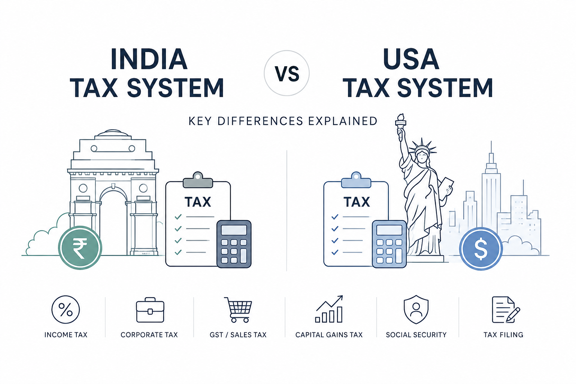
If you’re wondering how the India tax system vs USA compares, the biggest difference is that India has a centralized tax system with GST, while the United States has both federal and state taxes, making its tax structure more complex. Income tax rates, corporate taxes, and indirect taxes also differ significantly.
Whether you’re planning to move abroad, invest internationally, or simply want to understand global taxation, this guide explains the major differences with percentage rates and practical examples.
India Tax System vs USA at a Glance
| Tax Category | India | USA |
|---|---|---|
| Personal Income Tax | 0% to 30% (plus surcharge and 4% cess where applicable) | 10% to 37% federal, plus state tax (0% to about 13.3%) |
| Corporate Tax | 22% for eligible domestic companies, 15% for eligible new manufacturing companies | 21% federal plus state corporate tax |
| GST/Sales Tax | GST rates of 0%, 5%, 12%, 18%, and 28% | No GST. State sales tax ranges from 0% to about 10% |
| Capital Gains Tax | Generally 12.5% to 20%, depending on the asset and holding period | 0%, 15%, or 20% for most long term gains |
| Tax Authority | Income Tax Department | Internal Revenue Service (IRS) and state tax agencies |
| Tax Filing | One national income tax return | Federal return and, in many states, a separate state return |
How Does the Income Tax System Differ?
“Start investing with confidence! Explore
0 demat account
and grow your wealth.”
India
India follows a progressive income tax system. As your income increases, the tax rate also increases.
The highest standard income tax rate is 30%, although surcharge and a 4% health and education cess may increase the effective tax liability for higher income taxpayers.
USA
The United States also uses progressive taxation. However, taxpayers often pay both:
- Federal income tax
- State income tax (depending on where they live)
Federal tax rates range from 10% to 37%. Some states, such as Texas and Florida, do not charge state income tax, while others impose rates exceeding 10%.
GST vs Sales Tax
One of the biggest differences in the India tax system vs USA is indirect taxation.
India’s GST
India introduced the Goods and Services Tax (GST) to replace multiple indirect taxes.
GST slabs include:
- 0%
- 5%
- 12%
- 18%
- 28%
Most goods and services fall under the 18% category.
USA Sales Tax
The United States does not have a national GST.
Instead, each state sets its own sales tax rate. Local governments can also add additional taxes.
Sales tax generally ranges from 0% to around 10%, depending on the state and city.
Corporate Tax Comparison
Businesses also face different tax structures.
| Feature | India | USA |
|---|---|---|
| Standard Corporate Tax | 22% (eligible domestic companies) | 21% federal |
| New Manufacturing Companies | 15% (eligible companies) | No equivalent nationwide rate |
| State Corporate Tax | No | Yes, varies by state |
Although the federal corporate tax rate in the USA is slightly lower, state taxes often increase the total tax burden.
Capital Gains Tax
Capital gains tax applies when you sell investments for a profit.
India
Capital gains tax depends on:
- Type of asset
- Holding period
- Applicable tax rules
For many investments, long term capital gains are taxed between 12.5% and 20%.
USA
Long term capital gains are generally taxed at:
- 0%
- 15%
- 20%
Short term capital gains are usually taxed at ordinary income tax rates.
Social Security Contributions
Income tax is only one part of payroll deductions.
India
Employees may contribute to:
- Employees’ Provident Fund (EPF)
- Employees’ State Insurance (ESI), where applicable
USA
Employees generally pay:
- Social Security: 6.2%
- Medicare: 1.45%
Employers contribute matching amounts.
Tax Filing Process
India
Taxpayers typically file one annual income tax return through the Income Tax Department.
USA
Taxpayers usually file:
- Federal tax return with the IRS.
- State tax return, if required.
This makes tax filing more complex than in India.
Which Country Has Higher Taxes?
There is no simple answer.
The effective tax burden depends on:
- Annual income
- State of residence in the USA
- Tax deductions and exemptions
- Investment income
- Business structure
For example, someone living in California may pay a much higher overall tax rate than someone living in Texas because California has significant state income taxes.
Similarly, India’s surcharge and cess can increase taxes for high income individuals.
India Tax System vs USA: Pros and Cons
| India | USA |
|---|---|
| Simple nationwide income tax | Federal and state taxes increase complexity |
| Uniform GST system | Sales tax differs across states |
| Lower compliance for individuals | Multiple tax authorities |
| Higher GST on luxury goods | Lower indirect taxes in many states |
Frequently Asked Questions
Q. Which country has a higher income tax rate, India or the USA?
The USA has a higher maximum federal income tax rate at 37%, compared to India’s standard maximum rate of 30%, although additional surcharge and cess may apply in India.
Q. Does the USA have GST?
No. The USA uses state and local sales taxes instead of a nationwide GST.
Q. Which country has lower corporate tax?
The USA has a 21% federal corporate tax, while eligible domestic companies in India may pay 22%, with eligible new manufacturing companies paying 15%.
Q. Is tax filing easier in India?
Generally, yes. India has a centralized income tax system, whereas many Americans must file both federal and state tax returns.
Q. Which country is better for businesses?
It depends on the business type, industry, location, incentives, and overall compliance requirements. Tax rates are only one factor.
Key Takeaways
- India uses a centralized tax system, while the USA combines federal and state taxation.
- India’s GST ranges from 0% to 28%, whereas the USA relies on state sales taxes.
- Federal income tax reaches 37% in the USA and 30% in India before surcharge and cess.
- Corporate taxes are similar, but U.S. state taxes can increase the effective rate.
- Understanding these differences helps individuals, investors, and businesses make informed financial decisions.
Conclusion
When comparing the India tax system vs USA, neither system is universally better. India offers a more centralized and straightforward structure with GST and national income tax rules. The United States provides flexibility through state taxation but also adds complexity with separate federal, state, and local tax obligations.
For expatriates, investors, multinational businesses, and students planning to move abroad, understanding these tax differences is essential for better financial planning and compliance.
Disclaimer
The stocks mentioned in this article are not recommendations. Please conduct your own research and due diligence before investing. Investment in securities market are subject to market risks, read all the related documents carefully before investing. Please read the Risk Disclosure documents carefully before investing in Equity Shares, Derivatives, Mutual fund, and/or other instruments traded on the Stock Exchanges. As investments are subject to market risks and price fluctuation risk, there is no assurance or guarantee that the investment objectives shall be achieved. Lemonn (Formerly known as NU Investors Technologies Pvt. Ltd) do not guarantee any assured returns on any investments. Past performance of securities/instruments is not indicative of their future performance.
Related Posts

Download Lemonn
Download my app for share market trading, ipo investment, trading account, and all your investment needs.