Closing Auction Session (CAS): What Investors Should Know
 Written by Supratim Choudhury
 Reviewed by Gaurav Garg, SEBI-registered Research Analyst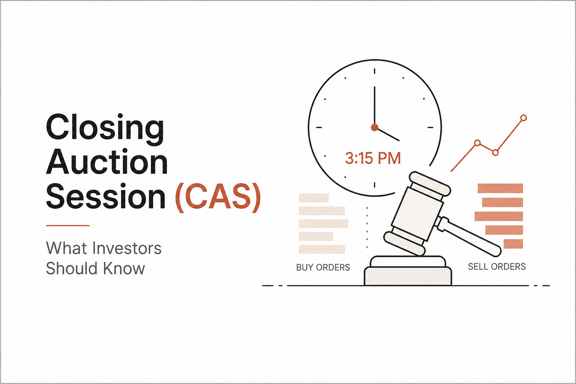
Waiting until 3:29 p.m. to exit a stock? For shares covered by the Closing Auction Session, continuous trading has already ended. This change can catch traders off guard: an order placed near the close now enters an auction, where execution depends on a collective matching process.
The Securities and Exchange Board of India (SEBI) introduced the Closing Auction Session (CAS) from 3 August 2026 for cash-market stocks on which futures and options (F&O) contracts are available. Buying or selling these shares near the close, therefore, requires a different understanding of timings and order behaviour.
This guide explains which stocks are covered, how the auction determines their closing prices, and what happens to pending orders. You will learn how to read indicative prices, plan end-of-day trades, and distinguish exchange rules from your broker’s square-off policy. It also explains what CAS means for long-term investors, swing traders, intraday traders, derivatives participants, and passive-fund investors.
What Is the Closing Auction Session?
CAS is an end-of-day auction that brings together buy and sell orders to discover a stock’s official closing price. Orders accumulate during a collection window and are subsequently matched at a single equilibrium price.
During continuous trading, compatible orders can execute as they arrive. During CAS, submitting an order does not produce an immediate trade. The exchange first assesses the collected demand and supply.
CAS applies to the underlying shares in the cash market. The presence of F&O contracts determines initial eligibility; it does not mean that futures and options themselves trade through this cash-market auction.
Stocks outside CAS continue with their existing closing-price method: the volume-weighted average price (VWAP) of trades during the final 30 minutes of continuous trading. VWAP weights each transaction price by the quantity traded, so larger trades have greater influence than smaller ones.
Why the Closing Price Matters
A stock’s last traded price and official closing price can differ. The last traded price records the latest completed transaction; the closing price follows the exchange’s prescribed calculation or auction mechanism.
This distinction matters beyond the final trade. Closing prices feed into index calculations, portfolio valuations, and derivatives settlement arrangements. Passive funds also need to transact close to the prices used by their benchmarks.
SEBI’s rationale is to pool closing liquidity and give different investor categories transparent access to the closing-price process. An auction can help funds transact at the benchmark closing price, but it cannot guarantee a stable price, sufficient liquidity, or execution of every order.
“Start investing with confidence! Explore
0 demat account
and grow your wealth.”
CAS Timings: What Happens After 3:15 p.m.?
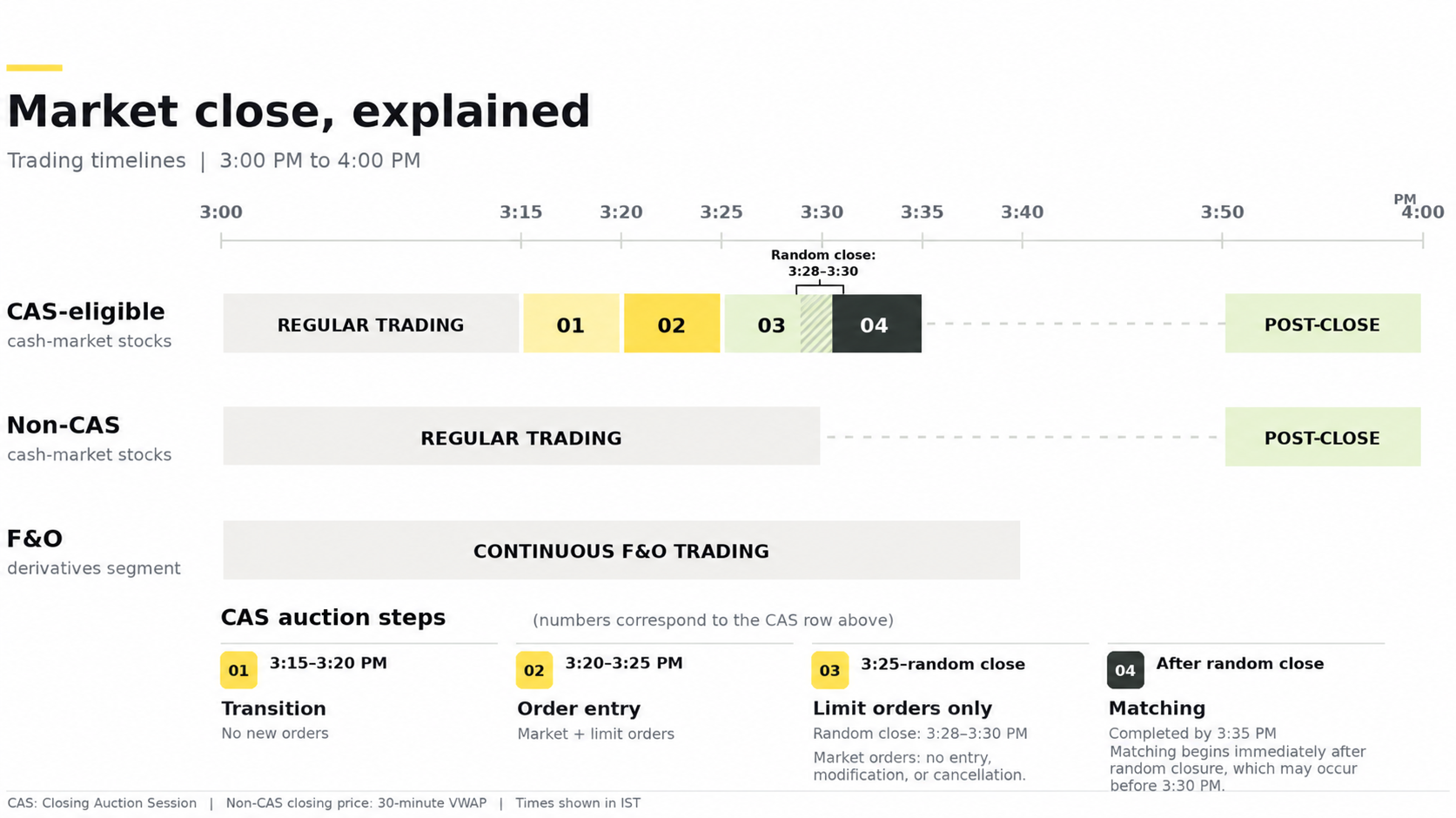
The standard CAS window runs from 3:15 p.m. to 3:35 p.m. All times below are Indian Standard Time.
| Time | Stage | What investors should know |
| 3:15–3:20 p.m. | Transition and reference-price calculation | Continuous trading has ended for eligible stocks. |
| 3:20–3:25 p.m. | Order collection | Limit and market orders can be entered, modified, or cancelled. |
| 3:25 p.m. until random closure | Restricted order collection | Only limit orders can be entered, modified, or cancelled. Market orders are locked. |
| Between 3:28 and 3:30 p.m. | Random closure | The system ends order collection at an unpredictable point within this window. |
| After random closure, through 3:35 p.m. | Matching and confirmation | Matching begins when collection ends; trades are confirmed. |
Do not assume you can change an order at 3:29 p.m. Random closure may already have occurred.
Continuous trading in non-CAS cash-market securities remains open until 3:30 p.m. Equity derivatives trade until 3:40 p.m. The cash-market post-close session operates from 3:50 p.m. to 4:00 p.m., with transactions at the established closing price. These are distinct sessions, each with its own function.
How CAS Determines the Closing Price
First, the exchange calculates a reference price, normally using the stock’s VWAP from 3:00 p.m. to 3:15 p.m. If there were no trades in that interval, it uses the day’s last traded price. Further fallback rules apply when the stock has not traded that day.
The CAS price band is 3% above or below the reference price. This sets the permitted auction range; it does not predict where the stock will close.
The exchange then identifies the price at which the maximum number of shares can be matched. If several prices qualify, it applies tie-breakers, first favouring the smallest unmatched quantity and then proximity to the reference price. If no equilibrium price is discovered, the reference price becomes the closing price.
A simple auction example
Consider a hypothetical stock with a ₹100 reference price. Its auction range is ₹97–₹103. Assume the collected orders produce these totals at three candidate prices:
| Candidate price | Shares buyers would buy | Shares sellers would sell | Shares that can match |
| ₹99 | 1,000 | 400 | 400 |
| ₹100 | 800 | 700 | 700 |
| ₹101 | 500 | 900 | 500 |
At each price, executable volume is the smaller of eligible buying and selling quantities. Here, ₹100 permits the largest match: 700 shares. Assuming no other candidate permits a larger match, ₹100 becomes the equilibrium price.
A buy limit of ₹101 sets the highest acceptable purchase price. If that order receives an allocation in this auction, it executes at ₹100. However, an acceptable limit does not guarantee a full fill: available supply and order priority still matter.
Which Orders Are Allowed, and What Carries Forward?
CAS permits market and limit orders. Stop-loss and iceberg orders are excluded. An iceberg order reveals only part of its total quantity; CAS requires the full quantity to be disclosed.
At the exchange level, eligible unexecuted limit orders from continuous trading are carried into the CAS. Exceptions include stop-loss orders, iceberg orders, and orders priced outside the CAS band. Carried-forward limit orders retain their earlier time priority over newly entered auction limit orders; however, any modification to these orders changes that priority.
Market orders receive execution priority over limit orders. Eligible limit orders are then handled according to price and time priority. New CAS orders face applicable margin checks, as do carried-forward orders modified during CAS.
For traders, the practical task is to review outstanding orders before the transition. An old limit order may remain relevant to the auction even if you originally placed it for an earlier part of the day. Confirm its status rather than assuming it has expired.
What CAS Means for Different Retail Investors
The same auction rules have different practical implications for investors holding shares, trading short-term moves, using derivatives, or investing through funds.
Long-term and delivery investors
For long-term shareholders, CAS mainly changes the closing-price reference and the process for transactions near the close. A difference between the auction price and the last continuous-trading price alone does not justify changing an investment thesis.
If you are adding shares or trimming a holding late in the day, choose a limit that reflects your valuation and price tolerance. Check the executed quantity before assuming the intended portfolio adjustment is complete.
Swing and positional traders
If your strategy uses daily closing prices to confirm a breakout or breakdown, distinguish the final official close from both the 3:15 p.m. last traded price and the indicative auction price. A signal based on the confirmed close cannot be treated as confirmed while auction collection is still under way.
For positions held overnight, review the exit plan before continuous trading ends. Stop-loss orders are unavailable during CAS, so do not assume an existing stop protects you throughout the auction.
Intraday traders and scalpers
For traders seeking to close positions the same day, timing and execution uncertainty are central. Check when your broker stops accepting intraday orders and begins automatic square-offs; the exchange’s CAS timetable does not establish those deadlines.
If an exit depends on immediate execution or repeated order changes, account for the switch to auction matching at 3:15 p.m. Market orders become unchangeable from 3:25 p.m., and random closure can end limit-order changes before 3:30 p.m.
Futures and options traders and hedgers
Even if you never place a cash-market auction order, CAS can matter because underlying stock closing prices feed into index calculations and derivatives settlement arrangements. Treat indicative auction values as provisional, especially when managing positions near expiry.
If you combine shares with derivatives, reconcile confirmed cash-market fills with the hedge. A partial share purchase or sale can leave a different exposure from the one intended. Also distinguish a derivative’s traded price from the underlying closing price and the clearing corporation’s applicable settlement price.
Index-fund and ETF investors
For investors in equity index funds or exchange-traded funds (ETFs), CAS matters indirectly through eligible stocks held by the fund and the benchmark’s closing values. One regulatory objective is to help passive funds transact at stock closing prices and reduce tracking error, which means reducing divergence from their benchmarks.
This is an intended benefit, not a promise of higher returns or perfect tracking. Holding a passive fund does not require you personally to place auction orders in its underlying shares.
Across these groups, use indicative prices cautiously, understand order restrictions, and confirm execution before acting.
Are Further CAS Changes Being Considered?
SEBI published a consultation paper on 12 September 2026 reviewing aspects of CAS, market timings, and derivatives settlement methodologies. Consultation proposals need a final regulatory decision and an applicable implementation date before they become trading rules.
This guide presents the framework that has been implemented, based on the official sources reviewed in mid-October 2026. Recheck subsequent SEBI and exchange circulars before using session timings or settlement rules for a live trade.
Key Takeaways
- For CAS stocks, plan around the 3:15 p.m. end of continuous trading.
- Review pending orders and understand when modification becomes unavailable.
- Separate the reference price, indicative auction price, and confirmed closing price.
- Match your response to your investing style, and confirm execution before assuming a position is closed.
Frequently Asked Questions (FAQs)
Q: Can retail investors participate in CAS?
A: Yes. The framework provides access across investor categories. Participation through your trading account depends on your broker’s supported order facilities and applicable risk checks.
Q: Does a market order guarantee execution in CAS?
A: No. Priority does not create matching supply or demand. Your order may receive a partial fill or remain unexecuted, so check the confirmed trade status.
Q: Can I rely on a stop-loss order during CAS?
A: No. Stop-loss orders are not permitted in CAS and are excluded from the eligible orders carried forward from continuous trading. Plan exits with this limitation in mind.
Q: Does CAS apply to every listed stock?
A: No. Its initial coverage is cash-market stocks with derivatives available. Check the exchange’s current eligibility information for the particular security you intend to trade.
Q: Is CAS the same as the post-close session?
A: No. CAS discovers the closing price through an auction. The separate post-close session allows transactions at the already established closing price, subject to available matching orders.
Disclaimer
The stocks mentioned in this article are not recommendations. Please conduct your own research and due diligence before investing. Investment in securities market are subject to market risks, read all the related documents carefully before investing. Please read the Risk Disclosure documents carefully before investing in Equity Shares, Derivatives, Mutual fund, and/or other instruments traded on the Stock Exchanges. As investments are subject to market risks and price fluctuation risk, there is no assurance or guarantee that the investment objectives shall be achieved. Lemonn (Formerly known as NU Investors Technologies Pvt. Ltd) do not guarantee any assured returns on any investments. Past performance of securities/instruments is not indicative of their future performance.
Related Posts


Download Lemonn
Download my app for share market trading, ipo investment, trading account, and all your investment needs.