Income Tax Return Filing (ITR): Complete Guide to Filing Income Tax Return Online in India (2026)
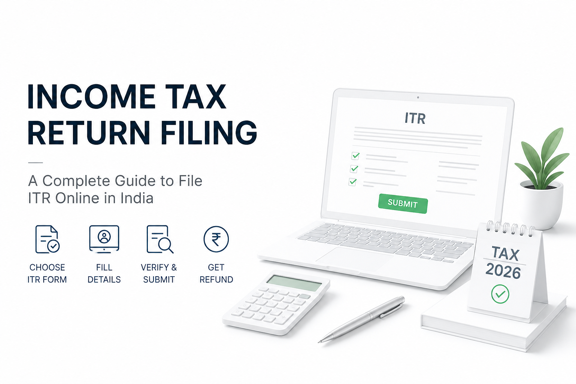
Filing your Income Tax Return (ITR) is one of the most important financial responsibilities for taxpayers in India. Whether you are a salaried employee, freelancer, business owner, investor, or pensioner, filing your ITR on time can help you stay compliant with tax laws, claim refunds, carry forward losses, and strengthen your financial profile.
In recent years, the income tax filing process has become faster and more user-friendly through the Income Tax Department’s e-Filing portal. With pre-filled information, AIS (Annual Information Statement), Form 26AS integration, and online verification, taxpayers can complete the process within minutes if their documents are in order.
This comprehensive guide explains everything you need to know about Income Tax Return filing, including eligibility, ITR forms, documents required, due dates, tax regimes, common mistakes, refund timelines, and frequently asked questions.
What is Income Tax Return (ITR)?
An Income Tax Return (ITR) is a form through which taxpayers report their income, deductions, taxes paid, and tax liability to the Income Tax Department.
Your return includes details such as:
- Salary income
- Business income
- Capital gains
- Rental income
- Interest income
- Tax-saving investments
- Taxes deducted (TDS)
- Advance tax paid
- Refund due (if any)
Once your return is filed and verified, the Income Tax Department processes it and issues any eligible refund.
Who Should File an Income Tax Return?
You should file an ITR if:
- Your total income exceeds the applicable exemption limit.
- TDS has been deducted and you want to claim a refund.
- You have capital gains from shares, mutual funds, property, or gold.
- You are a freelancer or consultant earning professional income.
- You own a business.
- You wish to carry forward capital or business losses.
- You are an NRI with taxable income in India.
- You have foreign assets or overseas income that must be disclosed.
- You need income proof for a visa, loan, or financial application.
Even if your income is below the taxable limit, filing an ITR can be beneficial in many situations.
“Start investing with confidence! Explore
0 demat account
and grow your wealth.”
Benefits of Filing Income Tax Return
Filing your return offers several advantages beyond tax compliance:
1. Claim Income Tax Refunds
If excess tax has been deducted, filing an ITR enables you to claim a refund.
2. Carry Forward Capital Losses
Losses from stocks, mutual funds, or property can be carried forward only if your return is filed within the prescribed timeline, subject to applicable tax provisions.
3. Easier Loan Approval
Banks often request ITR acknowledgements while processing home, education, business, or personal loans.
4. Visa Applications
Many countries require previous years’ ITRs as proof of financial stability.
5. Financial Documentation
ITRs serve as widely accepted proof of income for various financial transactions.
Income Tax Return Filing Due Dates
Different categories of taxpayers have different filing deadlines. Always check the latest notifications issued by the Income Tax Department, as deadlines may be extended in some years.
| Taxpayer Category | Typical Due Date* |
|---|---|
| Individuals (non-audit cases) | As notified for the assessment year |
| Businesses requiring audit | As notified |
| Transfer pricing cases | As notified |
Note: Always verify the latest due dates on the Income Tax Department’s official portal.
Documents Required for ITR Filing
Keep these documents ready before filing:
Personal Documents
- PAN
- Aadhaar
- Bank account details
- Mobile number
- Email ID
Income Documents
- Form 16
- Salary slips
- Pension statement
- Interest certificates
- Rental income details
Investment Documents
- Mutual fund statements
- Stock transaction reports
- Capital gains statements
- Dividend statements
Tax Documents
- Form 26AS
- Annual Information Statement (AIS)
- Tax Information Statement (TIS)
- Advance tax details
- Self-assessment tax receipts
Deduction Proofs
- PPF
- ELSS
- NPS
- Life insurance
- Health insurance
- Home loan interest certificate
- Donations (where eligible)
Types of ITR Forms
Different taxpayers need different forms.
| ITR Form | Suitable For |
|---|---|
| ITR-1 | Salaried individuals with eligible income as prescribed |
| ITR-2 | Individuals with capital gains or multiple house properties |
| ITR-3 | Business or professional income |
| ITR-4 | Presumptive taxation scheme (eligible taxpayers) |
| ITR-5 | Firms, LLPs, AOPs |
| ITR-6 | Companies (other than those claiming exemption under applicable provisions) |
| ITR-7 | Trusts and specified institutions |
Which ITR Form Should You Choose?
| Your Situation | Recommended Form |
|---|---|
| Salary only | ITR-1 (if eligible) |
| Salary + Capital Gains | ITR-2 |
| Freelancer | ITR-3 or ITR-4 (subject to eligibility) |
| Proprietor | ITR-3 |
| LLP | ITR-5 |
| Company | ITR-6 |
Choosing the wrong form may result in your return being treated as defective.
New Tax Regime vs Old Tax Regime
Choosing the right tax regime can significantly impact your tax liability.
| Feature | New Tax Regime | Old Tax Regime |
|---|---|---|
| Tax rates | Lower slabs | Higher slabs |
| Deductions | Limited | Wide range of deductions available |
| Best suited for | Individuals with fewer deductions | Individuals claiming multiple deductions |
Evaluate your deductions before selecting a regime. Consider using an income tax calculator to compare both options.
How to File Income Tax Return Online
Follow these steps:
Step 1
Visit the official Income Tax e-Filing portal.
Step 2
Log in using your PAN/Aadhaar credentials.
Step 3
Select File Income Tax Return.
Step 4
Choose the relevant Assessment Year.
Step 5
Select the appropriate ITR form.
Step 6
Verify pre-filled information.
Step 7
Cross-check AIS, TIS, and Form 26AS.
Step 8
Report all sources of income accurately.
Step 9
Claim eligible deductions.
Step 10
Calculate tax payable or refund due.
Step 11
Submit your return.
Step 12
Complete e-verification using Aadhaar OTP, net banking, bank account, or demat account.
Your filing process is complete only after successful verification.
How to Calculate Income Tax
Your taxable income is generally determined using the following approach:
Gross Income
− Eligible Exemptions
− Eligible Deductions
= Taxable Income
Apply the applicable tax rates under your chosen regime to determine your tax liability.
AIS vs Form 26AS vs TIS
Understanding these documents is essential.
| Document | Purpose |
|---|---|
| Form 26AS | Tax credits, TDS, TCS, and certain tax payments |
| AIS | Comprehensive financial information reported to the department |
| TIS | Summarised taxpayer information derived from AIS |
Always reconcile these documents before filing to minimise the chances of notices or processing delays.
Reporting Different Types of Income
Ensure you report all applicable income, including:
Salary Income
Include salary, allowances, bonuses, and perquisites.
Capital Gains
Report gains or losses from:
- Shares
- Mutual funds
- Property
- Gold
- Other capital assets
Interest Income
Include interest from:
- Savings accounts
- Fixed deposits
- Recurring deposits
Dividend Income
Report dividends received during the financial year.
Rental Income
Include income earned from house property.
Business Income
Businesses and professionals should disclose profits and maintain appropriate records where required.
Common Mistakes While Filing ITR
Avoid these common errors:
- Choosing the wrong ITR form
- Not matching AIS with your return
- Ignoring Form 26AS
- Forgetting bank interest
- Missing dividend income
- Reporting incorrect capital gains
- Selecting the wrong tax regime
- Forgetting to e-verify
- Claiming unsupported deductions
- Entering incorrect bank account details
How to Revise an ITR
If you discover an error after filing, you can generally file a revised return within the timelines permitted under the Income-tax Act.
Common reasons include:
- Incorrect income
- Missing deductions
- Wrong bank account
- Incorrect TDS details
- Capital gains omitted
What is an Updated Return (ITR-U)?
An Updated Return (ITR-U) provides eligible taxpayers with an opportunity to update their tax return under specified conditions and within the timelines prescribed by law.
It can be useful if:
- Income was omitted
- Incorrect details were reported
- Additional tax needs to be paid
Certain restrictions and conditions apply.
Income Tax Refund Process
If excess tax has been paid, the Income Tax Department processes your return and issues a refund after successful verification and processing.
Refunds are generally credited directly to your validated bank account.
To help avoid delays:
- Validate your bank account
- Pre-validate your IFSC details
- Verify your return promptly
- Ensure your PAN and Aadhaar are correctly linked (where applicable)
Penalties for Late Filing
Late filing may result in consequences such as:
- Late filing fee (where applicable)
- Interest on tax due
- Delay in receiving refunds
- Inability to carry forward certain losses
- Additional compliance requirements
Filing within the prescribed timeline is generally advisable.
Best Practices Before Filing Your ITR
Use this quick checklist:
✔ Verify PAN and Aadhaar details
✔ Download AIS and Form 26AS
✔ Check all TDS entries
✔ Report every source of income
✔ Select the correct ITR form
✔ Choose the appropriate tax regime
✔ Claim only eligible deductions
✔ Validate your bank account
✔ E-verify your return immediately after filing
Frequently Asked Questions
Q. Is filing ITR mandatory?
It depends on your income level and other conditions prescribed under the Income-tax Act. Even when not mandatory, filing may be beneficial for refunds, loans, visas, and carrying forward eligible losses.
Q. Can I file ITR without Form 16?
Yes. You can use salary slips, AIS, Form 26AS, and other income records to prepare your return.
Q. Can I file ITR online myself?
Yes. Most individual taxpayers can file their return online through the Income Tax Department’s e-Filing portal.
Q. Which ITR form should salaried employees use?
Many salaried individuals with simple income may be eligible for ITR-1, while those with capital gains or more complex income may need another form, such as ITR-2.
Q. How long does it take to get an income tax refund?
Refund timelines vary based on verification, processing, and the accuracy of the information provided.
Q. Can I revise my ITR after filing?
Yes, if permitted under the applicable rules and timelines.
Q. What happens if I do not e-verify my return?
An unverified return is generally treated as not filed until verification is completed within the prescribed time.
Q. Can freelancers file ITR online?
Yes. Freelancers can file their returns online using the applicable ITR form based on their income and eligibility.
Q. Is Aadhaar mandatory for filing ITR?
The requirements are subject to prevailing tax rules and notifications. Check the latest guidance before filing.
Q. Can I claim a refund if TDS has been deducted?
Yes. If your total tax liability is lower than the tax already deducted, you may be eligible for a refund after filing and processing.
Final Thoughts
Income Tax Return filing is more than a legal requirement-it is an important part of sound financial planning. Filing your return accurately and on time can help you claim refunds, build financial credibility, carry forward eligible losses, and stay compliant with tax laws.
Before submitting your return, reconcile your income with AIS, Form 26AS, and other financial records, choose the correct ITR form, verify all deductions, and complete e-verification. If your tax situation involves complex issues such as business income, foreign assets, or intricate capital gains, consider consulting a qualified tax professional.
By following the guidance in this article and keeping your records organised throughout the year, you can make the ITR filing process smoother, faster, and more accurate.
Disclaimer
The stocks mentioned in this article are not recommendations. Please conduct your own research and due diligence before investing. Investment in securities market are subject to market risks, read all the related documents carefully before investing. Please read the Risk Disclosure documents carefully before investing in Equity Shares, Derivatives, Mutual fund, and/or other instruments traded on the Stock Exchanges. As investments are subject to market risks and price fluctuation risk, there is no assurance or guarantee that the investment objectives shall be achieved. Lemonn (Formerly known as NU Investors Technologies Pvt. Ltd) do not guarantee any assured returns on any investments. Past performance of securities/instruments is not indicative of their future performance.
Related Posts


Download Lemonn
Download my app for share market trading, ipo investment, trading account, and all your investment needs.