What Is a Property Investment Portfolio? Meaning, How to Build, and Strategies
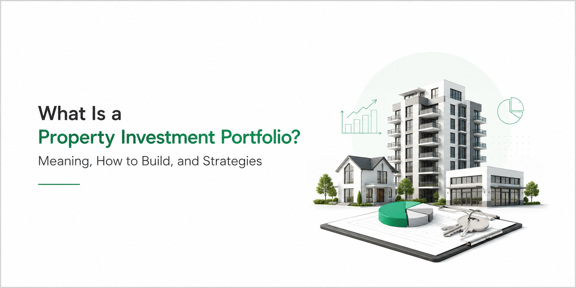
A property investment portfolio is a planned collection of real estate assets held to earn rental income, gain from price appreciation, or achieve both. It may include residential flats, commercial spaces, plots, warehouses, and property-linked investments such as Real Estate Investment Trusts (REITs).
The keyword is “planned.” Owning two or three properties does not automatically create a strong portfolio. A useful portfolio gives each asset a clear role, spreads risk, controls debt, and keeps enough liquidity for emergencies and opportunities.
What Is a Property Investment Portfolio?
A property investment portfolio is the real estate portion of an investor’s overall wealth plan. It records what the investor owns, why each asset was purchased, how it is financed, what income it generates, and when it may be sold.
For example, one flat may provide regular rent, a listed REIT may offer liquid exposure to commercial property, and a plot may be held for long-term growth. Together, these assets can form a property investment portfolio.
A self-occupied home is usually not treated as an income-generating investment. However, it should still be considered when measuring your total exposure to real estate. An investor who owns an expensive home and another flat in the same locality may already have high concentration risk.
Why Build a Property Investment Portfolio?
A portfolio approach helps you avoid treating every purchase as a separate decision. It can help you:
- Balance rental income and capital appreciation.
- Reduce dependence on one city, tenant type, developer, or property category.
- Match assets with short-, medium-, and long-term goals.
- Track debt, cash flow, taxes, and maintenance costs more accurately.
- Decide when to hold, sell, refinance, or add another asset.
Diversification does not remove risk. Property remains relatively illiquid, transaction costs can be high, and local conditions matter. The purpose of a portfolio is to manage these risks, not pretend they do not exist.
“Start investing with confidence! Explore
0 demat account
and grow your wealth.”
What Can a Property Investment Portfolio Include?
| Asset type | Main portfolio role | Key risks |
| Residential property | Rental income and long-term appreciation | Low yield, vacancy, maintenance, and local oversupply |
| Commercial property | Potentially higher rental income | Tenant concentration, longer vacancy, and larger ticket size |
| Land or plots | Long-term appreciation | No regular income, title risk, and slow exit |
| Warehouses or industrial assets | Business-linked rental income | Specialised demand, tenant quality, and location dependence |
| Listed REITs | Liquid, professionally managed property exposure | Market-price volatility, interest-rate sensitivity, and asset concentration |
| Small and Medium REITs (SM REITs) | Access to smaller pooled real estate schemes | Scheme-specific liquidity, manager quality, and concentration |
The Securities and Exchange Board of India (SEBI) describes REITs as pooled investment vehicles that invest in real estate and are listed and traded on stock exchanges like shares. SEBI has also introduced a regulatory framework for SM REITs, which is relevant when evaluating fractional or pooled property opportunities.
Read More: REIT (Real Estate Investment Trust)
How to Build a Property Investment Portfolio
1. Define the Goal Before Choosing the Property
Start by deciding what the portfolio must do.
Are you seeking monthly income, long-term growth, retirement cash flow, or diversification beyond stocks and mutual funds? Also define your investment period, acceptable debt level, and the amount of money you may need at short notice.
A property bought for rent should be judged differently from land bought for appreciation. Mixing the two goals can lead to poor decisions.
2. Set a Total Real Estate Allocation
Do not decide affordability only from the down payment. Consider your existing home, other properties, loans, emergency fund, insurance, and financial assets.
A property may look affordable on paper but still leave your net worth heavily concentrated in one illiquid asset. Keep money needed within the next few years outside long-term property investments.
3. Give Every Asset a Role
A simple portfolio can use three roles:
- Income assets: Ready properties with visible rental demand, or income-oriented listed REITs.
- Growth assets: Land, redevelopment opportunities, or property in an emerging business or infrastructure corridor.
- Liquidity assets: Listed REITs or uncommitted cash held outside the property portfolio.
This prevents you from buying several assets that all depend on the same outcome.
4. Research the Micro-Market
National headlines are less useful than local evidence. Study actual sale prices, achievable rent, vacancy, new supply, nearby employment, transport links, water availability, flood history, and resale demand.
Do not rely only on a broker’s projected appreciation. Compare registered transactions where available, speak with local residents and tenants, and visit the area at different times.
5. Complete Legal and Regulatory Checks
For an under-construction or recently launched project, verify registration on the relevant state Real Estate Regulatory Authority portal. The Real Estate (Regulation and Development) Act, 2016 (RERA) requires registration for covered projects and requires promoters to disclose important project information. Some projects are exempt, so registration alone should not replace legal due diligence.
A property lawyer should independently check the title chain, encumbrances, sanctioned plans, land use, approvals, agreement terms, completion or occupancy documents, and pending disputes. Note that “RERA-registered” is more accurate than “RERA-approved.”
6. Use Debt Carefully
Borrowing can increase returns when prices and rent rise, but it also increases losses and monthly pressure when they do not.
Before taking a loan, test whether you can pay the equated monthly instalment (EMI), maintenance, property tax, and repairs during several months of vacancy. Also test a higher interest rate and a delayed handover. Do not assume rent will always cover the EMI.
7. Calculate Net Return, Not Brochure Return
Use the total acquisition cost, not only the quoted property price.
Total acquisition cost = purchase price + stamp duty + registration + brokerage + loan charges + furnishing or fit-out costs
Gross rental yield = annual rent ÷ total acquisition cost × 100
Net rental yield = (annual rent − recurring costs − vacancy loss) ÷ total acquisition cost × 100
Suppose a flat costs ₹60 lakh and the total acquisition cost is ₹66 lakh. It earns ₹25,000 per month, or ₹3 lakh a year. If vacancy, maintenance, property tax, repairs, and insurance total ₹60,000, net annual income is ₹2.40 lakh.
The gross yield is about 4.55%, while the net yield is about 3.64%. Loan interest and income tax may reduce the investor’s final return further.
Rental income and gains on sale can create tax obligations. The treatment depends on the asset, holding period, ownership structure, and transaction date, so post-tax returns should be reviewed with a qualified tax professional.
Read More: What Is Property Tax? Types, Rates & Calculation Guide
8. Build Gradually
Your first investment does not need to be a large physical property. Some investors begin with listed REITs to understand property-linked income and market behaviour before committing to direct ownership.
Add a new asset only when it fills a genuine gap. Three similar flats in the same project are three units, but economically they may represent one concentrated bet.
9. Review the Portfolio Every Year
Track each asset using a simple scorecard:
- Current value based on realistic comparable sales.
- Gross and net rental yield.
- Occupancy and rent collection.
- Loan balance and interest cost.
- Maintenance and capital expenditure.
- Legal or project-status changes.
- Expected time and cost to sell.
Sell or rebalance when an asset no longer serves its role, not simply because its price has moved for a few months.
Property Investment Portfolio Strategies
Core and Growth Strategy
Keep most of the portfolio in assets with visible demand, completed construction, and reasonable resale liquidity. Use a smaller portion for higher-risk opportunities such as emerging locations or land.
This approach can limit damage if a growth idea takes longer than expected.
Income-First Strategy
Prioritise ready-to-lease assets, strong tenant catchments, and manageable maintenance. Focus on net yield, lease terms, tenant quality, and vacancy history rather than headline rent.
This may suit investors who want cash flow, but rental income is never guaranteed.
Diversification by Demand Driver
Diversify by more than city name. Two properties in different suburbs may still depend on the same technology park or infrastructure project.
Consider different demand drivers, such as offices, education, healthcare, logistics, tourism, and local residential demand.
Staggered Purchase Strategy
Avoid deploying all capital at once. A staged approach gives you time to learn, maintain liquidity, and respond to better opportunities.
It also reduces the chance that every asset is purchased at the same point in the local property cycle.
Value-Add Strategy
An investor may improve returns through renovation, better furnishing, professional tenant management, improved lease terms, or conversion to a more suitable use, subject to local laws and approvals.
The expected increase in rent or resale value should exceed the cost, time, and execution risk.
Common Mistakes to Avoid
The most common mistakes are buying emotionally, overestimating rent, ignoring transaction costs, using too much debt, skipping title checks, and assuming infrastructure announcements guarantee appreciation.
Also avoid unregulated pooled structures that promise fixed or unusually high returns. Verify the legal structure, regulator, asset ownership, valuation method, fees, exit process, and investor rights before committing money.
Key Takeaways
A property investment portfolio is not a collection of random properties. It is a structured plan in which each asset has a role (income, growth, and liquidity).
Start with clear goals, measure total real estate exposure, use debt conservatively, calculate net returns, complete legal checks, and diversify by asset type, location, and demand driver. Review the portfolio annually, and add new property only when it improves the overall balance.
Read More: Understanding Real Estate Investment Funds
Frequently Asked Questions (FAQs)
Q: What is a property investment portfolio?
A: It is a planned collection of real estate assets held for rental income, appreciation, or both. It may include physical properties, land, listed REITs, and other regulated property-linked investments.
Q: How many properties are needed to build a portfolio?
A: There is no fixed number. One direct property plus a listed REIT can already create two types of exposure. Quality, diversification, cash flow, and affordability matter more than the number of units.
Q: Can I build a property investment portfolio with a small amount?
A: Yes. Listed REITs can provide property exposure without the large down payment and management work required for direct ownership. Investors can add physical property later if it fits their finances and goals.
Q: Should a self-occupied home be included?
A: It is usually excluded from income calculations, but it should be included when measuring total real estate concentration, debt, and liquidity.
Q: How often should I review my property investment portfolio?
A: Review it at least once a year and after major events such as a loan-rate change, prolonged vacancy, project delay, large repair, tax change, or change in your financial goals.
Disclaimer
The stocks mentioned in this article are not recommendations. Please conduct your own research and due diligence before investing. Investment in securities market are subject to market risks, read all the related documents carefully before investing. Please read the Risk Disclosure documents carefully before investing in Equity Shares, Derivatives, Mutual fund, and/or other instruments traded on the Stock Exchanges. As investments are subject to market risks and price fluctuation risk, there is no assurance or guarantee that the investment objectives shall be achieved. Lemonn (Formerly known as NU Investors Technologies Pvt. Ltd) do not guarantee any assured returns on any investments. Past performance of securities/instruments is not indicative of their future performance.
Related Posts

Download Lemonn
Download my app for share market trading, ipo investment, trading account, and all your investment needs.