Large Cap, Mid Cap, or Small Cap: Which Fund Fits You?
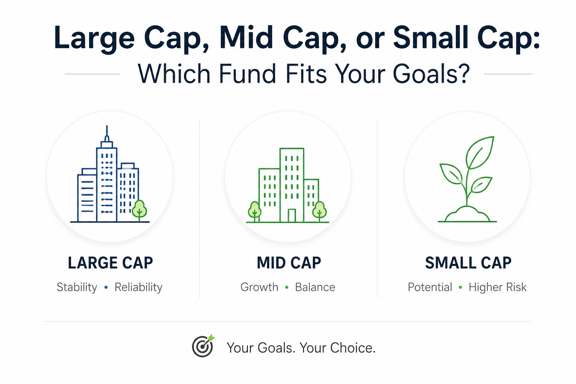
Choosing between large cap, mid cap, and small cap mutual funds depends on three things: your financial goals, risk tolerance, and investment horizon. If you want stability, large cap funds are often the best fit. If you’re looking for a balance between growth and risk, mid cap funds may suit you. If you can handle higher volatility for the potential of stronger long-term returns, small cap funds deserve a closer look.
The good news is that you don’t have to pick just one. Many investors build diversified portfolios by combining different market capitalizations to match their financial objectives.
What Are Large Cap, Mid Cap, and Small Cap Funds?
Mutual funds are categorized based on the market capitalization of the companies they invest in. In India, the Securities and Exchange Board of India (SEBI) defines these categories.
| Fund Type | Companies Invested In | Risk Level | Growth Potential |
|---|---|---|---|
| Large Cap Funds | Top 100 companies by market capitalization | Low to Moderate | Moderate |
| Mid Cap Funds | 101st to 250th ranked companies | Moderate to High | High |
| Small Cap Funds | Companies ranked 251st and below | High | Very High |
Each category plays a different role in a portfolio, making it important to understand how they perform under different market conditions.
What Are Large Cap Funds?
Large cap funds invest at least 80% of their assets in India’s top 100 listed companies by market capitalization, as mandated by SEBI.
These companies are typically established businesses with stable earnings, experienced management teams, and strong market positions.
“Start investing with confidence! Explore the best
mutual funds
and grow your wealth.”
Who Should Invest in Large Cap Funds?
Large cap funds are suitable if you:
- Prefer relatively stable returns
- Have a low to moderate risk appetite
- Are investing for goals that are 5 years or more away
- Want exposure to well-known companies such as Reliance Industries, HDFC Bank, or Infosys
Pros of Large Cap Funds
- Lower volatility during market downturns
- Strong liquidity
- Suitable for first-time investors
- Consistent long-term performance
Cons of Large Cap Funds
- Lower growth potential compared to smaller companies
- May underperform during strong bull markets led by mid and small caps
What Are Mid Cap Funds?
Mid cap funds invest primarily in companies ranked between 101 and 250 by market capitalization.
These businesses are often in the expansion phase. They have already established themselves but still have significant room for growth.
Who Should Invest in Mid Cap Funds?
Mid cap funds may be a good choice if you:
- Can stay invested for at least 7 years
- Want higher growth potential than large cap funds
- Are comfortable with moderate market fluctuations
Pros of Mid Cap Funds
- Better long-term growth potential
- Exposure to emerging market leaders
- Can outperform large caps during economic expansion
Cons of Mid Cap Funds
- Higher volatility
- Sharper corrections during market downturns
- Returns can be inconsistent over shorter periods
What Are Small Cap Funds?
Small cap funds invest in companies ranked 251st and beyond by market capitalization.
These companies are generally younger or smaller businesses with significant growth potential, but they also carry higher business and market risks.
Who Should Invest in Small Cap Funds?
Small cap funds are better suited for investors who:
- Have a high risk tolerance
- Can remain invested for at least 8 to 10 years
- Want to maximize long-term wealth creation potential
Pros of Small Cap Funds
- Highest growth potential
- Opportunity to benefit from emerging businesses
- Can generate strong long-term returns during favorable market cycles
Cons of Small Cap Funds
- High volatility
- Larger drawdowns during market corrections
- Performance may vary significantly across market cycles
Large Cap vs Mid Cap vs Small Cap Funds
Here’s a side-by-side comparison.
| Feature | Large Cap | Mid Cap | Small Cap |
|---|---|---|---|
| Risk | Low to Moderate | Moderate to High | High |
| Return Potential | Moderate | High | Very High |
| Volatility | Low | Moderate | High |
| Investment Horizon | 5+ years | 7+ years | 8 to 10+ years |
| Suitable For | Conservative investors | Balanced growth seekers | Aggressive long-term investors |
| Market Downturn Performance | Better | Moderate | Weakest |
Which Fund Should You Choose?
The right choice depends on your financial priorities.
Choose Large Cap Funds If
- Capital preservation matters most
- You prefer smoother investment journeys
- You’re new to equity investing
Choose Mid Cap Funds If
- You want a balance between stability and growth
- You can tolerate moderate volatility
- Your goals are several years away
Choose Small Cap Funds If
- You have a long investment horizon
- You’re comfortable with sharp market swings
- You want higher long-term growth potential
Can You Invest in All Three?
Yes. Many financial planners recommend diversification across market capitalizations instead of relying on a single category.
Here’s an example allocation based on different risk profiles.
| Investor Profile | Large Cap | Mid Cap | Small Cap |
|---|---|---|---|
| Conservative | 70% | 20% | 10% |
| Moderate | 50% | 30% | 20% |
| Aggressive | 30% | 40% | 30% |
These allocations are only examples. Your ideal mix should reflect your income, goals, existing investments, and ability to manage market fluctuations.
Factors to Consider Before Investing
Before choosing any equity mutual fund, ask yourself:
- What is my investment goal?
- How much market volatility can I tolerate?
- How long can I stay invested?
- Do I already have exposure to equities?
- Am I investing through a Systematic Investment Plan (SIP) or a lump sum?
Answering these questions can help narrow down the most suitable fund category.
Common Mistakes to Avoid
Many investors chase recent returns instead of focusing on long-term suitability.
Avoid these mistakes:
- Investing based only on past performance
- Ignoring your risk tolerance
- Exiting during temporary market declines
- Concentrating your portfolio in one market cap category
- Investing without reviewing your portfolio periodically
Final Thoughts
Large cap, mid cap, and small cap funds each serve a distinct purpose in a diversified investment portfolio. Large cap funds provide stability, mid cap funds offer a balance of growth and risk, and small cap funds aim for higher long-term returns while carrying greater volatility.
Instead of asking which category is the best, ask which one best matches your financial goals, investment horizon, and comfort with risk. For many investors, a thoughtful mix of all three categories can create a more balanced and resilient portfolio over time.
Frequently Asked Questions
Q. Which is better, large cap or small cap funds?
Neither is universally better. Large cap funds are generally more stable, while small cap funds offer higher growth potential with greater risk. The right choice depends on your investment goals and risk tolerance.
Q. Are mid cap funds riskier than large cap funds?
Yes. Mid cap funds are generally more volatile because they invest in companies that are still growing and may be more sensitive to economic conditions.
Q. How long should I stay invested in small cap funds?
A minimum investment horizon of 8 to 10 years is generally recommended to help ride out market volatility and improve the chances of long-term wealth creation.
Q. Can beginners invest in small cap funds?
Beginners can invest in small cap funds, but they should understand the higher level of risk involved. Starting with large cap funds or a diversified portfolio is often a more comfortable approach.
Q. Is it good to invest in all three fund categories?
Yes. Combining large, mid, and small cap funds can improve diversification and balance risk with growth potential, provided the allocation aligns with your financial goals.
Key Takeaways
- Large cap funds focus on stability and lower volatility.
- Mid cap funds balance growth potential with moderate risk.
- Small cap funds offer the highest growth potential but also the highest volatility.
- Your investment horizon and risk tolerance should guide your fund selection.
- A diversified mix of large, mid, and small cap funds can help build a balanced long-term portfolio.
Disclaimer
The stocks mentioned in this article are not recommendations. Please conduct your own research and due diligence before investing. Investment in securities market are subject to market risks, read all the related documents carefully before investing. Please read the Risk Disclosure documents carefully before investing in Equity Shares, Derivatives, Mutual fund, and/or other instruments traded on the Stock Exchanges. As investments are subject to market risks and price fluctuation risk, there is no assurance or guarantee that the investment objectives shall be achieved. Lemonn (Formerly known as NU Investors Technologies Pvt. Ltd) do not guarantee any assured returns on any investments. Past performance of securities/instruments is not indicative of their future performance.
Related Posts
Download Lemonn
Download my mutual fund app - your mutual funds, stock, invest in ipo, mf, trade invest hub with demat account features.