Mainboard IPO vs SME IPO: Key Differences for Retail Investors
 Written by Team Lemonn
 Reviewed by Gaurav Garg, SEBI-registered Research Analyst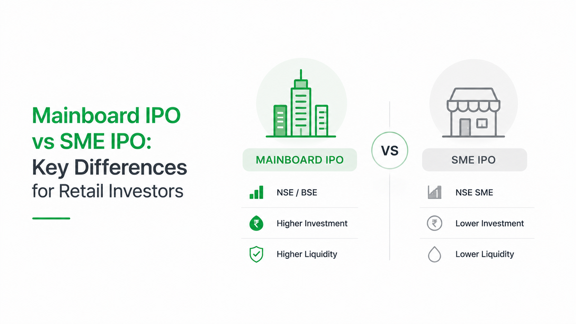
Every Initial Public Offering (IPO) you see in India falls into one of two buckets: Mainboard or SME. The difference is not just semantics. It changes how much money you need, how much regulatory protection you get, and how easily you can exit your investment.
A Mainboard IPO lists a larger, established company on the main platform of the National Stock Exchange (NSE) or the Bombay Stock Exchange (BSE). An SME IPO lists a smaller company on a dedicated platform, BSE SME or NSE Emerge, meant for Small and Medium Enterprises (SMEs). SME IPO meaning, in short: it is how a smaller business raises public capital under a lighter, exchange-supervised compliance regime rather than the full weight of Securities and Exchange Board of India (SEBI) scrutiny.
Here is what actually changes for you as an investor.
Mainboard IPO vs SME IPO: Quick Comparison
| Factor | Mainboard IPO | SME IPO |
| Listing platform | BSE, NSE (main board) | BSE SME, NSE Emerge |
| Company size | Large, established companies | Small and medium enterprises |
| Post-issue paid-up capital | Typically above ₹10 crore | Up to ₹25 crore |
| Minimum investment | Roughly ₹10,000 to ₹15,000 (1 lot) | Above ₹2 lakh (2 lots minimum) |
| DRHP vetting | Directly by SEBI | By the stock exchange, with SEBI in a supervisory role |
| Financial disclosures | Quarterly | Half-yearly |
| Cut-off price bidding | Available to retail investors | Not available |
| Bid revision | Allowed | Generally not allowed once submitted |
| Market maker | Not mandatory | Mandatory for 3 years from listing |
| Minimum public shareholders | 1,000 | 50 |
| Liquidity | Generally higher | Generally lower, wider lot sizes |
Read More: SME IPOs in India: A Strategic Gateway for Small Businesses to Go Public
Minimum Investment: The Biggest Practical Difference
This is usually the first thing that surprises new investors. A Mainboard IPO lot typically costs somewhere between ₹10,000 and ₹15,000, depending on the issue price, which is why it is genuinely accessible to a small retail investor.
An SME IPO works differently. Since July 2025, exchanges have enforced a SEBI-mandated minimum bid of two lots, which usually pushes the entry cost above ₹2 lakh. This single rule change effectively pushed SME IPOs out of reach for casual retail participation and into High Net-Worth Individual (HNI) territory. If you are applying with a modest amount, most SME IPOs simply are not built for you.
Who Vets the Company You’re Investing In
For a Mainboard IPO, the Draft Red Herring Prospectus (DRHP) goes through direct SEBI review before the company can raise money from the public. That process includes detailed scrutiny of financials, business risk, and governance.
For an SME IPO, the DRHP is reviewed and approved by the exchange (BSE or NSE), not SEBI directly, though SEBI retains supervisory oversight of the framework. Since 2025, SME issuers must also keep the DRHP open for public comments for 21 days before the issue opens, a transparency step introduced specifically to address past concerns about weak scrutiny. It is a genuine improvement, but the vetting is still lighter than what a Mainboard company goes through. That difference in scrutiny is exactly why SME investing calls for more homework on your part.
Eligibility Rules Have Gotten Stricter for SMEs
SEBI tightened SME IPO norms substantially through 2024 and 2025 after flagging fund diversion, inflated revenue reporting, and weak governance at some listed SMEs. The current framework requires:
- An operating profit (EBITDA) of at least ₹1 crore in two of the last three financial years before filing.
- Offer for Sale (OFS) capped at 20% of the total issue size, with no individual selling shareholder offloading more than 50% of their holding.
- General Corporate Purposes (GCP) allocation capped at 15% of the issue size or ₹10 crore, whichever is lower.
- A ban on using IPO proceeds to repay loans owed to promoters or related parties.
These rules exist because SME IPOs previously had almost no floor on profitability, which let thinly capitalised, occasionally opaque businesses raise public money. The 2025 changes raise the quality bar, but they do not eliminate the risk gap with Mainboard companies, which typically face a longer profitability and disclosure track record before listing.
An update that writers writing on this topic often miss: SME companies that cross the ₹25 crore post-issue paid-up capital threshold through a later fundraise are no longer forced to migrate to the Mainboard, as long as they comply with SEBI’s Listing Obligations and Disclosure Requirements (LODR) that apply to Mainboard companies. A company staying on the SME platform longer is not automatically a red flag; check whether it is complying with these enhanced disclosure norms instead.
Liquidity and Risk: Why SME Stocks Behave Differently
Mainboard shares trade in single-share lots with participation from mutual funds, insurance companies, and Foreign Portfolio Investors (FPIs), which keeps trading active and price discovery relatively orderly.
SME shares trade in large, fixed lot sizes with far fewer participants, mostly retail and HNI investors chasing listing gains. To offset this, SEBI mandates that every SME IPO appoint a registered market maker for a minimum of three years from listing. The market maker is required to continuously quote both buy and sell prices for most of the trading day, which helps you exit a position even when organic buyers are scarce. It is a genuine safety net, but it does not eliminate volatility. SME stocks can move sharply on thin volumes, and the wider bid-ask spread the market maker is permitted to quote means you may not always exit at the price you expect.
Financial reporting frequency reinforces this risk gap. Mainboard companies file results every quarter; SME companies only file half-yearly, so you go longer between checkpoints on how the business is actually performing.
Read More: Understanding Stock Market Liquidity and Its Importance
Where an IPO Dashboard Helps
Whether you are tracking a Mainboard IPO or an SME IPO, an IPO dashboard, the kind offered by NSE, BSE, and most brokers, is where you should check three things before applying: live subscription status by investor category, grey market premium (GMP) trends, and the allotment date. For SME IPOs specifically, pay closer attention to the Non-Institutional Investor (NII) subscription numbers rather than Qualified Institutional Buyer (QIB) figures, since QIB participation in SME issues is often minimal or absent. A dashboard that separates SME and Mainboard IPOs clearly will save you from comparing subscription multiples that are not really comparable.
Which One Should You Choose?
If you are newer to IPO investing, have a limited budget, or want more predictable liquidity, Mainboard IPOs are the more forgiving starting point. The lower entry cost, quarterly disclosures, and direct SEBI vetting give you more room to learn without taking on outsized risk.
SME IPOs suit investors who can commit upward of ₹2 lakh per application, are comfortable reading a DRHP closely since the vetting bar is lower, and can tolerate the possibility of low liquidity for years, not weeks. The reward-to-risk ratio can be higher precisely because you are investing earlier in a company’s public life, but that same stage is where governance and execution risk are highest.
Key Takeaways
- SME IPOs need a much larger minimum investment (2 lots together, usually costing above ₹2 lakh in total) than Mainboard IPOs (roughly ₹10,000 to ₹15,000).
- Mainboard DRHPs are vetted directly by SEBI; SME DRHPs are vetted by the exchange, with a newer 21-day public comment window added for transparency.
- SEBI’s 2024-2025 reforms (EBITDA test, OFS cap, GCP cap) have raised SME IPO quality standards, but the risk gap with Mainboard companies remains.
- SME stocks lean on a mandatory three-year market maker for liquidity; Mainboard stocks don’t need one.
- Use an IPO dashboard to check subscription status, GMP, and allotment dates before applying to either type.
Frequently Asked Questions (FAQs)
What is the SME IPO meaning in simple terms?
An SME IPO is how a small or medium-sized company raises public funds by listing on BSE SME or NSE Emerge instead of the main stock exchange platform, under a lighter compliance framework supervised by the exchange rather than SEBI directly.
Can a small retail investor with ₹20,000 apply for an SME IPO?
Not comfortably. The minimum SME IPO application now requires two lots, which typically exceeds ₹2 lakh in total, so most SME issues are effectively priced for HNI and NII investors rather than small retail investors.
Is BSE SME IPO different from NSE Emerge IPO?
Both are SME platforms under the same SEBI framework and largely follow the same eligibility, disclosure, and market-making rules. BSE SME is BSE’s version of the SME exchange, while NSE Emerge is NSE’s equivalent; a company lists on only one of the two.
Do SME IPOs eventually move to the Mainboard?
Some do, once they meet Mainboard eligibility and choose to migrate, but as of the 2025 SEBI amendments, crossing the ₹25 crore post-issue paid-up capital threshold no longer forces migration if the company complies with Mainboard-equivalent disclosure norms.
Which is riskier, Mainboard or SME IPO?
SME IPOs carry higher risk due to lighter DRHP vetting, half-yearly rather than quarterly disclosures, and lower trading liquidity, despite the mandatory three-year market-maker requirement designed to ease exits.
Disclaimer
The stocks mentioned in this article are not recommendations. Please conduct your own research and due diligence before investing. Investment in securities market are subject to market risks, read all the related documents carefully before investing. Please read the Risk Disclosure documents carefully before investing in Equity Shares, Derivatives, Mutual fund, and/or other instruments traded on the Stock Exchanges. As investments are subject to market risks and price fluctuation risk, there is no assurance or guarantee that the investment objectives shall be achieved. Lemonn (Formerly known as NU Investors Technologies Pvt. Ltd) do not guarantee any assured returns on any investments. Past performance of securities/instruments is not indicative of their future performance.