What Is a Meme Stock? Meaning, Risks, Examples & Indian Context
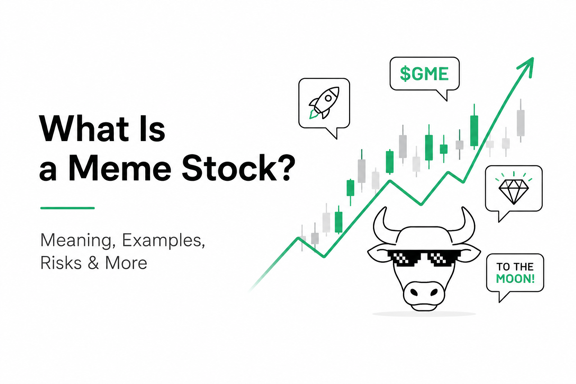
A meme stock is a stock that experiences sharp price movements because of social media buzz and retail investor enthusiasm rather than the company’s financial performance. These stocks often become popular through online communities on platforms such as Reddit, X (formerly Twitter), Telegram, Discord, or YouTube.
Although the meme stock phenomenon began in the United States during the GameStop rally of 2021, Indian investors are increasingly hearing the term as social media continues to influence market sentiment. While India has seen hype-driven rallies in certain stocks, the market has not witnessed a meme stock event on the same scale as GameStop.
What Is a Meme Stock?
A meme stock is an equity that gains popularity because of viral discussions, memes, and coordinated buying by retail investors. Unlike traditional investing, where stock prices are influenced mainly by earnings, revenue growth, and business fundamentals, meme stocks are often driven by investor sentiment and online momentum.
Quick Definition
A meme stock is a publicly traded company’s stock whose price is driven primarily by social media attention and retail investor demand instead of its intrinsic business value.
“Start investing with confidence! Explore
Lemonn
and grow your wealth.”
How Do Meme Stocks Work?
Most meme stocks follow a similar pattern.
- A company attracts online attention.
- Retail investors begin buying the stock in large numbers.
- Trading volumes increase rapidly.
- The stock price rises sharply.
- More investors join due to FOMO (Fear of Missing Out).
- If the stock has a high short interest, a short squeeze may accelerate the rally.
- Eventually, the hype fades, and prices often correct significantly.
Because these price movements are driven largely by sentiment, meme stocks can become extremely volatile.
Why Did Meme Stocks Become Popular?
The global meme stock trend became mainstream in early 2021 when retail investors on Reddit’s r/WallStreetBets collectively bought shares of GameStop (NYSE: GME). Their buying pressure contributed to a short squeeze, causing the stock price to surge dramatically and leading to significant losses for some hedge funds with bearish positions.
This event demonstrated how social media communities could influence market prices over short periods.
Characteristics of Meme Stocks
Most meme stocks share several common traits.
- High social media engagement
- Sudden spike in trading volumes
- Large participation from retail investors
- High price volatility
- Weak connection between stock price and business fundamentals
- Often associated with heavily shorted companies
Not every trending stock is a meme stock. Strong companies can also trend online because of positive earnings or major announcements.
Famous Meme Stock Examples
| Company | Ticker | Why It Became Popular |
|---|---|---|
| GameStop | GME | Reddit-driven short squeeze in 2021 |
| AMC Entertainment | AMC | Retail investors backed the cinema chain |
| BlackBerry | BB | Renewed interest through online investing communities |
| Bed Bath & Beyond | BBBY | Viral trading despite weak business performance |
These examples are largely from the US market, where the meme stock phenomenon originated.
Does India Have Meme Stocks?
For several years, India did not have a true meme stock comparable to GameStop. However, that changed in 2026 with the Parle Industries episode, which many analysts consider India’s closest meme stock event.
After Prime Minister Narendra Modi gifted Melody toffees to Italian Prime Minister Giorgia Meloni, the viral “Melodi” trend spread rapidly across social media. Retail investors mistakenly began buying shares of Parle Industries Ltd, believing it was associated with the Melody candy brand.
In reality, Parle Products, the manufacturer of Melody and Parle-G, is an unlisted private company. Parle Industries is a separate listed business with no connection to the confectionery company. Nevertheless, the stock repeatedly hit the 5% upper circuit as social media hype fuelled buying interest.
The incident demonstrated how viral content, brand-name confusion, and FOMO can influence Indian equity markets. It also highlighted why investors should always verify a company’s business before investing.
Meme Stocks vs Fundamental Investing
| Feature | Meme Stocks | Fundamentally Strong Stocks |
| Main driver | Social media sentiment | Financial performance |
| Price movement | Highly volatile | Generally linked to earnings |
| Investment horizon | Short term | Long term |
| Risk level | Very high | Moderate to high, depending on the company |
| Valuation | Often disconnected from fundamentals | Based on business performance |
Advantages of Meme Stocks
Some traders participate in meme stocks because they offer:
- Potential for significant short-term gains
- High liquidity during periods of popularity
- Opportunities for momentum trading
- Strong community participation
However, these benefits usually come with equally significant risks.
Risks of Investing in Meme Stocks
Before investing, consider the following risks.
Extreme Volatility
Prices can rise or fall by double-digit percentages within a single trading session.
FOMO Investing
Many investors buy only because others are buying, rather than conducting proper research.
Difficulty Timing the Market
Buying near the top of a hype cycle can result in substantial losses when sentiment reverses.
Weak Business Fundamentals
Many meme stocks trade far above what their financial performance would normally justify.
Regulatory Action
In India, unusual trading patterns may attract regulatory surveillance from exchanges and SEBI, which can affect liquidity and price movement.
Should You Invest in Meme Stocks?
Meme stocks are better viewed as speculative trades than long-term investments.
If you choose to invest:
- Invest only money you can afford to lose.
- Diversify your portfolio.
- Avoid making decisions based solely on social media trends.
- Study the company’s financial statements before investing.
- Have a predefined exit strategy.
Long-term wealth creation typically depends on investing in businesses with sustainable earnings, competitive advantages, and strong management rather than following viral trends.
Key Takeaways
- A meme stock is driven primarily by social media hype instead of company fundamentals.
- The trend gained global attention during the 2021 GameStop rally.
- India has witnessed hype-driven stocks but not a true GameStop-style meme stock movement.
- SEBI, NSE, and BSE monitor unusual trading activity through surveillance measures such as ASM and GSM.
- Meme stocks offer the potential for quick gains but carry significant downside risk.
Frequently Asked Questions
Q. What is a meme stock in simple words?
A meme stock is a company’s stock that becomes popular on social media, causing its price to rise or fall sharply because of investor excitement rather than business performance.
Q. Are meme stocks legal in India?
Yes. Buying and selling listed stocks is legal. However, market manipulation, spreading false information, and insider trading are illegal under SEBI regulations.
Q. Does India have meme stocks?
India has seen stocks become popular through social media discussions, but it has not experienced a meme stock event comparable to GameStop in the US.
Q. Why are meme stocks risky?
Their prices are driven mainly by investor sentiment instead of company fundamentals. This makes them highly volatile and difficult to value.
Q. Can beginners invest in meme stocks?
Beginners should understand the risks before investing. Meme stocks are speculative and may not be suitable for investors seeking long-term wealth creation.
Disclaimer
The stocks mentioned in this article are not recommendations. Please conduct your own research and due diligence before investing. Investment in securities market are subject to market risks, read all the related documents carefully before investing. Please read the Risk Disclosure documents carefully before investing in Equity Shares, Derivatives, Mutual fund, and/or other instruments traded on the Stock Exchanges. As investments are subject to market risks and price fluctuation risk, there is no assurance or guarantee that the investment objectives shall be achieved. Lemonn do not guarantee any assured returns on any investments. Past performance of securities/instruments is not indicative of their future performance.
To read the RA disclaimer
Research Analyst - Gaurav Garg
Related Posts


Download Lemonn
Download my share market app for stock trading—trade stocks effortlessly in the market.