
How to Choose Stocks for Intraday Trading in India (7 Key Criteria)
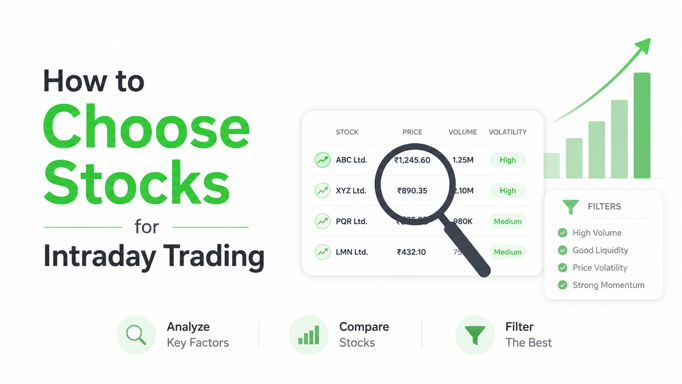
Choosing the right stock is often more important than choosing the right strategy.
Many beginners spend hours learning candlestick patterns, indicators, and trading setups, yet still lose money because they pick the wrong stocks. The reality is that even the best trading strategy can fail if the stock lacks liquidity, volume, or momentum.
If you’re wondering how to choose stocks for intraday trading in India, the answer lies in identifying stocks that offer sufficient movement, strong participation, and favorable trading conditions during the day.
In this guide, you’ll learn the seven most important criteria professional traders use to select intraday stocks, along with practical tips, tools, and common mistakes to avoid.
Why Stock Selection Is the #1 Intraday Skill
Most intraday losses occur because traders choose unsuitable stocks.
For example:
- A stock with low trading volume may not move enough to generate profits.
- A stock with poor liquidity can make it difficult to exit positions.
- A stock with no catalyst may remain range-bound throughout the day.
Professional traders often spend more time selecting stocks than placing trades.
Good stock selection can:
- Improve win rates
- Reduce slippage
- Increase trading opportunities
- Improve risk-to-reward ratios
That’s why learning how to choose stocks for intraday trading in India should be one of the first skills every trader develops.
7 Criteria to Select the Best Intraday Stocks
“Start investing with confidence! Explore
0 demat account
and grow your wealth.”
1. High Liquidity
Liquidity refers to how easily a stock can be bought or sold without significantly affecting its price.
For intraday trading, liquidity is essential.
Why Liquidity Matters
High liquidity ensures:
- Faster order execution
- Smaller bid-ask spreads
- Easier entry and exit
- Reduced slippage
A highly liquid stock allows traders to execute large orders without major price impact.
What to Look For
As a rule of thumb:
- Daily traded volume should exceed 5 lakh shares
- Stocks should be actively traded on NSE
Examples of Liquid Stocks
- Reliance Industries
- HDFC Bank
- ICICI Bank
- Infosys
- Tata Motors
- SBI
These stocks attract significant institutional and retail participation every day.
2. Adequate Volatility
Volatility measures how much a stock’s price moves during a trading session.
Without movement, there is no opportunity for profit.
Ideal Volatility Range
For intraday trading, stocks that move approximately:
1% to 3% daily
often provide enough opportunities without becoming excessively risky.
Why Volatility Matters
A stock moving only 0.2% throughout the day may not generate sufficient profits after brokerage and taxes.
Conversely, extremely volatile stocks can create unpredictable price swings.
The goal is to find stocks that move consistently but remain tradable.
How to Check Volatility
You can review:
- Average True Range (ATR)
- Daily percentage movement
- Historical price swings
Many trading platforms provide these metrics automatically.
3. Strong Sector Momentum
Stocks rarely move independently.
Most movements are driven by sector-wide trends.
For example:
- Banking stocks often move together.
- IT stocks react to similar news.
- Auto stocks respond to industry developments.
Why Sector Momentum Matters
When an entire sector is strong, individual stocks within that sector are more likely to continue moving higher.
For example:
If Bank Nifty is rallying strongly, stocks such as:
- HDFC Bank
- ICICI Bank
- Axis Bank
- Kotak Mahindra Bank
may provide better trading opportunities than stocks from weak sectors.
Popular Intraday Trading Sectors in India
- Banking
- Information Technology
- Auto
- FMCG
- Financial Services
- Energy
Professional traders often begin their day by identifying the strongest and weakest sectors.
4. News Catalysts
One of the fastest ways to find intraday opportunities is by tracking news-driven stocks.
A major news event can significantly increase both volume and volatility.
Common News Catalysts
- Quarterly earnings results
- Government policy announcements
- RBI decisions
- Mergers and acquisitions
- Large contract wins
- Management changes
- Regulatory approvals
Example
If a company reports earnings significantly above expectations, its stock may experience heavy buying throughout the day.
Such stocks often become prime intraday candidates.
Where to Find News
- NSE announcements
- Company filings
- Financial news portals
- Broker research updates
- Corporate earnings calendars
News-driven momentum frequently creates some of the best intraday trades.
5. Trending on NSE Heatmap
One of the most effective tools for stock selection is the NSE heatmap.
A stock heatmap visually displays market performance using color-coded blocks.
What the Colors Mean
- Dark green = Strong gains
- Light green = Moderate gains
- Red = Declines
- Dark red = Significant declines
What Block Size Represents
Larger blocks generally represent larger companies by market capitalization.
How Traders Use Heatmaps
Before entering a trade, many traders:
- Check the strongest sectors.
- Identify stocks leading those sectors.
- Look for unusual strength or weakness.
- Confirm with price action and volume.
Example
If most banking stocks are green and HDFC Bank is showing stronger gains than its peers, it may indicate institutional buying activity.
Heatmaps provide a quick visual snapshot of where money is flowing in the market.
6. Above-Average Trading Volume
Volume is one of the most reliable indicators of trading interest.
When volume increases, it often signals that institutional investors and active traders are participating.
Why Volume Matters
High volume:
- Improves liquidity
- Confirms price moves
- Reduces manipulation risk
- Creates stronger trends
What to Look For
A good intraday candidate often shows:
- Volume 20% to 50% above its average
- Significant activity during the first hour
- Volume spikes near breakout levels
Volume Confirmation Rule
Never trade a breakout without volume confirmation.
A breakout accompanied by high volume is far more reliable than one occurring on weak participation.
7. Avoid F&O Ban Stocks
Many traders overlook this criterion.
Stocks under the Futures & Options (F&O) ban list can become difficult to trade effectively.
What Is an F&O Ban?
An F&O ban occurs when open interest exceeds exchange-prescribed limits.
During this period:
- New derivative positions may be restricted
- Liquidity may be affected
- Price behavior can become unusual
Why Avoid Them
Intraday traders generally prefer:
- Normal market conditions
- Consistent liquidity
- Predictable order flow
Checking the daily F&O ban list before trading can help avoid unnecessary risk.
Best Sectors for Intraday Trading in India
Certain sectors consistently attract trading activity.
Banking
Banking stocks often experience:
- Strong liquidity
- High volume
- Predictable reactions to economic news
Popular choices include:
- HDFC Bank
- ICICI Bank
- SBI
- Axis Bank
Information Technology
IT stocks react to:
- US market trends
- Dollar movements
- Earnings announcements
Examples include:
- Infosys
- TCS
- Wipro
- HCLTech
Auto
Auto stocks frequently move based on:
- Sales data
- Government policy changes
- Commodity prices
Examples include:
- Tata Motors
- Mahindra & Mahindra
- Maruti Suzuki
FMCG
Although generally less volatile, FMCG stocks can provide opportunities during earnings seasons and major announcements.
Tools to Find Intraday Stocks Fast
Professional traders rely on tools rather than guesswork.
NSE Heatmap
Ideal for:
- Identifying strong sectors
- Spotting market leaders
- Tracking institutional activity
Stock Screeners
Useful filters include:
- High volume
- Volume breakout
- Top gainers
- Top losers
- 52-week highs
Trading Platforms
Advanced trading terminals allow traders to monitor:
- Price action
- Volume
- Market depth
- Sector performance
Combining these tools significantly improves stock selection.
Common Mistakes When Picking Intraday Stocks
Avoiding mistakes can improve profitability immediately.
Chasing Social Media Tips
Stocks promoted on social media may already have completed their move.
Always verify independently.
Trading Low-Volume Stocks
Low-volume stocks often produce:
- Wide spreads
- Poor liquidity
- Unpredictable movement
Ignoring Sector Trends
A strong stock in a weak sector often struggles to sustain momentum.
Trading Too Many Stocks
Monitoring multiple positions simultaneously can reduce focus.
Many successful traders focus on just a few high-quality opportunities each day.
Ignoring Stop-Losses
Even the perfect stock selection cannot eliminate risk.
Always protect capital.
Simple Intraday Stock Selection Checklist
Before placing any trade, ask:
✅ Is the stock highly liquid?
✅ Is daily volume above average?
✅ Does it move at least 1–3% daily?
✅ Is the sector strong?
✅ Is there a news catalyst?
✅ Is it showing strength on the NSE heatmap?
✅ Is it free from F&O restrictions?
If most answers are “yes,” the stock may be worth further analysis.
Key Takeaways
- Learning how to choose stocks for intraday trading in India is crucial for long-term success.
- Liquidity and volume are non-negotiable.
- Stocks should have sufficient volatility.
- Sector momentum often drives individual stock performance.
- News catalysts create high-probability opportunities.
- NSE heatmaps help identify market leaders quickly.
- Avoid F&O ban stocks and low-volume shares.
- Focus on quality setups rather than quantity.
Frequently Asked Questions
Which stocks are best for intraday trading in India today?
The best intraday stocks are usually highly liquid stocks with strong volume, sector momentum, and a clear catalyst. Banking, IT, and auto stocks frequently appear on traders’ watchlists.
How many stocks should I trade intraday?
Most traders perform better by focusing on one to three high-quality opportunities rather than tracking dozens of stocks.
Can I use F&O stocks for intraday trading?
Yes. Many traders prefer F&O stocks because of their liquidity and volume. However, stocks under an F&O ban should generally be avoided.
What is the most important factor in stock selection?
Liquidity is often considered the most important criterion because it allows smooth entry and exit without significant slippage.
How can beginners find intraday stocks quickly?
Beginners can use NSE heatmaps, stock screeners, top gainers lists, and sector performance tools to identify potential opportunities.
Conclusion
Successful intraday trading starts long before you place a trade. The ability to identify the right stocks consistently is what separates profitable traders from struggling ones.
When learning how to choose stocks for intraday trading in India, focus on the seven key criteria discussed in this guide: liquidity, volatility, sector momentum, news catalysts, heatmap trends, volume, and avoiding restricted stocks.
Instead of chasing random tips, build a repeatable stock selection process. Over time, this disciplined approach can dramatically improve your trading performance and help you find higher-probability opportunities every trading day.
Ready to start trading smarter? Open a Demat account with Lemonn, explore the NSE stock heatmap, and build your daily watchlist using a data-driven approach.
Disclaimer
The stocks mentioned in this article are not recommendations. Please conduct your own research and due diligence before investing. Investment in securities market are subject to market risks, read all the related documents carefully before investing. Please read the Risk Disclosure documents carefully before investing in Equity Shares, Derivatives, Mutual fund, and/or other instruments traded on the Stock Exchanges. As investments are subject to market risks and price fluctuation risk, there is no assurance or guarantee that the investment objectives shall be achieved. Lemonn (Formerly known as NU Investors Technologies Pvt. Ltd) do not guarantee any assured returns on any investments. Past performance of securities/instruments is not indicative of their future performance.
Related Posts


Download Lemonn
Download my app for share market trading, ipo investment, trading account, and all your investment needs.



