Vedanta Demerged Companies Listed: What It Means for Investors
Vedanta’s demerger is one of the most significant corporate restructuring moves in India’s mining, metals, and natural resources sector. Once the demerged companies are listed separately, investors will hold shares in multiple independent businesses instead of a single diversified Vedanta entity.
For shareholders, this could unlock value, improve business focus, and provide greater transparency. However, it also introduces new risks, including sector-specific volatility and varying growth prospects across the newly listed companies.
In this guide, we’ll explain what Vedanta’s demerger means, which companies are involved, and how investors can evaluate the opportunity.
Understanding the Vedanta Demerger
Vedanta Limited announced plans to split its diversified operations into separate listed companies. The goal is to allow each business to operate independently, attract targeted investors, and pursue growth strategies tailored to its industry.
Instead of being part of a large conglomerate, each segment will have its own management, financial reporting, and market valuation.
Why Is Vedanta Demerging?
The company cited several reasons for the restructuring:
- Unlock shareholder value
- Simplify the corporate structure
- Improve operational focus
- Enable industry-specific capital allocation
- Attract investors interested in particular sectors
Many conglomerates trade at a “holding company discount,” where the market values the combined entity less than the sum of its individual businesses. Demergers are often used to address this issue.
Which Vedanta Businesses Are Being Demerged?
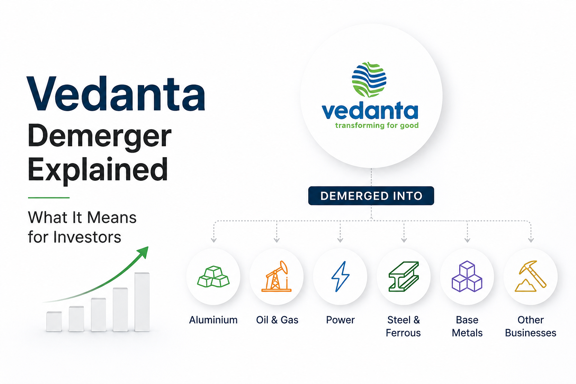
Under the proposed restructuring, Vedanta’s major businesses are expected to operate as separate listed entities.
These include:
| Business Segment | Core Operations |
| Aluminium | Production of aluminium and related products |
| Oil & Gas | Exploration and production of hydrocarbons |
| Power | Thermal and renewable power generation |
| Steel & Ferrous Materials | Iron ore and steel-related operations |
| Base Metals | Zinc, lead, silver, and related activities |
| Other Resource Businesses | Sector-specific operations depending on final structure |
The final structure and listing timelines depend on regulatory approvals and corporate actions.
What Happens to Existing Vedanta Shareholders?
Existing shareholders typically receive shares in the newly demerged companies according to a predetermined ratio.
In simple terms:
- Investors continue holding Vedanta shares.
- Additional shares of the newly formed entities are allotted.
- Once listed, these companies trade independently on stock exchanges.
This means shareholders gain exposure to multiple focused businesses without needing to purchase additional shares initially.
Potential Benefits for Investors
1. Value Unlocking
One of the biggest expectations from the demerger is value creation.
Investors can assess each business individually rather than assigning a single valuation to the entire conglomerate.
For example:
- A fast-growing aluminium business may command a higher valuation multiple.
- An oil and gas company may attract investors seeking energy exposure.
- A power company may be valued differently based on cash flow stability.
2. Better Business Transparency
Separate companies provide:
- Independent financial statements
- Clearer earnings visibility
- Easier comparison with industry peers
This allows investors to make more informed decisions.
3. Focused Management Teams
Each company can concentrate on its own industry challenges and opportunities.
Benefits may include:
- Faster decision-making
- More efficient capital allocation
- Industry-specific growth strategies
4. Greater Investor Choice
Not every investor wants exposure to all commodity sectors.
After listing, investors can:
- Hold all businesses
- Increase exposure to preferred sectors
- Exit segments they do not favor
Risks Investors Should Consider
Commodity Price Volatility
Most Vedanta businesses operate in cyclical industries.
Prices of:
- Aluminium
- Zinc
- Silver
- Oil
- Steel
can fluctuate significantly due to global economic conditions.
Debt Allocation Concerns
One of the key questions investors often ask is how debt will be distributed among the demerged entities.
The financial strength of each company will depend partly on:
- Debt levels
- Cash flow generation
- Capital expenditure requirements
Execution Risk
Large corporate restructurings can face challenges such as:
- Regulatory delays
- Integration issues
- Market uncertainty
Investors should monitor management updates closely.
Different Growth Profiles
Not all businesses may perform equally.
Some segments may deliver strong earnings growth, while others may face cyclical downturns.
How Could the Market Value the New Companies?
Historically, demergers can lead to:
- Initial price discovery volatility
- Re-rating of high-quality businesses
- Greater institutional participation
- Improved analyst coverage
However, market performance ultimately depends on:
- Business fundamentals
- Earnings growth
- Commodity cycles
- Capital allocation discipline
Simply demerging does not guarantee higher stock prices.
What Should Existing Investors Do?
Long-Term Investors
If you believe in India’s long-term demand for:
- Metals
- Energy
- Infrastructure
- Natural resources
holding the demerged entities may provide diversified exposure across key sectors.
Income-Focused Investors
Review each company’s:
- Dividend policy
- Cash flow generation
- Debt profile
before making decisions.
Growth Investors
Focus on businesses with:
- Strong market positions
- Expansion opportunities
- Competitive advantages
- Consistent profitability
Risk-Averse Investors
Evaluate whether you are comfortable with commodity-linked earnings, which can be more volatile than many consumer or technology businesses.
Key Questions Investors Should Monitor
Before and after listing, investors should track:
- Final share allotment ratios
- Debt allocation among entities
- Management teams for each company
- Dividend policies
- Capital expenditure plans
- Regulatory approvals
- Listing timelines
These factors can significantly influence long-term shareholder returns.
Key Takeaways
- Vedanta’s demerger aims to create separate listed companies focused on individual business segments.
- Existing shareholders are expected to receive shares in the newly listed entities.
- The restructuring could unlock value through improved transparency and focused management.
- Investors gain flexibility to choose specific sectors rather than owning a diversified conglomerate.
- Risks include commodity price fluctuations, debt allocation concerns, and execution challenges.
- Long-term performance will depend on the fundamentals of each demerged company rather than the demerger alone.
FAQs
Q. What is the Vedanta demerger?
The Vedanta demerger is a corporate restructuring plan that separates the company’s major business segments into independently listed companies.
Q. Will existing Vedanta shareholders receive shares in the new companies?
Yes, shareholders are generally expected to receive shares in the demerged entities based on the approved share entitlement ratio.
Q. Is the Vedanta demerger good for investors?
It can be beneficial if the market assigns higher valuations to the standalone businesses. However, outcomes depend on execution and future business performance.
Q. Can investors sell individual demerged companies after listing?
Yes. Once listed separately, investors can buy, sell, or hold each company independently.
Q. Will the demerged companies have different valuations?
Yes. Each company will be valued based on its own earnings, growth prospects, industry conditions, and financial position.
Conclusion
The listing of Vedanta’s demerged companies marks a major shift in how investors gain exposure to India’s natural resources and metals sectors. By creating focused businesses with independent management and financial reporting, the restructuring has the potential to unlock value and improve market transparency.
For investors, the opportunity lies in understanding each company’s strengths, risks, and long-term growth potential. Rather than viewing the demerger as a short-term event, it is worth evaluating how each newly listed business fits into your overall investment strategy.
Disclaimer
The stocks mentioned in this article are not recommendations. Please conduct your own research and due diligence before investing. Investment in securities market are subject to market risks, read all the related documents carefully before investing. Please read the Risk Disclosure documents carefully before investing in Equity Shares, Derivatives, Mutual fund, and/or other instruments traded on the Stock Exchanges. As investments are subject to market risks and price fluctuation risk, there is no assurance or guarantee that the investment objectives shall be achieved. Lemonn (Formerly known as NU Investors Technologies Pvt. Ltd) do not guarantee any assured returns on any investments. Past performance of securities/instruments is not indicative of their future performance.