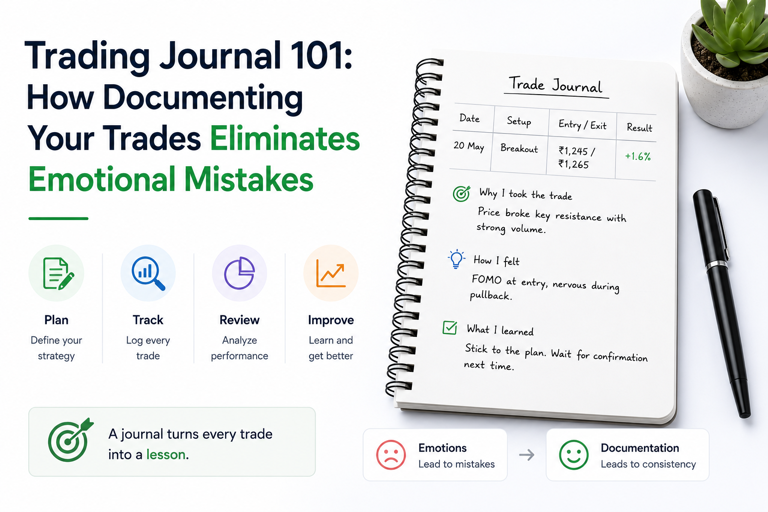
Trading Journal 101: How Documenting Your Trades Eliminates Emotional Mistakes
Why Most Investors Don’t Keep a Journal — And Why They Should
Professional traders universally credit journaling as a key part of their development. Yet less than 5% of retail investors keep any record of their trade decisions. Without a journal, you repeat the same mistakes because you have no systematic feedback loop. The market charges tuition — trading journals help you learn from it.
What to Record in Every Trade
| Entry Field | What to Write | Why It Matters |
|---|---|---|
| Date and time | Exact entry time | Identify time-of-day patterns |
| Stock and trade direction | E.g., ‘Nifty 50 long’ | Clear trade definition |
| Thesis | Why you entered (1-3 sentences) | Reveals reasoning quality over time |
| Setup type | E.g., ‘RSI oversold bounce at support’ | Track which setups work |
| Entry price and position size | Exact numbers | Accurate P&L tracking |
| Stop loss and target | Pre-defined levels | Enforce discipline |
| Exit price and date | When closed | Calculate actual vs planned result |
| Emotional state at entry | Calm/anxious/FOMO-driven/revenge | Identify emotional trigger patterns |
| Post-trade notes | What went right/wrong | The learning extract |
“Start investing with confidence! Explore
0 demat account
and grow your wealth.”
Weekly and Monthly Review Process
Weekly Review (15 minutes every Friday)
- Total P&L for the week: met expectations?
- How many trades matched your pre-defined setups vs impulsive entries?
- Which trades were influenced by FOMO, revenge, or confirmation bias?
- What is the hit rate and profit factor this week?
Monthly Review (30 minutes at month end)
- Most profitable setup vs least profitable — double down on what works
- Average holding period: are you cutting winners too early?
- Emotional state pattern: are losses concentrated on specific days/market conditions?
- Win rate vs expectancy — a 40% win rate can be profitable with good risk:reward
Simple Journal Template for Lemonn Users
You can maintain your journal in a spreadsheet with columns matching the fields above. Alternatively, photograph your Lemonn trade confirmation for each trade and annotate it with your thesis. The most important habit is consistency — even 3 sentences per trade is far better than nothing.
Key Metrics to Track Over Time
| Metric | Formula | Target |
|---|---|---|
| Win Rate | Winning trades / Total trades | 40–60% is typical for good traders |
| Average Win vs Average Loss | Avg profit / Avg loss | Should be > 1.5x (e.g., +3% wins vs -2% losses) |
| Profit Factor | Total gains / Total losses | > 1.5 is good; > 2.0 is excellent |
| Expectancy per trade | (Win rate × Avg win) – (Loss rate × Avg loss) | Should be positive |
| Emotional trade % | Impulsive trades / Total trades | Target < 10% |
Disclaimer
The stocks mentioned in this article are not recommendations. Please conduct your own research and due diligence before investing. Investment in securities market are subject to market risks, read all the related documents carefully before investing. Please read the Risk Disclosure documents carefully before investing in Equity Shares, Derivatives, Mutual fund, and/or other instruments traded on the Stock Exchanges. As investments are subject to market risks and price fluctuation risk, there is no assurance or guarantee that the investment objectives shall be achieved. Lemonn (Formerly known as NU Investors Technologies Pvt. Ltd) do not guarantee any assured returns on any investments. Past performance of securities/instruments is not indicative of their future performance.
Related Posts


Download Lemonn
Download my app for share market trading, ipo investment, trading account, and all your investment needs.