Ex-Dividend Date vs Record Date vs Payment Date: The Three Dates Every Investor Must Know
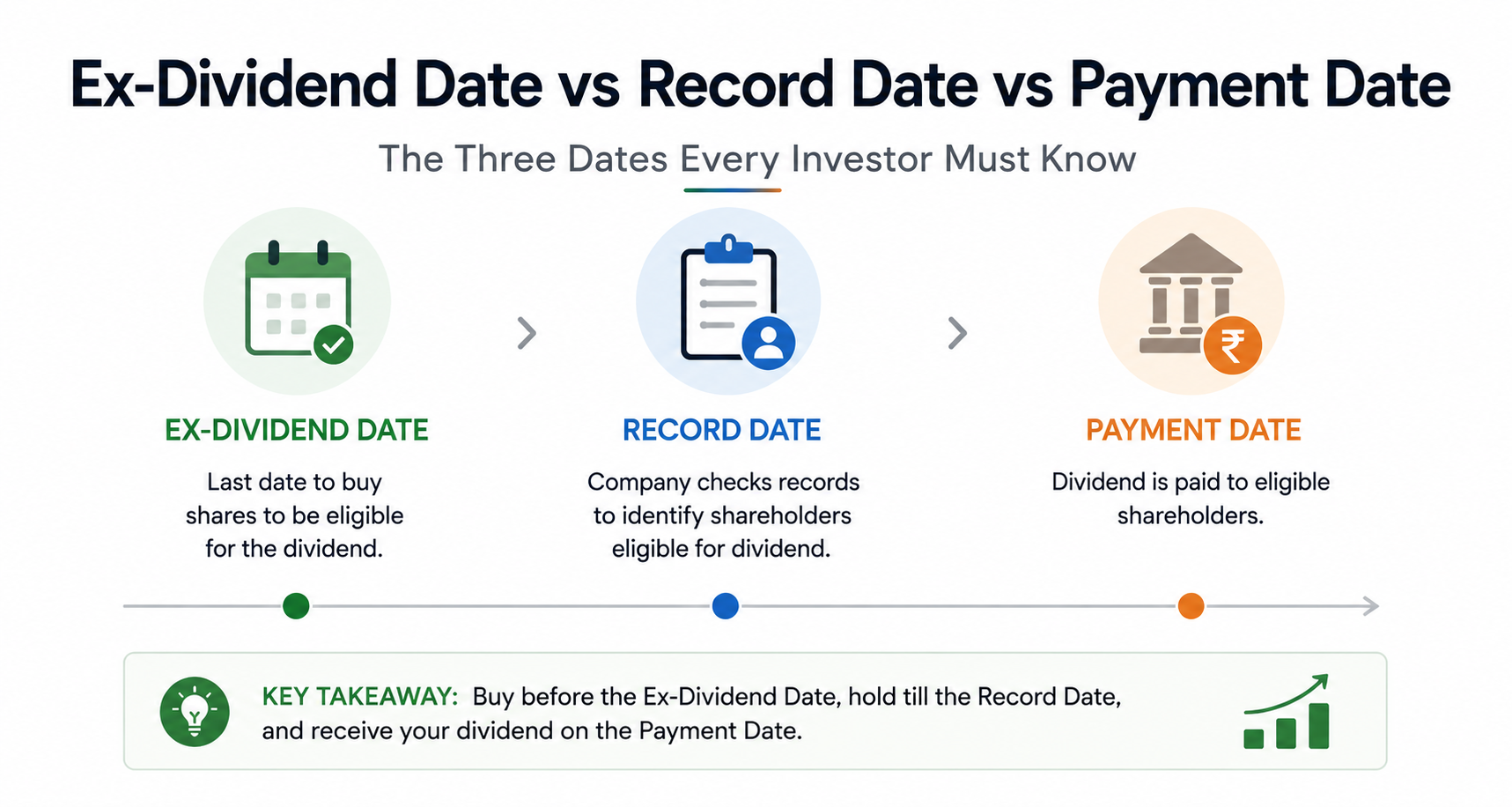
The Three Dates Explained
| Date | Definition | What Happens |
|---|---|---|
| Declaration Date | Board approves dividend + announces all dates | Investor notes the key dates |
| Ex-Dividend Date | First day buyer does NOT receive dividend | Crucial buying deadline |
| Record Date | Company checks its register for eligible shareholders | Usually T+1 after ex-date (settlement) |
| Payment Date | Dividend deposited to eligible shareholders’ bank | Receives cash (or demat credit for NCDs) |
Why Ex-Date and Record Date Differ by 1 Day
In India, equity trades settle on T+1 basis (since January 2023). This means if you buy a stock on Monday, you are officially the owner (registered in company records) on Tuesday. Therefore, to appear in the company’s records on the Record Date, you must purchase the stock one trading day before the Record Date — i.e., on or before the Ex-Dividend Date minus 1.
“Start investing with confidence! Explore
0 demat account
and grow your wealth.”
Practical Example: Coal India Dividend
| Event | Date | What You Do |
|---|---|---|
| Dividend Declaration | March 1 (Monday) | Note the ex-date |
| Ex-Dividend Date | March 15 (Monday) | BUY ON OR BEFORE March 14 (Friday) |
| Record Date | March 16 (Tuesday) | Your name in records if you bought before ex-date |
| Payment Date | April 5 | Dividend credited to your bank account |
The Price Drop on Ex-Date: What to Expect
On the ex-date morning, the stock exchange applies a price adjustment equal to the dividend amount. The Previous Close is reduced by the dividend. This is why Nifty or Sensex sometimes open lower purely due to large dividend adjustments — it is not a market move, it is a mechanical adjustment.
Mutual Funds: IDCW Option Ex-Date
Mutual funds paying IDCW (Income Distribution cum Capital Withdrawal, formerly called dividend option) also have ex-dates. The NAV falls by the IDCW amount on the ex-date — the investor receives the IDCW but the NAV adjusts. This is another reason to prefer Growth option over IDCW in mutual funds — no artificial NAV drops.
Summary: The Rule for Dividend-Seeking Investors
- Buy at least 1 trading day before ex-date to receive dividend
- Buying ON the ex-date does NOT get you the dividend
- Buying AFTER ex-date: you pay a lower price (already adjusted) — neither get dividend nor overpay for it
- Setting alerts for ex-dates in Lemonn watchlist prevents missing eligible dates
Disclaimer
The stocks mentioned in this article are not recommendations. Please conduct your own research and due diligence before investing. Investment in securities market are subject to market risks, read all the related documents carefully before investing. Please read the Risk Disclosure documents carefully before investing in Equity Shares, Derivatives, Mutual fund, and/or other instruments traded on the Stock Exchanges. As investments are subject to market risks and price fluctuation risk, there is no assurance or guarantee that the investment objectives shall be achieved. Lemonn (Formerly known as NU Investors Technologies Pvt. Ltd) do not guarantee any assured returns on any investments. Past performance of securities/instruments is not indicative of their future performance.
Related Posts


Download Lemonn
Download my app for share market trading, ipo investment, trading account, and all your investment needs.