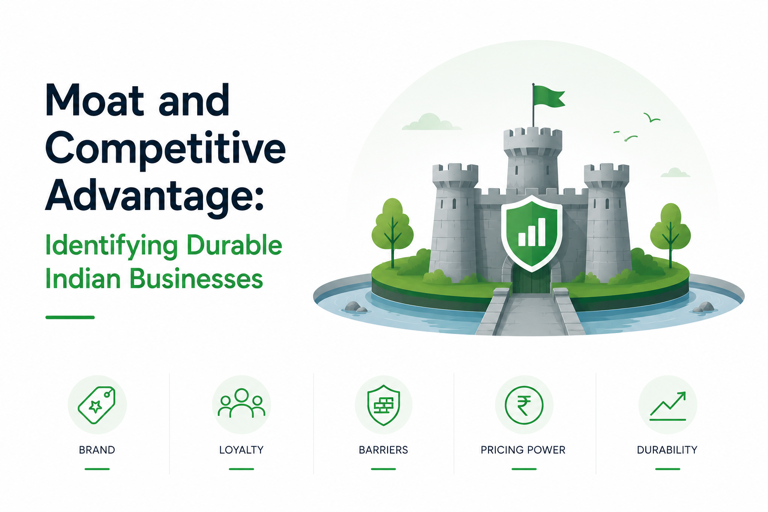
Moat and Competitive Advantage: Identifying Durable Indian Businesses
What is an Economic Moat?
Warren Buffett popularised the concept of an economic moat — a durable competitive advantage that allows a company to earn above-average returns on capital for extended periods while preventing competitors from eroding those returns. Investing in moat businesses and holding them long-term is one of the most reliable wealth-building strategies.
Types of Moats and Indian Examples
| Moat Type | Description | Indian Examples |
|---|---|---|
| Brand / Pricing Power | Premium price sustainably above cost | Asian Paints, HUL, Nestlé India |
| Switching Costs | Painful/expensive to switch to competitor | TCS enterprise software clients, CAMS (MF registrar) |
| Network Effects | More users = more valuable (exponential) | NSE (exchange), CAMS (more funds = more data) |
| Cost Advantage | Lower cost structure than competitors | Titan (jewellery vertical integration), Coal India (lowest-cost producer) |
| Intangible Assets | Licences, patents, brand recognition | Pidilite (Fevicol brand), Sun Pharma (complex generic patents) |
| Efficient Scale | Natural monopoly in niche market | CDSL/NSDL (depository), CRISIL (rating agency) |
“Start investing with confidence! Explore
0 demat account
and grow your wealth.”
How to Identify a Moat: The ROCE Test
Companies with moats consistently earn ROCE (Return on Capital Employed) above their cost of capital over 10+ years. Screen on Screener.in: ROCE > 15% for every year in the past 10 years. Companies meeting this criterion in cyclical industries almost always have structural moats.
The Moat Erosion Watch: When to Sell
- Pricing power eroding: Price increases no longer possible without losing market share
- Switching costs lowering: Technology making it easier to switch from your company’s product
- New entrant disruption: Startup with 10x better product at lower cost entering the market
- Regulatory change: Government removes licence/protection moat (e.g., coal sector reforms)
Moat Investing in Practice
Moat businesses are almost always expensive on near-term P/E. Paying a fair price for a moat company is far better than paying a cheap price for a commoditised business. The key question is not ‘Is this cheap?’ but ‘Will this company earn above-normal returns 10 years from now?’ If the answer is yes with high conviction — pay the premium.
Disclaimer
The stocks mentioned in this article are not recommendations. Please conduct your own research and due diligence before investing. Investment in securities market are subject to market risks, read all the related documents carefully before investing. Please read the Risk Disclosure documents carefully before investing in Equity Shares, Derivatives, Mutual fund, and/or other instruments traded on the Stock Exchanges. As investments are subject to market risks and price fluctuation risk, there is no assurance or guarantee that the investment objectives shall be achieved. Lemonn (Formerly known as NU Investors Technologies Pvt. Ltd) do not guarantee any assured returns on any investments. Past performance of securities/instruments is not indicative of their future performance.
Related Posts

Download Lemonn
Download my app for share market trading, ipo investment, trading account, and all your investment needs.