Wall Street falls as Iran tensions, 3-year high inflation hit tech
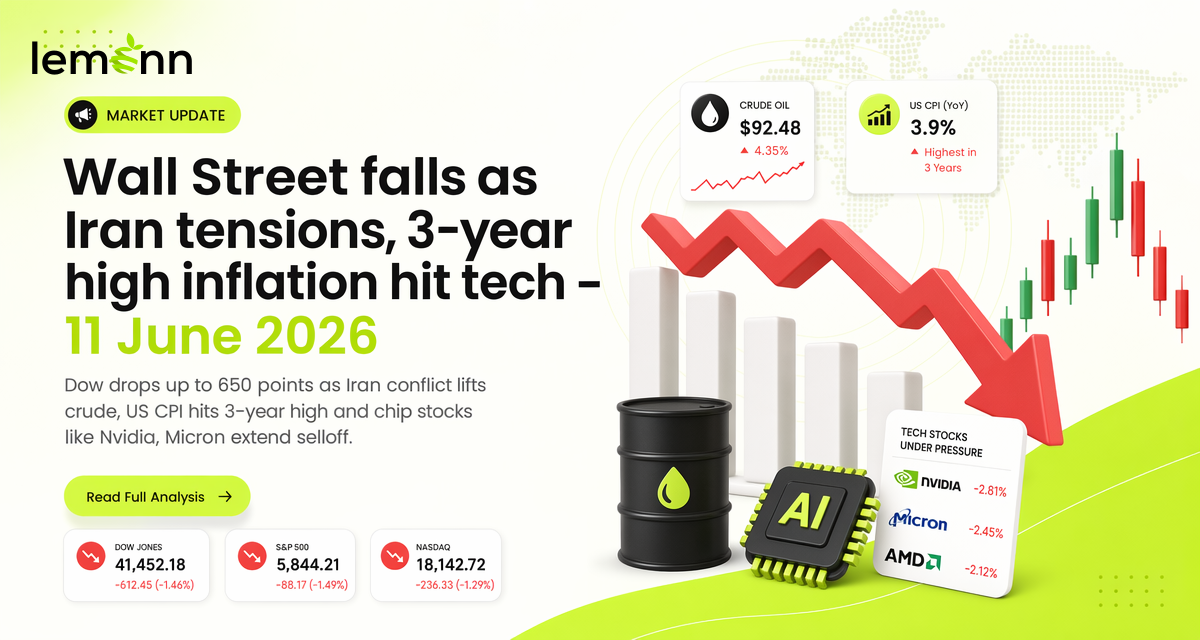
US stocks fell on Wednesday, with the Dow Jones Industrial Average sliding up to 650 points intraday on June 10 as renewed US–Iran tensions lifted crude prices and a 4.2% May CPI print, the highest in three years, pressured rate expectations and high-growth technology shares.
Market overview
| Index | 10 Jun 2026 Close / Intraday | Move & % Change | Comments |
|---|---|---|---|
| Dow Jones Industrial Average | around 50,200–50,450 intraday | down 450–650 pts (approx. 0.9%–1.3%) | Dropped after Trump vowed to attack Iran “very hard”. |
| S&P 500 | around 7,386 previous close; lower by 0.8% intraday | down about 40 pts (approx. 0.8%) | Hit by inflation worries and tech weakness. |
| Nasdaq Composite | around 25,679 previous close; intraday down about 1.1% | down nearly 192 pts (approx. 1.1%) | Tech and chip stocks led declines. |
| Nasdaq 100 futures | not stated | down 1.3% | Pointed to further pressure on large-cap tech. |
| S&P 500 futures | not stated | down 0.9% | Signalled weak open after prior session losses. |
| Dow futures | not stated | down 0.8% | Reflected risk-off mood before cash session. |
Note: figures are approximate; final exchange data not available at time of publication.
- US stocks opened lower, with the Dow initially down over 250 points.
- Losses deepened after President Donald Trump threatened more attacks on Iran.
- The VIX volatility index jumped almost 7%, indicating rising risk aversion.
Inflation and Fed outlook
- US CPI for May rose 4.2% year-on-year, highest since April 2023.
- April CPI had printed at 3.8%, highlighting a renewed acceleration in prices.
- Core CPI increased 2.9% year-on-year, up from 2.8% in April.
- On a monthly basis, core prices rose 0.2%, slightly below economist expectations.
- Traders have priced in a potential 25 bps Fed rate hike by December 2026.
- The data arrived ahead of next week’s Federal Reserve policy meeting.
- The 10-year US Treasury yield hovered just below 4.53% after the CPI release.
Geopolitical tensions and crude oil
| Market/Asset | Movement | Notes |
|---|---|---|
| Brent crude futures | around $93–93.26, up about 1.7% | Rebounded nearly $2 after US strikes on Iran. |
| WTI crude futures | around $89–90, up 1%–2.2% | Rose after renewed conflict near Strait of Hormuz. |
| US gasoline (regular) | $4.15 per gallon | Up from $2.98 in late February, a 39% jump. |
- US forces launched “self-defense strikes” on Iranian targets after a US Apache helicopter was reportedly downed.
- Trump said Iran had “taken too long to negotiate a deal” and would “pay the price”.
- He later added “we’re going to be attacking them very hard”, escalating rhetoric.
- The conflict has disrupted Middle East oil supply and raised Strait of Hormuz risk.
- Oil had briefly fallen earlier in the week on hopes of easing tensions and weak China demand.
Sectoral and stock action
| Sector/Index | Direction (approx.) | Key Drivers |
|---|---|---|
| Technology / Semiconductors | down 1%–plus | Chip selloff resumed, weighing on Nasdaq and S&P 500. |
| Oil & Gas | up | Benefited from higher crude prices amid Iran conflict. |
| Telecom & Financials | up | Among few sectors trading in the green. |
| Industrials & Materials | down | Hit by risk-off sentiment and growth worries. |
- Nvidia shares fell about 1.37%, extending recent volatility in AI-linked names.
- Micron Technology declined about 1.52%, part of a broader semiconductor pullback.
- Advanced Micro Devices and Broadcom also traded lower, continuing a multi-session slide.
- The iShares Semiconductor ETF dropped about 1%, adding to prior sharp losses.
- Caterpillar led Dow losers with a 5% fall, reflecting cyclical growth concerns.
- Boeing slipped 2.5%, while Goldman Sachs lost 2%.
- Oil and gas stocks outperformed, tracking the rebound in crude benchmarks.
Market dynamics and recent session context
- The latest drop followed a mixed close on Tuesday, when the S&P 500 fell 0.26%.
- On that day, the Nasdaq Composite had already declined 0.97% as chip gains faded.
- The Dow had bucked the trend on Tuesday, rising 86 points to 50,872.11.
- Gold fell 1.76% on Tuesday to $4,286.40 an ounce, its lowest since December 2025.
- Silver dropped 4.88% to $65.24 an ounce, also hitting multi-month lows.
- The pullback in safe-haven metals suggested some rotation out of earlier defensive trades.
- Existing US home sales rose 3.2% in May to 4.17 million units annualised.
- The median home price hit a record $429,300, up 1.3% year-on-year.
Tech rotation and volatility
- The S&P 500 slipped 0.3% in a recent session as investors rotated out of tech.
- Earlier, a powerful chip rally had driven Wall Street to multiple record highs.
- Recent swings in indices were compared with volatility during past tariff disputes.
- Some market participants view the pullback as consolidation of the AI trade.
- Others highlight that higher rates, geopolitics and valuations could keep volatility elevated.
FAQs
Q: Why did the Dow fall as much as 650 points on June 10?
- The Dow dropped as Iran tensions escalated after fresh US strikes and threats of further attacks, while a 4.2% May CPI print reinforced expectations of higher-for-longer interest rates, pressuring cyclicals and tech.
Q: How are chip stocks affecting the broader US market?
- A renewed selloff in semiconductor names such as Nvidia, Micron, AMD and Broadcom has dragged on the Nasdaq and S&P 500, reversing part of the earlier AI-driven rally and amplifying index-level declines.
Q: What does the 4.2% US CPI reading mean for the Federal Reserve?
- With headline inflation at a three-year high and core CPI at 2.9%, traders see an increased risk of a 25 bps rate hike by December 2026, and the Fed is expected to keep policy on hold at its upcoming meeting while monitoring energy-driven price pressures.
Frequently Asked Questions
Why did the Dow fall as much as 650 points on June 10?
The Dow dropped as Iran tensions escalated after fresh US strikes and threats of further attacks, while a 4.2% May CPI print reinforced expectations of higher-for-longer interest rates, pressuring cyclicals and tech.
How are chip stocks affecting the broader US market?
A renewed selloff in semiconductor names such as Nvidia, Micron, AMD and Broadcom has dragged on the Nasdaq and S&P 500, reversing part of the earlier AI-driven rally and amplifying index-level declines.
What does the 4.2% US CPI reading mean for the Federal Reserve?
With headline inflation at a three-year high and core CPI at 2.9%, traders see an increased risk of a 25 bps rate hike by December 2026, and the Fed is expected to keep policy on hold at its upcoming meeting while monitoring energy-driven price pressures.
Disclaimer
The stocks mentioned in this article are not recommendations. Please conduct your own research and due diligence before investing. Investment in securities market are subject to market risks, read all the related documents carefully before investing. Please read the Risk Disclosure documents carefully before investing in Equity Shares, Derivatives, Mutual fund, and/or other instruments traded on the Stock Exchanges. As investments are subject to market risks and price fluctuation risk, there is no assurance or guarantee that the investment objectives shall be achieved. Lemonn (Formerly known as NU Investors Technologies Pvt. Ltd) do not guarantee any assured returns on any investments. Past performance of securities/instruments is not indicative of their future performance.